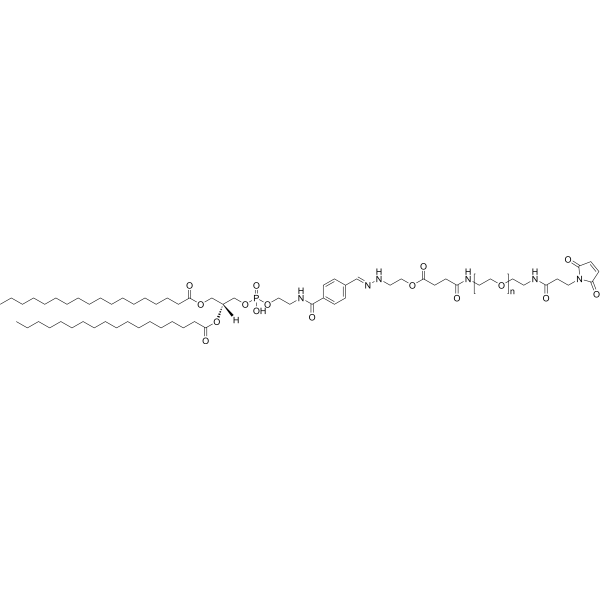
DSPE-Hyd-PEG, also known as distearoylphosphoethanolamine-hydrazide-polyethylene glycol, is a type of lipid-based polymer that has various applications in drug delivery and biomedical research. One of the main applications of DSPE-Hyd-PEG is in the field of targeted drug delivery. It is often used as a component of liposomes or lipid nanoparticles to improve the stability and targeting ability of drug carriers. DSPE-Hyd-PEG can be conjugated with targeting ligands, such as antibodies or peptides, to specifically bind to receptors on the surface of target cells. This targeted drug delivery system allows for more efficient and selective delivery of therapeutic agents to the desired site, while minimizing off-target effects.
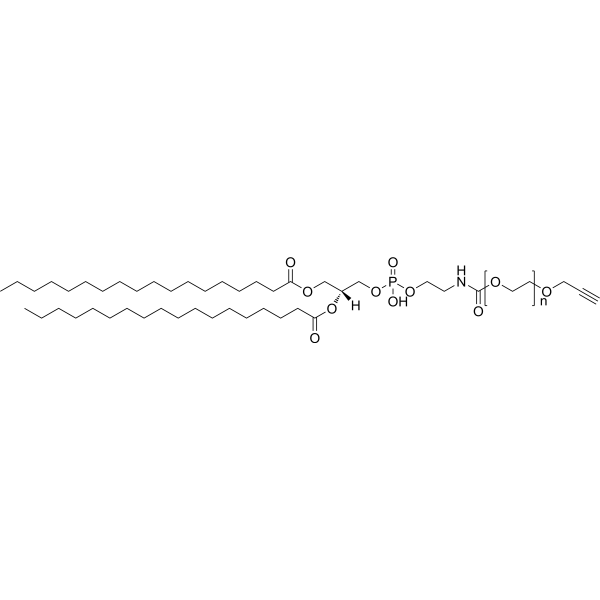
The phospholipid polyethylene glycol alkyne (DSPE PEG Alkyne) can be used to modify proteins, peptides and other materials or small molecules. Alkynyl (- ALK) can react with copper catalyzed azide in aqueous solution. 2-Distearoyl-sn-Glycero-3-Phosphoethanolamine (DSPE) conjugated polyethylene glycol is a combination of phospholipid and polyethylene glycol with hydrophilicity and hydrophobicity. Polyethylene glycol phospholipid liposomes form high-quality materials, which can be used for drug delivery, gene transfection and vaccine delivery. PEGylated phospholipid can significantly improve blood circulation time and stabilize drug encapsulation. These materials can also be used for targeted drug delivery by modifying ligands with target surfaces such as antibodies and peptides.
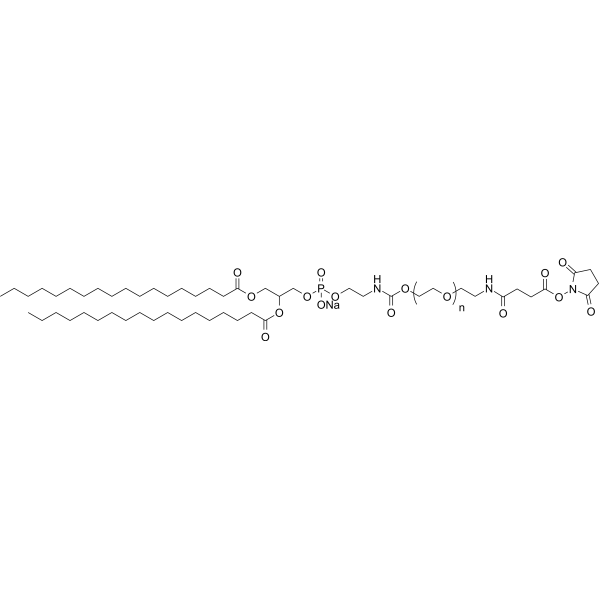
DSPE-m-PEG-NHS (MW 3400) is a pegylated phospholipid derivatives which can be used to prepare liposome or lipid nanoparticles for targeted drug delivery system, such as DNA or mRNA vaccine.
DSPE-PEG-Biotin (MW 1000) is a PEG-based PROTAC linker

DSPE-Hyd-PEG, also known as distearoylphosphoethanolamine-hydrazide-polyethylene glycol, is a type of lipid-based polymer that has various applications in drug delivery and biomedical research. One of the main applications of DSPE-Hyd-PEG is in the field of targeted drug delivery. It is often used as a component of liposomes or lipid nanoparticles to improve the stability and targeting ability of drug carriers. DSPE-Hyd-PEG can be conjugated with targeting ligands, such as antibodies or peptides, to specifically bind to receptors on the surface of target cells. This targeted drug delivery system allows for more efficient and selective delivery of therapeutic agents to the desired site, while minimizing off-target effects.

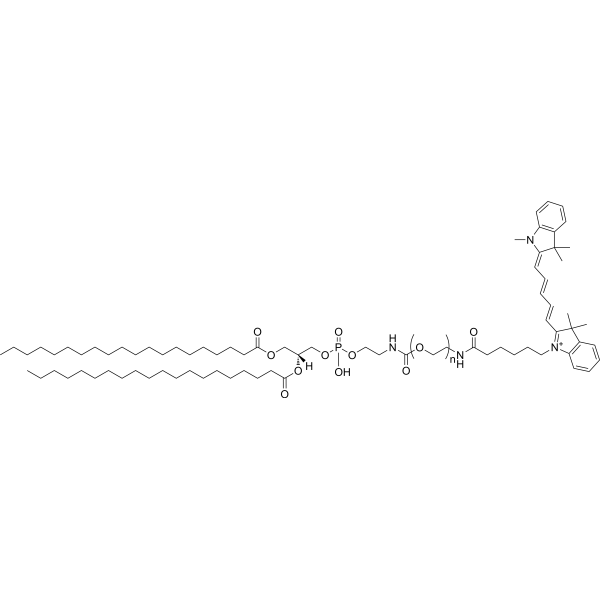
The molecules can be labeled in the aqueous phase without organic solvents. Therefore, the product is especially suitable for labeling proteins that are easily denatured in the organic phase and proteins with low solubility. Polyethylene glycol phospholipid liposomes form high-quality materials, which can be used for drug delivery, gene transfection and vaccine delivery. Pegylated phospholipids can significantly improve blood circulation time and stabilize drug encapsulation. These materials can also be used for targeted drug delivery by modifying surface ligands such as antibodies and peptides. (DSPE) conjugated polyethylene glycol is a combination of phospholipids and polyethylene glycol, which has hydrophilicity and hydrophobicity. These materials can also be used for targeted drug delivery by modifying ligands with target surfaces, such as antibodies and peptides. Cyanogen dye cyanine is often used in biomolecular labeling, fluorescence imaging and other fluorescent biological analysis. Cy5 (sulfo-cyanine5) is a reactive dye used to label amino groups of peptides, proteins and oligonucleotides. Excitation wavelength (nm): 649, emission wavelength (nm): 670.
DSPE-PEG-SH, MW 2000 is a pegylated phospholipid with thiol group which is reactive with maleimide to form a covalent thioether linkage. The amphiphatic polymer can form lipid bilayer in aqueous solution and be used to encapsulate agents for drug delivery system, such as mRNA vaccine.
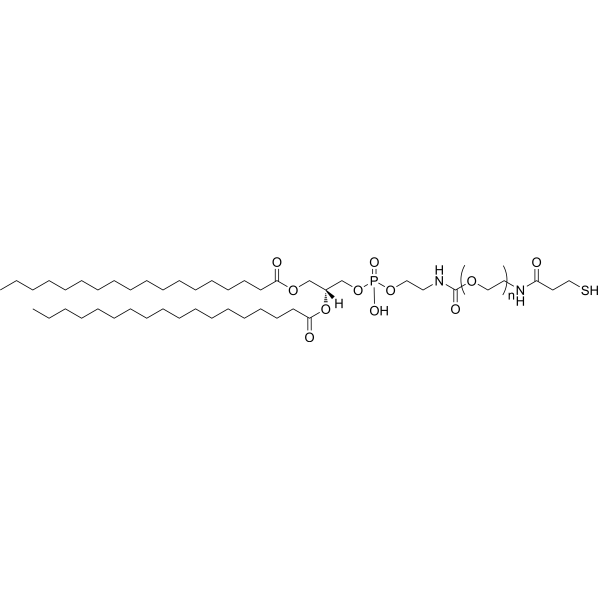
DSPE-Hyd-PEG, also known as distearoylphosphoethanolamine-hydrazide-polyethylene glycol, is a type of lipid-based polymer that has various applications in drug delivery and biomedical research. One of the main applications of DSPE-Hyd-PEG is in the field of targeted drug delivery. It is often used as a component of liposomes or lipid nanoparticles to improve the stability and targeting ability of drug carriers. DSPE-Hyd-PEG can be conjugated with targeting ligands, such as antibodies or peptides, to specifically bind to receptors on the surface of target cells. This targeted drug delivery system allows for more efficient and selective delivery of therapeutic agents to the desired site, while minimizing off-target effects.

DSPE-Hyd-PEG, also known as distearoylphosphoethanolamine-hydrazide-polyethylene glycol, is a type of lipid-based polymer that has various applications in drug delivery and biomedical research. One of the main applications of DSPE-Hyd-PEG is in the field of targeted drug delivery. It is often used as a component of liposomes or lipid nanoparticles to improve the stability and targeting ability of drug carriers. DSPE-Hyd-PEG can be conjugated with targeting ligands, such as antibodies or peptides, to specifically bind to receptors on the surface of target cells. This targeted drug delivery system allows for more efficient and selective delivery of therapeutic agents to the desired site, while minimizing off-target effects.

The affinity between lactoferrin and iron ion is very high, which is 250 to 300 times that of transferrin. According to the difference of lactoferrin binding iron ions, it can be divided into three types: iron deficiency type, iron semi-satiation type and iron saturated type. Different types of lactoferrin have different ability to resist pasteurization thermal denaturation, in which iron saturated type resistance is strong, iron deficiency type resistance is weak. Lactoferrin can bind not only Fe3+ and Fe2+, but also Cu2+, Mn2+ and Zn2+.

DSPE-Hyd-PEG, also known as distearoylphosphoethanolamine-hydrazide-polyethylene glycol, is a type of lipid-based polymer that has various applications in drug delivery and biomedical research. One of the main applications of DSPE-Hyd-PEG is in the field of targeted drug delivery. It is often used as a component of liposomes or lipid nanoparticles to improve the stability and targeting ability of drug carriers. DSPE-Hyd-PEG can be conjugated with targeting ligands, such as antibodies or peptides, to specifically bind to receptors on the surface of target cells. This targeted drug delivery system allows for more efficient and selective delivery of therapeutic agents to the desired site, while minimizing off-target effects.

Phospholipids are commonly used polymeric gene carriers. DSPE with high molecular weight can effectively compound DNA, and has strong buffered capacity under endosomal pH conditions, showing good transfection efficiency for a variety of cells. However,DAPE is not easily degraded, and high molecular weight DAPE as a gene carrier may lead to short - or long-term cytotoxicity.

DSPE-glutaric acid is a lipid. DSPE-glutaric acid can be used for the research of various biochemical.

DSPE-Hyd-PEG, also known as distearoylphosphoethanolamine-hydrazide-polyethylene glycol, is a type of lipid-based polymer that has various applications in drug delivery and biomedical research. One of the main applications of DSPE-Hyd-PEG is in the field of targeted drug delivery. It is often used as a component of liposomes or lipid nanoparticles to improve the stability and targeting ability of drug carriers. DSPE-Hyd-PEG can be conjugated with targeting ligands, such as antibodies or peptides, to specifically bind to receptors on the surface of target cells. This targeted drug delivery system allows for more efficient and selective delivery of therapeutic agents to the desired site, while minimizing off-target effects.