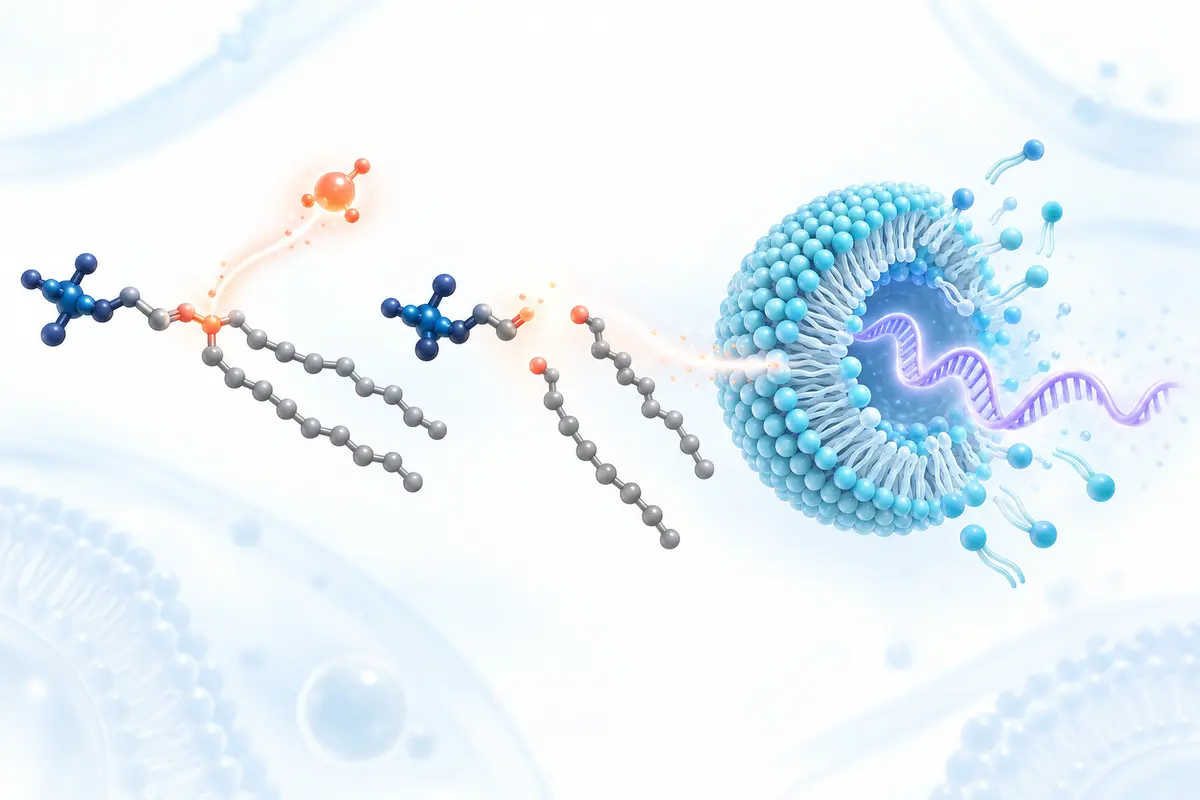
Explore lipid designs with reported responses to reactive oxygen species. Responsive degradation or cargo release is distinguished from antioxidant scavenging.
2 products currently listedResearch-use products only
Evidence noteCategory membership indicates research relevance. Organ targeting, cell specificity and performance must be verified from the formulation and study conditions cited for each product.
Cell studies and mouse tumor studies BAmP-TK-12 is a thioketal-containing carrier evaluated for ROS-responsive mRNA release in tumor-delivery research.
[1] Source Primary abstract; EP4487871A1 exact TK21/BAmP-TK-12 and ROS-release experiments
Intraperitoneal 4A2-B8-PH is a thioketal-containing lipid evaluated for ROS-responsive mRNA delivery in pancreatic-cancer research.
[2] Source Primary abstract and indexed text identifying 4A2-B8-PH
Each entry identifies the reported lipid or complete formulation, experimental setting and source. Reference products and limited-expression findings are labeled in their study context.
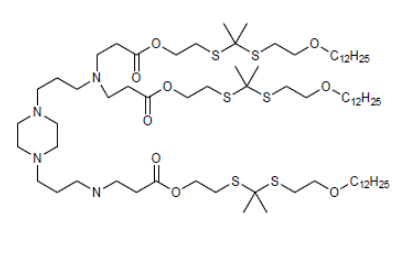
BAmP-TK-12 is a ROS-responsive ionizable lipid designed for tumor-cell mRNA delivery. It features a bis(aminopropyl)piperazine-derived ionizable headgroup and four C12 tails connected through cleavable thioketal linkers. In the reported study, BAmP-TK-12 achieved RFP expression in up to 95% of HeLa cells, comparable to Lipofectamine 3000, with lower cytotoxicity under the tested conditions. ROS-triggered linker cleavage supported intracellular mRNA release in high-ROS tumor cells. When formulated with DUF5 mRNA, the LNP suppressed tumor growth in HCT-116 and A549 xenograft models, supporting its use as a promising preclinical research lipid for stimulus-responsive mRNA delivery.
4A2-B8-PH is an optimally designed thioketal-incorporated biodegradable ionizable lipid (TBIL) for mRNA delivery to pancreatic ductal epithelial cells. It features a 4A2 headgroup with three tertiary amines, a biodegradable thioketal-based B8 linker, and a branched PH tail. The thioketal linker enables ROS-responsive degradation in the tumor microenvironment, enhancing endosomal escape and mRNA release. In vivo, 4A2-B8-PH LNPs achieve 98.3% pancreas-specific targeting after intraperitoneal administration, with a 218-fold improvement in delivery efficiency compared to previous benchmarks. It successfully transfects 30.5% of pancreatic ductal epithelial cells and induces complete tumor regression in orthotopic PDAC models via IL-12 mRNA therapy, demonstrating high efficacy and safety.