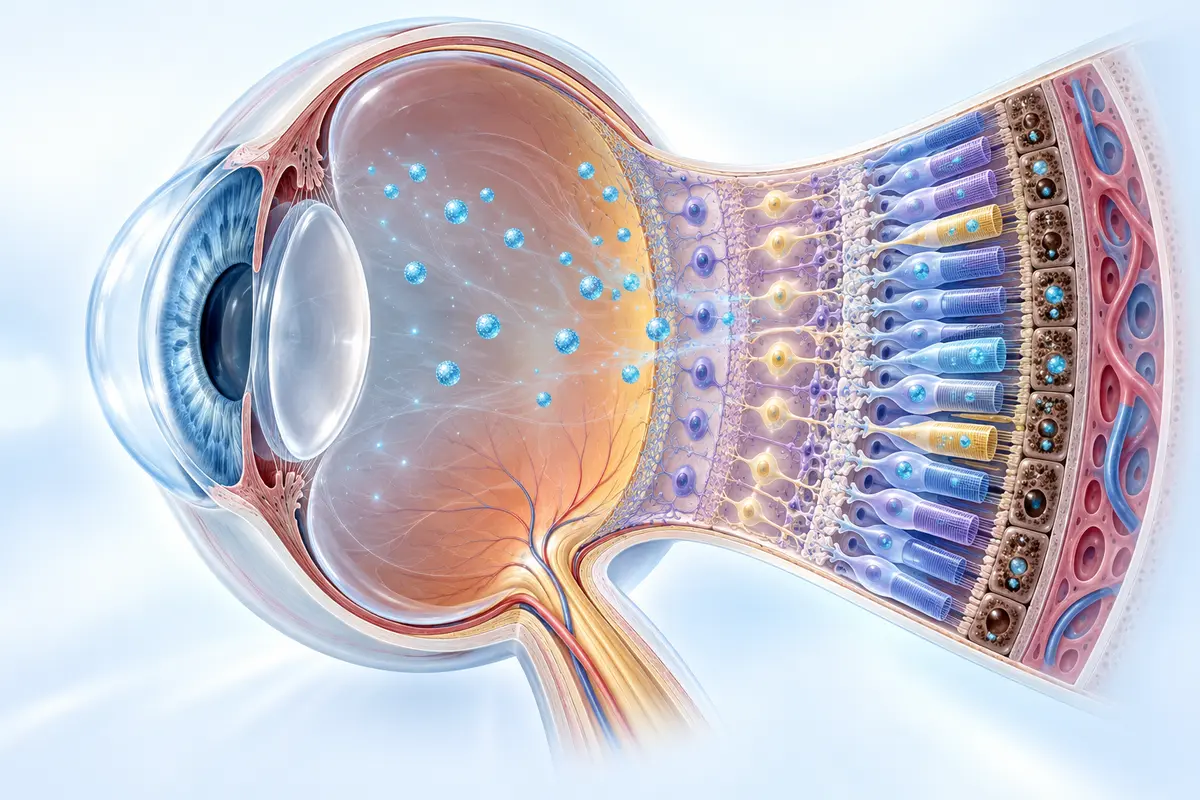
This focused collection covers ionizable lipids relevant to ocular nucleic-acid delivery research. Local anatomy, administration route, tolerability and formulation properties are critical variables and should be assessed from product-specific evidence.
2 products currently listedResearch-use products only
Evidence noteCategory membership indicates research relevance. Organ targeting, cell specificity and performance must be verified from the formulation and study conditions cited for each product.
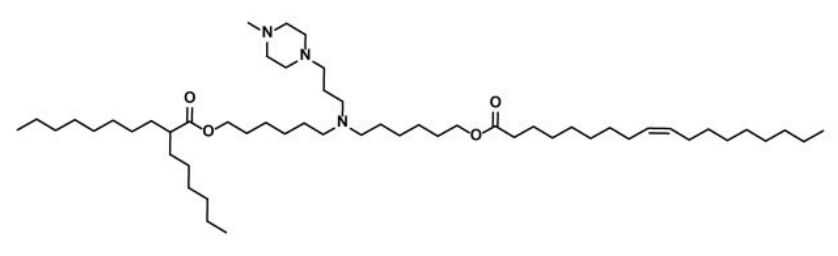
S-Ac7-DOg is an ionizable lipid engineered for optimized mRNA delivery to the retina, featuring a sulfur-based ester bond (S-Ac) and dual oleyl glyceride chains (DOg). Its pKa (~6.74) is finely tuned to enhance endosomal escape in acidic environments, enabling efficient cytosolic mRNA release. Unlike traditional lipids (e.g., C12-200, MC3), S-Ac7-DOg incorporates biodegradable ester linkages that hydrolyze intracellularly, minimizing lipid accumulation and reducing innate immune activation. In vitro, S-Ac7-DOg LNPs achieved >80% transfection efficiency in retinal cells (ARPE-19, MIO-M1) with negligible cytokine secretion, outperforming MC3 and rivaling C12-200 while avoiding the latter’s high immunogenicity. In vivo, intravitreal delivery in mice showed robust protein expression in the optic nerve head (ONH) and Müller glia (75–100% of eyes), sustained for ≥7 days. Critically, it induced the lowest immunogenicity among tested lipids: minimal leukocyte infiltration (<1.5-fold vs. PBS), no microglial reactivity, and reduced GFAP upregulation.
Lipid M3 is a novel ionizable lipid. Lipid M3's primary role is to enable the efficient co-encapsulation and delivery of CRISPR/Cas9 components—Cas9 mRNA and sgRNA targeting the VEGFA gene—into human retinal endothelial cells. M3 facilitates critical steps for successful gene editing, including stabilizing the nucleic acid cargo, promoting cellular uptake, and enabling effective endosomal escape to release the payload into the cytoplasm. This results in high gene-editing efficiency (indel frequency ~28.7%). A single intravitreal injection of the M3-F4 LNP carrying this CRISPR system demonstrated potent therapeutic effects in mouse models of diabetic retinopathy by significantly inhibiting pathological neovascularization and vascular leakage, while maintaining excellent biocompatibility.