SM-102
DC52025
Recommended because it shares a closely related research category or delivery context. Formulation and performance are product- and study-specific.
View product →
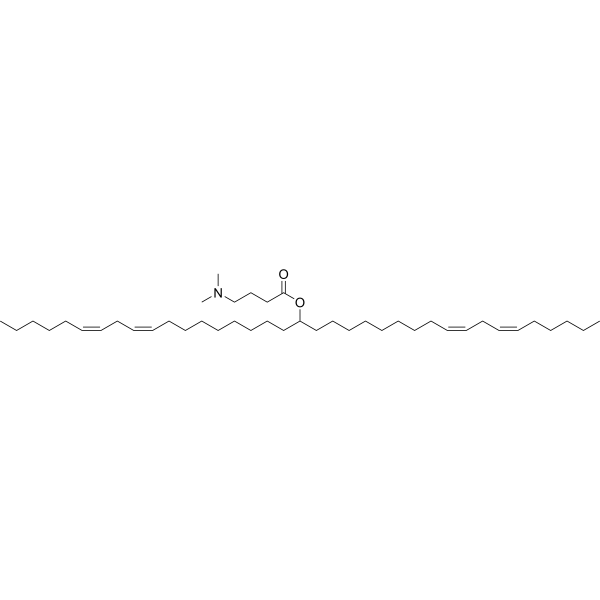
DLin-MC3-DMA (MC3) is an ionizable lipid studied for hepatic siRNA delivery. The 2012 study reported formulation-dependent Factor VII silencing in mice and transthyretin silencing in cynomolgus monkeys. Initial and optimized lipid compositions are documented separately.
Open full Formulation & Performance →
MC3 potency depends on the complete lipid composition. The initial screening formulation and the optimized animal formulation have different PEG-lipid proportions and different ED50 values.
MC3 is lipid 16 in Jayaraman et al. The product molecular weight is 642.11. The LNP apparent pKa of 6.44 is a formulation measurement, not a molecular-weight or purity specification.
| Component | DC Chemicals product | Molecular weight | Molar ratio | Mass at 1 µmol total lipid (mg) |
|---|---|---|---|---|
| DLin-MC3-DMA | DC10800 | 642.11 | 40 | 0.256844 |
| DSPC | DC57005 | 790.15 | 10 | 0.079015 |
| Cholesterol | DCD-041 | 386.65 | 40 | 0.154660 |
| PEG-C18 carbamate | Not uniquely mapped | Not established | 10 | Not calculable from disclosed data |
Initial screen: MC3/DSPC/cholesterol/PEG-C18 carbamate = 40:10:40:10 mol%. The source reports siRNA/total lipid = 0.05 by mass, equivalent to total lipid/siRNA = 20:1. This is not an N/P ratio. The PEG component is not DMG-PEG2000; its catalog mapping and molecular weight remain unassigned.
Not all inputs are assigned to a single verified study formulation; unassigned fields are blank. Enter your own values to calculate a research scenario. Molecular weights and ratios are editable. Results are calculated, not measured study data. No N/P or RNA dose is inferred.
| Component | MW | Molar ratio | Mass (mg) | Mass % |
|---|---|---|---|---|
| DLin-MC3-DMA | ||||
| DSPC | ||||
| Cholesterol | ||||
| PEG-C18 carbamate |
| Component | DC Chemicals product | Molecular weight | Molar ratio | Mass at 1 µmol total lipid (mg) |
|---|---|---|---|---|
| DLin-MC3-DMA | DC10800 | 642.11 | 50 | 0.321055 |
| DSPC | DC57005 | 790.15 | 10 | 0.079015 |
| Cholesterol | DCD-041 | 386.65 | 38.5 | 0.148860 |
| PEG-lipid; precise identity pending SI verification | Not uniquely mapped | Not established | 1.5 | Not calculable from disclosed data |
Optimized MC3/DSPC/cholesterol/PEG-lipid = 50:10:38.5:1.5 mol%. The main text supplies the proportions but does not independently establish the optimized PEG identity in this review. The screening formulation PEG molecular weight is not carried over.
Not all inputs are assigned to a single verified study formulation; unassigned fields are blank. Enter your own values to calculate a research scenario. Molecular weights and ratios are editable. Results are calculated, not measured study data. No N/P or RNA dose is inferred.
| Component | MW | Molar ratio | Mass (mg) | Mass % |
|---|---|---|---|---|
| DLin-MC3-DMA | ||||
| DSPC | ||||
| Cholesterol | ||||
| PEG-lipid; precise identity pending SI verification |
| Study / condition | Result | Interpretation |
|---|---|---|
| Apparent ionization | MC3-containing LNP pKa 6.44 | Reported for the study LNP; not an intrinsic constant under all conditions. |
| Initial screening LNPs | 40:10:40:10; RNA/total lipid 0.05 by mass | This formulation generated the 0.03 mg/kg mouse ED50. |
| Screen-wide particle characterization | 70–90 nm; PDI 0.11 ± 0.04 across the screened library | Pooled library description, not a batch specification for MC3. |
Jayaraman et al., main text, Table 1 and Figs. 4–5.
| Study / condition | Result | Interpretation |
|---|---|---|
| Endpoint | Circulating Factor VII protein after FVII siRNA delivery | Gene silencing, not reporter mRNA expression. |
| MC3 / lipid 16 | ED50 0.03 mg siRNA/kg in the 40:10:40:10 formulation | Dose producing approximately 50% silencing in this model. |
| Structure comparison | The MC3 pKa region coincided with high potency in the tested series | This association does not make pKa alone a universal predictor. |
Main Table 1 and Figs. 4–5. Dose units refer to siRNA, not lipid mass.
| Study / condition | Result | Interpretation |
|---|---|---|
| 50:10:38.5:1.5 formulation | ED50 0.005 mg siRNA/kg | Sixfold lower ED50 than the initial MC3 composition. |
| Comparison basis | Same named ionizable lipid; changed helper-lipid proportions | The optimized ED50 must not be assigned to the initial screen recipe. |
| Figure reporting | Dose-response inset in Fig. 7; n = 5, mean ± SD | The graph supports a formulation-specific potency statement. |
Main text and Fig. 7 inset.
| Study / condition | Result | Interpretation |
|---|---|---|
| Model and administration | Cynomolgus monkeys; TTR siRNA; 15-minute intravenous infusion | Optimized 50:10:38.5:1.5 lipid composition. |
| Doses | 0.03, 0.1 and 0.3 mg siRNA/kg | Different target and species from the mouse FVII experiment. |
| Outcome | TTR silencing ED50 <0.03 mg/kg; n = 3 per group | Supports primate hepatic siRNA delivery; does not establish mRNA or extrahepatic performance. |
Main Fig. 7. Detailed time-point verification remains pending the complete supporting information.
| Study / condition | Result | Interpretation |
|---|---|---|
| Mixed-lipid experiment | FVII measured 24 h after 0.1 mg siRNA/kg in Fig. 6 | Ionization and delivery activity were examined using mixtures of related lipids. |
| Safety interpretation | This article is primarily a delivery-potency study | Do not infer a chronic toxicity margin or human dosing recommendation. |
| Translation limits | FVII and TTR are distinct hepatic endpoints | A single ED50 cannot summarize every MC3 formulation, RNA payload or route. |
Main Figs. 6–7. Complete SI retrieval was unsuccessful; missing PEG identity and detailed assay conditions are left unresolved.
Mouse and primate dose-response curves — Figure 7 — Original source figures.
Ionization and silencing comparisons — Figures 5–6 — Original source figures.
| CAS No. | 1224606-06-7 |
| Chemical Name | DLin-MC3-DMA |
| Synonyms | DLinMC3DMA, DLin MC3 DMA |
| SMILES | CCCCC/C=C\C/C=C\CCCCCCCCC(OC(=O)CCCN(C)C)CCCCCCCC/C=C\C/C=C\CCCCC |
| Formula | C43H79NO2 |
| M.Wt | 642.11 |
| Purity | >95% by ELSD-HPLC |
| Storage | Pure form: −20 °C, 1 year; In solvent: −80 °C, 6 months; −20 °C, 1 month. Sealed and protected from light. |
| Shipping condition | Ships from Shanghai. Pure lipid is stable during ice-pack transport. |
| Publication |
The product molecular weight is prefilled when available and remains editable. Confirm solvent compatibility and solubility before preparation.
Solvent volumes update from the molecular weight above.
| Mass | 1 mM | 5 mM | 10 mM |
|---|---|---|---|
| 10 mg | 15.5858 mL | 3.1172 mL | 1.5586 mL |
| 25 mg | 38.9645 mL | 7.7929 mL | 3.8964 mL |
| 50 mg | 77.9290 mL | 15.5858 mL | 7.7929 mL |
| 100 mg | 155.8579 mL | 31.1716 mL | 15.5858 mL |
| 250 mg | 389.6448 mL | 77.9290 mL | 38.9645 mL |
Contact our team with the catalog number and requested quantity.