SM-102
DC52025
Recommended because it shares a closely related research category or delivery context. Formulation and performance are product- and study-specific.
View product →
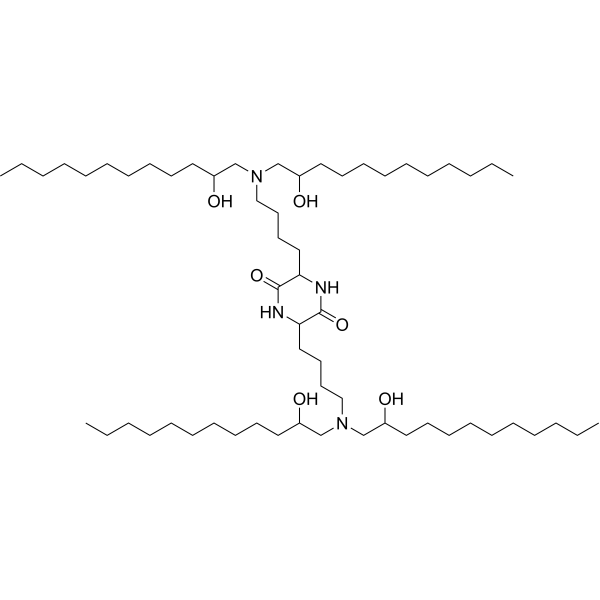
cKK-E12 is an ionizable lipopeptide lipid investigated for hepatocyte-selective siRNA delivery. Published studies report potent factor VII silencing in rodents and greater than 95% liver TTR mRNA silencing in cynomolgus monkeys at 0.3 mg/kg siRNA.
Open full Formulation & Performance →
The 2014 PNAS paper provides mouse, rat and nonhuman-primate siRNA evidence. Rodent ED50 values, cell-selectivity experiments and the monkey fixed-dose TTR result are shown separately.
DC49882 is cKK-E12. The catalog molecular weight 993.62 is retained. This module reports the original siRNA study; results from later mRNA formulations are not merged into its formulation record.
| Component | DC Chemicals product | Molecular weight | Molar ratio | Mass at 1 µmol total lipid (mg) |
|---|---|---|---|---|
| cKK-E12 | DC49882 | 993.62 | Not assigned | Not calculable from disclosed data |
| DSPC | DC57005 | 790.15 | Not assigned | Not calculable from disclosed data |
| Cholesterol | DCD-041 | 386.65 | Not assigned | Not calculable from disclosed data |
| PEG-lipid (identity unassigned) | Not uniquely mapped | Not established | Not assigned | Not calculable from disclosed data |
Main text identifies cKK-E12, DSPC, cholesterol and a PEG-lipid. The complete 2014 SI was not retrieved, so molar ratios, PEG identity/MW, N/P and lipid:RNA mass ratio are not assigned. A familiar 50:10:38.5:1.5 recipe is not assumed to be the verified original formulation.
Not all inputs are assigned to a single verified study formulation; unassigned fields are blank. Enter your own values to calculate a research scenario. Molecular weights and ratios are editable. Results are calculated, not measured study data. No N/P or RNA dose is inferred.
| Component | MW | Molar ratio | Mass (mg) | Mass % |
|---|---|---|---|---|
| cKK-E12 | ||||
| DSPC | ||||
| Cholesterol | ||||
| PEG-lipid (identity unassigned) |
| Study / parameter | Reported evidence | Source / interpretation |
|---|---|---|
| Reported component classes | cKK-E12 / DSPC / cholesterol / PEG-lipid with siRNA | Main Results; complete proportions remain unverified |
| DLS diameter | Approximately 70 nm | Main text and Fig. 2; approximate study value |
| Cryo-TEM | Particles approximately 35–85 nm | Main Fig. 2; imaging and hydrodynamic size are different measurements |
| Unassigned parameters | Exact PEG identity, proportions, N/P, encapsulation percentage and PDI | Complete original SI required before these values are prefilled |
| Study / parameter | Reported evidence | Source / interpretation |
|---|---|---|
| Mouse FVII | ED50 approximately 0.002 mg/kg entrapped siRNA | Main Fig. 2; a factor VII silencing endpoint |
| Rat FVII | ED50 below 0.01 mg/kg siRNA | Main Results; species-specific potency estimate |
| Dose interpretation | Values are siRNA dose-based, not lipid dose-based | Not an mRNA expression dose or reporter-editing percentage |
| Benchmark interpretation | The paper compares dose-response profiles of multiple delivery systems | Do not rank every application by one FVII assay |
| Study / parameter | Reported evidence | Source / interpretation |
|---|---|---|
| Pten silencing | 0.1 mg/kg siRNA produced >80% silencing in mouse hepatocytes | Main Fig. 4; cell-resolved Pten experiment |
| Other liver populations | No significant Pten silencing in endothelial cells or leukocytes at that dose | Same Pten experiment; not an absolute ban on extrahepatic delivery |
| Separate target assays | Tie2 and CD45 studies used 1 mg/kg and gave weaker cell-population responses | Main Fig. 4; different genes/doses cannot be treated as a single selectivity ratio |
| Apolipoprotein E | ApoE enhanced uptake/potency; activity fell in ApoE-deficient mice but remained in LDLR-deficient mice | Main Fig. 5; supports an ApoE-associated mechanism without requiring LDLR alone |
| Study / parameter | Reported evidence | Source / interpretation |
|---|---|---|
| Species and cohort | Cynomolgus monkeys; n = 3 | Main Fig. 6 |
| Treatment | Single intravenous infusion of 0.3 mg/kg siTTR-containing LPNs | 15-minute infusion in the reported study |
| Measurement | Liver biopsy at 48 h; TTR mRNA measured relative to GAPDH | Main Fig. 6; liver transcript endpoint |
| Outcome | Greater than 95% TTR mRNA silencing | 0.3 mg/kg is a tested effective dose, not a reported primate ED50 |
| Scope | No clinical response or long-term primate safety conclusion is established by this result | Do not equate liver mRNA silencing with serum protein reduction |
| Study / parameter | Reported evidence | Source / interpretation |
|---|---|---|
| Rat tolerability | Paper reports tolerability at 1 mg/kg siRNA | Supporting toxicology Table S2 was not independently retrieved |
| Safety margin description | Paper describes a dose above 100 times the rat FVII ED50 | Study-specific comparison; not a validated human therapeutic index |
| Published correction | The 2014 correction adds funding acknowledgments | DOI 10.1073/pnas.1404711111; no efficacy-data correction described |
| Remaining gaps | Complete original SI and exact formulation mapping | No invented NOAEL, immune-response panel or recipe |
Original Figs. 2, 4–6: particle properties, cell selectivity, ApoE and monkey TTR response — Original source figures.
| CAS No. | 1432494-65-9 |
| Chemical Name | CKK-E12 |
| Synonyms | 2,5-Piperazinedione, 3,6-bis[4-[bis(2-hydroxydodecyl)amino]butyl]-;CKKE12, CKK E12 |
| SMILES | N1C(CCCCN(CC(O)CCCCCCCCCC)CC(O)CCCCCCCCCC)C(=O)NC(CCCCN(CC(O)CCCCCCCCCC)CC(O)CCCCCCCCCC)C1=O |
| Formula | C60H120N4O6 |
| M.Wt | 993.62 |
| Purity | >95% by ELSD-HPLC |
| Storage | Pure form: −20 °C, 1 year; In solvent: −80 °C, 6 months; −20 °C, 1 month. Sealed and protected from light. |
| Shipping condition | Ships from Shanghai. Pure lipid is stable during ice-pack transport. |
| Publication |
The product molecular weight is prefilled when available and remains editable. Confirm solvent compatibility and solubility before preparation.
Solvent volumes update from the molecular weight above.
| Mass | 1 mM | 5 mM | 10 mM |
|---|---|---|---|
| 10 mg | 10.0642 mL | 2.0128 mL | 1.0064 mL |
| 25 mg | 25.1605 mL | 5.0321 mL | 2.5161 mL |
| 50 mg | 50.3210 mL | 10.0642 mL | 5.0321 mL |
| 100 mg | 100.6421 mL | 20.1284 mL | 10.0642 mL |
| 250 mg | 251.6052 mL | 50.3210 mL | 25.1605 mL |
Contact our team with the catalog number and requested quantity.