Lipid 8
DC86601
Recommended because it shares a closely related research category or delivery context. Formulation and performance are product- and study-specific.
View product →
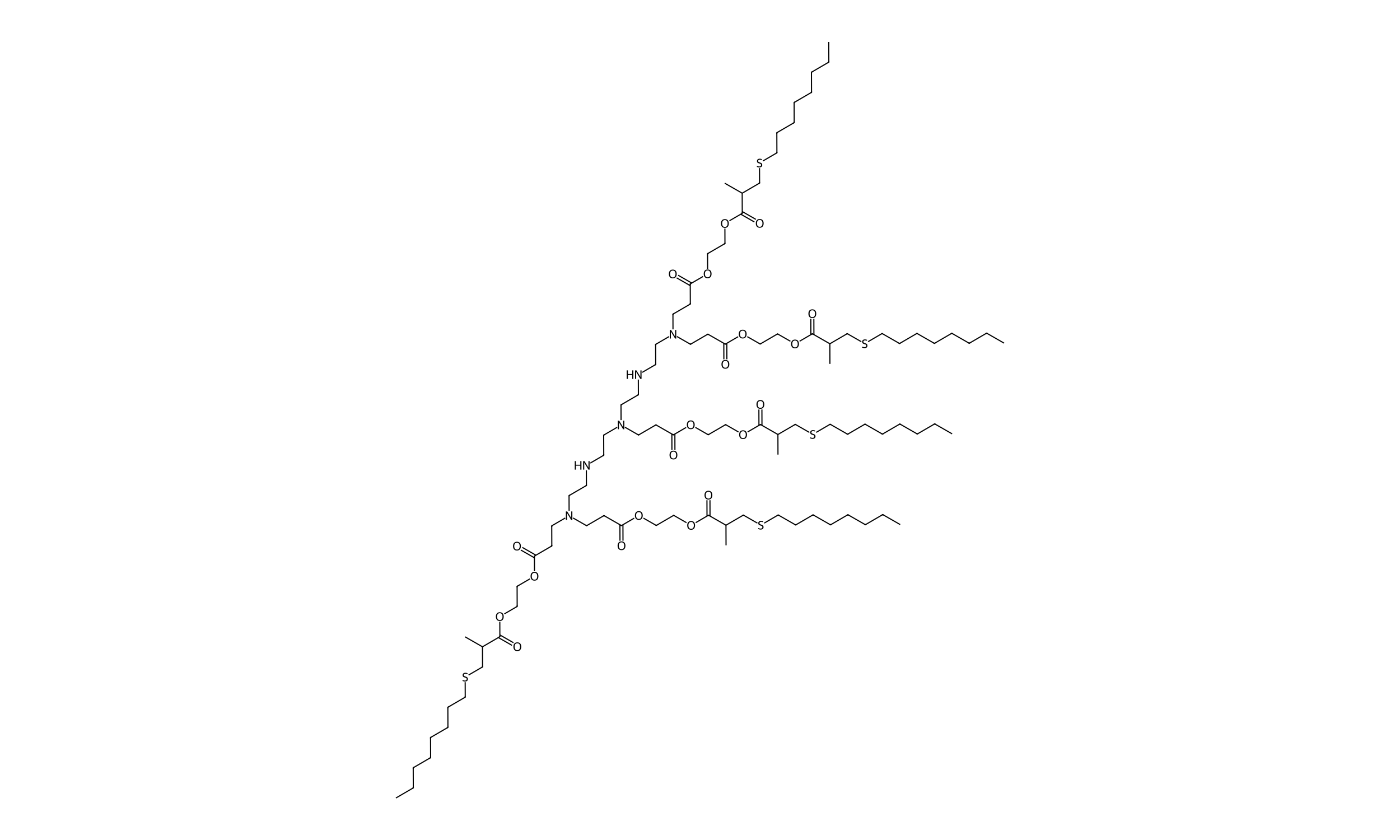
5A2-SC8 is a degradable dendrimer lipid studied for small-RNA delivery and as the ionizable component of later multicomponent mRNA LNPs. Published evidence includes liver siRNA knockdown and formulation-dependent bone-marrow reporter delivery. Bone-marrow tropism in the later study required an additional covalent lipid or crosslinker.
Open full Formulation & Performance →
The 2016 small-RNA study and 2024 bone-marrow study are kept separate. The four-component base LNP is not presented as equivalent to a five-component bone-marrow-homing LNP.
The results below describe the cited research formulations. Product specifications and commercial pack options are shown in the Specifications and ordering sections.
| Component | DC Chemicals product | Molecular weight | Molar ratio | Mass at 1 µmol total lipid (mg) |
|---|---|---|---|---|
| 5A2-SC8 | DC49907 | 1841.76 | 15 | 0.438514 |
| DOPE | DC33634 | 744.03 | 15 | 0.177150 |
| Cholesterol | DCD-041 | 386.65 | 30 | 0.184119 |
| DMG-PEG2000 | DC40169 | 2507 | 3 | 0.119381 |
2024 base formulation: 5A2-SC8/DOPE/cholesterol/DMG-PEG2000 = 15:15:30:3 relative molar parts (sum 63). The paper also presents rounded percentages 23.8:23.8:47.6:4.8. Total lipid:RNA weight ratios vary by experiment: 40:1 for luciferase/characterization, 20:1 for Cre and 10:1 for the reported genome-editing cargos. None is an N/P ratio. This composition is not assigned to the 2016 siRNA experiments.
Prefilled proportions follow the source specified above. Molecular weights and ratios are editable. Results are calculated, not measured study data. No N/P or RNA dose is inferred.
| Component | MW | Molar ratio | Mass (mg) | Mass % |
|---|---|---|---|---|
| 5A2-SC8 | ||||
| DOPE | ||||
| Cholesterol | ||||
| DMG-PEG2000 |
| Component | DC Chemicals product | Molecular weight | Molar ratio | Mass at 1 µmol total lipid (mg) |
|---|---|---|---|---|
| 5A2-SC8 | DC49907 | 1841.76 | 19 | 0.349934 |
| DOPE | DC33634 | 744.03 | 19 | 0.141366 |
| Cholesterol | DCD-041 | 386.65 | 38 | 0.146927 |
| DMG-PEG2000 | DC40169 | 2507 | 4 | 0.100280 |
| Covalent lipid / crosslinker (study-specific fifth component) | Not uniquely mapped | Not established | 20 | Not calculable from disclosed data |
2024 bone-marrow formulations: 19:19:38:4:20 mol%. The fifth component is a selected covalent lipid or crosslinker (for example AA11 in the indicated reporter experiment). No generic fifth-component molecular weight or catalog mapping is assigned.
Not all inputs are assigned to a single verified study formulation; unassigned fields are blank. Enter your own values to calculate a research scenario. Molecular weights and ratios are editable. Results are calculated, not measured study data. No N/P or RNA dose is inferred.
| Component | MW | Molar ratio | Mass (mg) | Mass % |
|---|---|---|---|---|
| 5A2-SC8 | ||||
| DOPE | ||||
| Cholesterol | ||||
| DMG-PEG2000 | ||||
| Covalent lipid / crosslinker (study-specific fifth component) |
| Endpoint | Model / conditions | Reported evidence |
|---|---|---|
| Factor VII silencing | Mouse IV siRNA dose-response | Approximately 0.02 mg/kg EC50; main text states <0.02 mg/kg while Fig. 4D labels 0.02 mg/kg. |
| let-7g tumour study | MYC-driven liver tumour model; 1 mg/kg RNA IV weekly from day 26 | Reduced tumour burden and extended survival; Fig. 6. A long-surviving animal is not treated as a group median or universal outcome. |
| Particle measurements | Main text reports approximately 80 nm particles and stability observations | New SI retrieval remains unavailable; source-reported summaries are not treated as independently re-extracted supplementary data. |
| Model / population | Study conditions | Reported outcome |
|---|---|---|
| Healthy mouse bone marrow, AA11-containing five-component LNP | Cre mRNA, 0.6 mg/kg IV; 72 h | 44.80% reporter activation in LSK cells and 40.20% in long-term HSCs; Main Fig. 2 and supplementary population analysis. |
| Leukaemic stem-cell population | Cre mRNA, 0.6 mg/kg IV; 72 h | Tested bone-marrow-homing formulations activated reporter in 13–18% of YFP+/CD11b+/CD117+ cells; Main Fig. 5f,g. |
| Base formulation control | Same leukaemia reporter experiment without added covalent lipid | Less than 0.3% activation in the evaluated populations; Main Fig. 5g. |
The added fifth component is essential to interpreting these data. Cre reporter activation is a functional-delivery readout, not a direct percentage of therapeutic genome correction.
| Evidence | What was tested | What it does not establish |
|---|---|---|
| 2016 repeat-dose observation | Four IV doses of 75 mg/kg dendrimer plus 3 mg/kg control siRNA, on days 32, 36, 40 and 44; n = 5; better tolerated than 6A3-SC12 | Not a universal tolerated dose for other cargos or five-component LNPs. |
| 2024 multicomponent system | Biological properties depend on the selected covalent lipid/crosslinker and cargo | Base-lipid safety cannot be inferred from one complete formulation. |
| Cross-study comparison | 2016 siRNA and 2024 mRNA used different formulation contexts | Their potency and safety endpoints are not pooled into a single ranking. |
| Source | Reviewed in this update | Remaining limitation |
|---|---|---|
| PNAS 2016 | Full main article, figures and captions | Supplementary download was blocked; exact older helper-lipid ratio assignment remains unresolved. |
| Nature Nanotechnology 2024 | Full main article including formulation Methods | Supplementary download was blocked. Unverified supplemental numerical datasets are not newly claimed. |
2016 original Figures 4 and 6 — Original source figures.
2024 original Figures 2 and 5 — Original source figures.
| CAS No. | 1857341-90-2 |
| Chemical Name | 5A2-SC8 |
| Synonyms | 5A2SC8, 5A2 SC8 |
| SMILES | N(CCC(=O)OCCOC(=O)C(C)CSCCCCCCCC)(CCNCCN(CCC(=O)OCCOC(=O)C(C)CSCCCCCCCC)CCC(=O)OCCOC(=O)C(C)CSCCCCCCCC)CCNCCN(CCC(=O)OCCOC(=O)C(C)CSCCCCCCCC)CCC(=O)OCCOC(=O)C(C)CSCCCCCCCC |
| Formula | C93H173N5O20S5 |
| M.Wt | 1841.76 |
| Purity | >95% by ELSD-HPLC |
| Storage | Pure form: −20 °C, 1 year; In solvent: −80 °C, 6 months; −20 °C, 1 month. Sealed and protected from light. |
| Shipping condition | Ships from Shanghai. Pure lipid is stable during ice-pack transport. |
| Publication |
|
The product molecular weight is prefilled when available and remains editable. Confirm solvent compatibility and solubility before preparation.
Molecular formula: C93H173N5O20S5. Molecular weight: 1841.76. Five-arm connectivity: 2016 SI Fig. S26.
Solvent volumes update from the molecular weight above.
| Mass | 1 mM | 5 mM | 10 mM |
|---|---|---|---|
| 10 mg | 5.4296 mL | 1.0859 mL | 542.96 μL |
| 25 mg | 13.5740 mL | 2.7148 mL | 1.3574 mL |
| 50 mg | 27.1479 mL | 5.4296 mL | 2.7148 mL |
| 100 mg | 54.2959 mL | 10.8592 mL | 5.4296 mL |
| 250 mg | 135.7397 mL | 27.1479 mL | 13.5740 mL |
Contact our team with the catalog number and requested quantity.