A curated ionizable-lipid library designed to support comparative LNP screening across headgroups, linkers and hydrophobic domains. Standardize cargo, formulation process and assay conditions when comparing candidates.
3 products currently listedResearch-use products only
Evidence noteCategory membership indicates research relevance. Organ targeting, cell specificity and performance must be verified from the formulation and study conditions cited for each product.
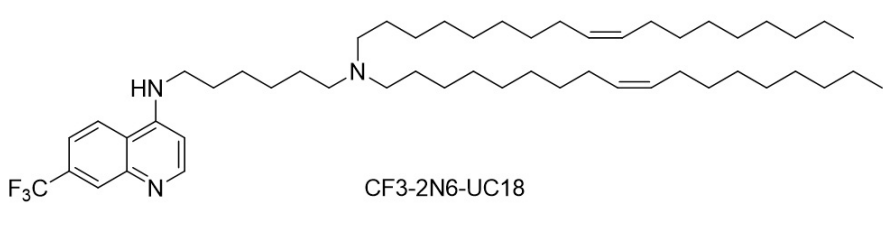
CF3-2N6-UC18 is a rationally designed chloroquine-inspired ionizable lipid that enables robust mRNA delivery and genome editing. It integrates three modular components: a 7-trifluoromethyl-substituted quinoline scaffold (mimicking chloroquine’s endosomolytic properties), a hexamethylenediamine linker with two ionizable nitrogen atoms (pH-responsive protonation), and two unsaturated oleyl (C18:1) hydrophobic tails (enhancing membrane fusion and nanoparticle stability). This lipid self-assembles into ecoLNPs (endosomolytic chloroquine-like lipid nanoparticles) with spherical morphology (~200 nm diameter, 98% mRNA encapsulation). Its pH-sensitive activity triggers endosomal escape through dual mechanisms: proton sponge effect (buffering endo-lysosomal pH) and saposin B-mediated membrane disruption (molecular docking confirms chloroquine-like binding to lysosomal saposin B). In vitro, ecoLNPs outperform commercial reagents (18.9-fold higher mRNA delivery than Lipofectamine 2000) and penetrate 3D cell models. They resist serum/RNase degradation and retain >90% activity after 7-day storage at 4°C. In vivo, ecoLNPs achieve tissue-specific mRNA expression via multiple routes (intravenous, intramuscular, etc.), with strong lymph node tropism (90.2% after intramuscular injection) comparable to SM-102 LNPs (Moderna’s COVID-19 vaccine carrier). They mediate efficient Cre mRNA-driven recombination and CRISPR-Cas9 editing in transgenic mice. CF3-2N6-UC18’s modular design, stability, and dual endosomal escape strategies position it as a versatile platform for mRNA vaccines, gene therapy, and genome editing applications.
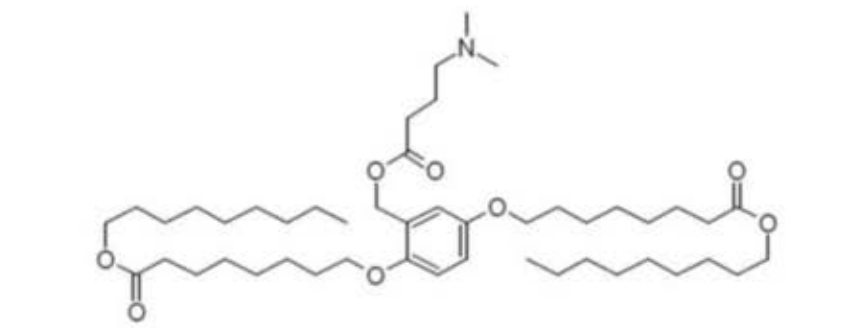
XH-04 is an ionizable lipid engineered for advanced mRNA delivery developed by JiaChen West Lake Biotech. Its core structure features a central benzene ring with asymmetric hydrophobic tails (C9-C10 chains) and pH-responsive tertiary amines that enable efficient mRNA encapsulation and endosomal escape. As detailed in CN113993839A, XH04 outperforms industry benchmarks (e.g., MC3 lipid), boosting protein expression by >10-fold in BHK cells. In PCT/CN2024/121624, JiaChen further demonstrated its utility in lung-targeted LNPs (tLNP/tLCNP). When combined with cationic lipids (e.g., DOTMA at 2:1 molar ratio), XH 04 redirects >80% of mRNA delivery to murine lungs—overcoming liver tropism—while maintaining low toxicity. The lipid’s benzenic core and optimized alkyl chain geometry (patent claims 1-9) are credited for enhanced endosomal disruption and mRNA release kinetics. JiaChen’s innovations position XH-04 as a cornerstone for next-generation mRNA therapeutics.
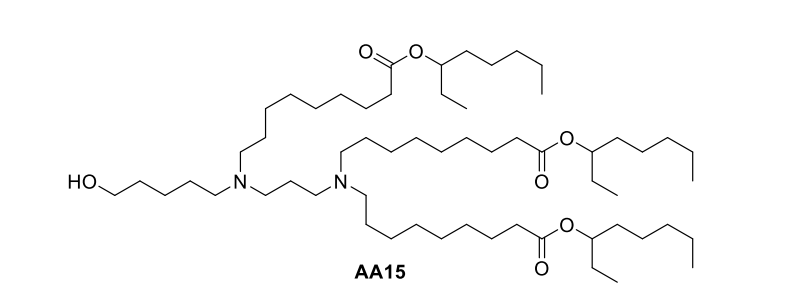
The AA15 lipid, an amino acid-derived ionizable lipid, integrates a carboxylic acid-containing headgroup and biodegradable branched ester tails (R2) to enhance mRNA delivery. Optimized as AA15V LNP, it exhibits a hydrodynamic diameter of 102.3 ± 4.1 nm, low polydispersity (PDI <0.15), and slightly positive zeta potential (+4–6 mV), enabling efficient tumor-targeted delivery. With a pKa ~6.1–6.4, AA15V ensures protonation in acidic endosomes, promoting mRNA release. It achieves >85% mRNA encapsulation efficiency, critical for stable saRNA delivery. In vitro, AA15V LNP-sSE-SCTs induced sustained SE-SCT expression (69% H-2Kb+β2m+ B16F10 cells at 72 h), outperforming mRNA formulations. In vivo, a single intratumoral dose of AA15V LNP-sSE-SCTs suppressed tumor growth by 22-fold in vaccinated mice, synergizing with checkpoint inhibitors (anti-PD-1/CTLA-4) for complete regression in 28.6% of lymphoma models. Ex vivo, AA15V enabled SE-SCT expression in human glioblastoma (7.1% CD45− cells) and lung cancer samples (5.8–8.7%), underscoring clinical potential. Key data: pKa ~6.3; encapsulation: 85–89%; zeta: +4–6 mV; size: 102.3 ± 4.1 nm.