EB-Lipid
DC67650
Recommended because it shares a closely related research category or delivery context. Formulation and performance are product- and study-specific.
View product →
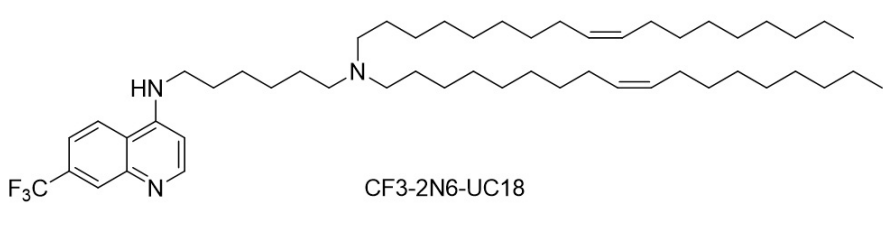
Ionizable lipid for LNP and nucleic-acid delivery research.
CF3-2N6-UC18 is a rationally designed chloroquine-inspired ionizable lipid that enables robust mRNA delivery and genome editing. It integrates three modular components: a 7-trifluoromethyl-substituted quinoline scaffold (mimicking chloroquine’s endosomolytic properties), a hexamethylenediamine linker with two ionizable nitrogen atoms (pH-responsive protonation), and two unsaturated oleyl (C18:1) hydrophobic tails (enhancing membrane fusion and nanoparticle stability). This lipid self-assembles into ecoLNPs (endosomolytic chloroquine-like lipid nanoparticles) with spherical morphology (~200 nm diameter, 98% mRNA encapsulation). Its pH-sensitive activity triggers endosomal escape through dual mechanisms: proton sponge effect (buffering endo-lysosomal pH) and saposin B-mediated membrane disruption (molecular docking confirms chloroquine-like binding to lysosomal saposin B). In vitro, ecoLNPs outperform commercial reagents (18.9-fold higher mRNA delivery than Lipofectamine 2000) and penetrate 3D cell models. They resist serum/RNase degradation and retain >90% activity after 7-day storage at 4°C. In vivo, ecoLNPs achieve tissue-specific mRNA expression via multiple routes (intravenous, intramuscular, etc.), with strong lymph node tropism (90.2% after intramuscular injection) comparable to SM-102 LNPs (Moderna’s COVID-19 vaccine carrier). They mediate efficient Cre mRNA-driven recombination and CRISPR-Cas9 editing in transgenic mice. CF3-2N6-UC18’s modular design, stability, and dual endosomal escape strategies position it as a versatile platform for mRNA vaccines, gene therapy, and genome editing applications.
| CAS No. | Not available |
| Chemical Name | CF3-2N6-UC18 |
| Synonyms | CF32N6UC18, CF3 2N6 UC18 |
| SMILES | CCCCCCCC/C=C\CCCCCCCCN(CCCCCCCC)CCCCCCNC1=CC=NC2=C1C=CC(C(F)(F)F)=C2 |
| Formula | C53H92F3N3 |
| M.Wt | 828.34 |
| Purity | ELSD-HPLC>95% |
| Storage | Pure form: −20 °C, 1 year; In solvent: −80 °C, 6 months; −20 °C, 1 month. Sealed and protected from light. |
| Shipping condition | Ships from Shanghai. Pure lipid is stable during ice-pack transport. |
| Publication | Structure-guided design of endosomolytic chloroquine-like lipid nanoparticles for mRNA delivery and genome editing-Nature Communications volume 16, Article number: 4241 (2025) |
The product molecular weight is prefilled when available and remains editable. Confirm solvent compatibility and solubility before preparation.
Solvent volumes update from the molecular weight above.
| Mass | 1 mM | 5 mM | 10 mM |
|---|---|---|---|
| 10 mg | 12.0723 mL | 2.4145 mL | 1.2072 mL |
| 25 mg | 30.1808 mL | 6.0362 mL | 3.0181 mL |
| 50 mg | 60.3617 mL | 12.0723 mL | 6.0362 mL |
| 100 mg | 120.7234 mL | 24.1447 mL | 12.0723 mL |
| 250 mg | 301.8084 mL | 60.3617 mL | 30.1808 mL |
Contact our team with the catalog number and requested quantity.