SM-102
DC52025
Recommended because it shares a closely related research category or delivery context. Formulation and performance are product- and study-specific.
View product →
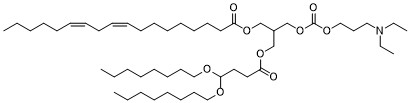
LP-01 is a biodegradable ionizable lipid used in the LNP-INT01 delivery system for Cas9 mRNA and guide RNA. Published rodent studies show liver-directed genome editing, sustained reduction of serum transthyretin and rapid clearance of the lipid and RNA components.
Open full Formulation & Performance →
The 2018 Cell Reports paper reports durable Ttr editing after transient exposure to LP-01-containing LNPs. Serum protein reduction, whole-liver DNA editing and lipid clearance are reported separately.
The paper names the lipid LP01 and the complete formulation LNP-INT01. DC31000 is the lipid component, not a preformulated editor product.
| Component | DC Chemicals product | Molecular weight | Molar ratio | Mass at 1 µmol total lipid (mg) |
|---|---|---|---|---|
| LP-01 | DC31000 | 852.292 | 45 | 0.383531 |
| DSPC | DC57005 | 790.15 | 9 | 0.071113 |
| Cholesterol | DCD-041 | 386.65 | 44 | 0.170126 |
| DMG-PEG2000 | DC40169 | 2507 | 2 | 0.050140 |
Experimental Procedures, LNP Formulation: LP01 / DSPC / cholesterol / PEG2k-DMG = 45:9:44:2 mol%. Reported N/P = 4.5; mRNA:sgRNA = 1:1 by mass. These are different quantities. DMG-PEG2000 uses MW 2507 for the calculated component masses.
Prefilled proportions follow the source specified above. Molecular weights and ratios are editable. Results are calculated, not measured study data. No N/P or RNA dose is inferred.
| Component | MW | Molar ratio | Mass (mg) | Mass % |
|---|---|---|---|---|
| LP-01 | ||||
| DSPC | ||||
| Cholesterol | ||||
| DMG-PEG2000 |
| Study / parameter | Reported evidence | Source / interpretation |
|---|---|---|
| Composition | 45% LP01, 9% DSPC, 44% cholesterol, 2% PEG2k-DMG | Main-text Experimental Procedures |
| Charge/cargo ratios | N/P 4.5; Cas9 mRNA:sgRNA 1:1 mass ratio | N/P is amine-to-RNA-phosphate, not lipid:RNA mass ratio |
| Particle size and RNA association | Main text reports formulations <100 nm and >95% encapsulation | The underlying SI Table S1 was not independently retrieved; no narrower values assigned |
| Ionization | Approximate pKa 6.1 reported for LP01 | Results section; assay context should accompany comparisons |
| Study / parameter | Reported evidence | Source / interpretation |
|---|---|---|
| Cell model | Mouse primary hepatocytes; transfection assessed at 42–48 h by sequencing | Experimental Procedures, LNP Delivery In Vitro |
| Guide screening | In vitro guide activity correlated with the corresponding mouse-liver screen | Main Fig. 1c; guide selection affects the delivered system |
| Co-delivery | Main text reports coformulation more effective than split delivery | SI Fig. S1 referred to by the main text; individual SI panels not rechecked |
| Interpretation | Results depend on lipid, formulation and RNA design together | The activity is not an intrinsic potency value of the pure lipid |
| Study / parameter | Reported evidence | Source / interpretation |
|---|---|---|
| Long-term study | CD-1 mice; single systemic dose 0.3, 1 or 3 mg/kg RNA; followed up to 12 months | Main Fig. 2f–h; n = 5 at indicated collection points |
| Highest-dose result | At 3 mg/kg, >97% serum TTR reduction and approximately 70% whole-liver DNA editing | Main Results and Fig. 2; protein knockdown is not editing percentage |
| Durability | Editing and protein reduction remained stable through the reported 12-month follow-up | Not persistence of intact LNP or Cas9 mRNA |
| Repeated administration | Multiple doses produced cumulative editing in the reported study | Main Fig. 3; do not substitute a multi-dose result for the single-dose result |
| Study / parameter | Reported evidence | Source / interpretation |
|---|---|---|
| Rat efficacy | Systemic 1, 2 or 5 mg/kg; dose-dependent response with approximately 70% liver editing and >90% TTR reduction at high response | Main Fig. 4; outcomes depend on guide and dose |
| RNA clearance | Cas9 mRNA and guide RNA were undetectable in plasma/liver by 72 h in the reported assay | Main Fig. 2a–b; assay detection limit applies |
| Lipid turnover | Reported LP01 liver half-life approximately 6 h | Main Fig. 2c |
| Editing kinetics | Editing reached its maximum later, around 96 h | Main Fig. 2d–e; pharmacokinetics and pharmacodynamics are separate |
| Study / parameter | Reported evidence | Source / interpretation |
|---|---|---|
| Reported endpoints | Main text describes mouse/rat tolerability with respect to cytokine responses and body-weight change | Detailed supporting panels S2c–h were not independently rechecked |
| Tissue selectivity | Liver was the principal delivery site, with low detectable editing also reported in spleen and kidney | Main Discussion and Fig. 4c; liver-directed does not mean exclusive |
| Study boundary | Rodent preclinical evidence; no human efficacy or universal safety claim | Specific cargo, dose and assay conditions matter |
| Open items | Complete original SI and panel-level formulation characterization remain to be verified | Do not infer exact PDI, NOAEL or shelf life |
Original Figs. 1–4: cellular/liver activity, durability, repeat dosing and rat results — Original source figures.
| CAS No. | 1799316-64-5 |
| Chemical Name | LP-01 |
| Synonyms | 3-[4,4-Bis(octyloxy)-1-oxobutoxy]-2-[[[[3-(diethylamino)propoxy]carbonyl]oxy]methyl]propyl (9Z,12Z)-9,12-octadecadienoate;CIN16645;[2-[3-(diethylamino)propoxycarbonyloxymethyl]-3-(4,4-dioctoxybutanoyloxy)propyl] (9Z,12Z)-octadeca-9;(9Z,12Z)-3-((4,4-Bis(octyloxy)butanoyl)oxy)-2-((((3-(diethylamino)propoxy)carbonyl)oxy)methyl)propyl octadeca-9,12-dienoate;LP01, LP 01 |
| SMILES | O(C([H])([H])C([H])([H])C([H])([H])C([H])([H])C([H])([H])C([H])([H])C([H])([H])C([H])([H])[H])C([H])(C([H])([H])C([H])([H])C(=O)OC([H])([H])C([H])(C([H])([H])OC(=O)OC([H])([H])C([H])([H])C([H])([H])N(C([H])([H])C([H])([H])[H])C([H])([H])C([H])([H])[H])C([H])([H])OC(C([H])([H])C([H])([H])C([H])([H])C([H])([H])C([H])([H])C([H])([H])C([H])([H])/C(/[H])=C(/[H])\C([H])([H])/C(/[H])=C(/[H])\C([H])([H])C([H])([H])C([H])([H])C([H])([H])C([H])([H])[H])=O)OC([H])([H])C([H])([H])C([H])([H])C([H])([H])C([H])([H])C([H])([H])C([H])([H])C([H])([H])[H] |
| Formula | C50H93NO9 |
| M.Wt | 852.292 |
| Purity | >95% by ELSD-HPLC |
| Storage | Pure form: −20 °C, 1 year; In solvent: −80 °C, 6 months; −20 °C, 1 month. Sealed and protected from light. |
| Shipping condition | Ships from Shanghai. Pure lipid is stable during ice-pack transport. |
| Publication |
The product molecular weight is prefilled when available and remains editable. Confirm solvent compatibility and solubility before preparation.
Solvent volumes update from the molecular weight above.
| Mass | 1 mM | 5 mM | 10 mM |
|---|---|---|---|
| 10 mg | 11.7331 mL | 2.3466 mL | 1.1733 mL |
| 25 mg | 29.3327 mL | 5.8665 mL | 2.9333 mL |
| 50 mg | 58.6653 mL | 11.7331 mL | 5.8665 mL |
| 100 mg | 117.3307 mL | 23.4661 mL | 11.7331 mL |
| 250 mg | 293.3267 mL | 58.6653 mL | 29.3327 mL |
Contact our team with the catalog number and requested quantity.