C12-200
DC58046
Recommended because it shares a closely related research category or delivery context. Formulation and performance are product- and study-specific.
View product →
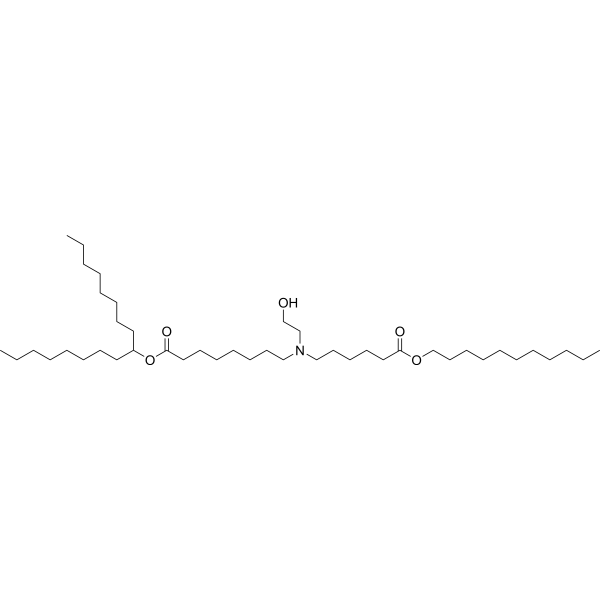
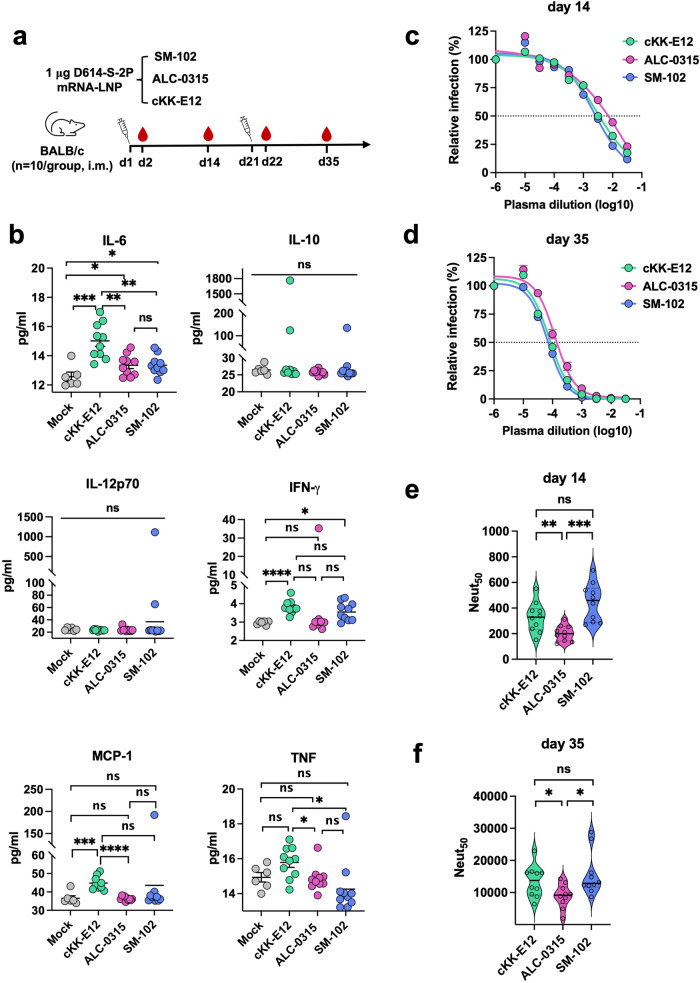
SM-102 is an ionizable lipid used in LNP research for mRNA delivery. A controlled mouse study compared SM-102 with ALC-0315 and cKK-E12 using matched helper lipids, measuring intramuscular reporter expression, antibody responses, inflammatory markers and storage-dependent potency.
Research category: Ionizable lipids for in vivo T-cell engager
SM-102 LNPs delivered self-amplifying RNA encoding a CLDN6 nanobody-based T-cell engager, with circulating expression and antitumor studies in mice. Route: Intravenous.
DC Chemicals can supply SM-102 (DC52025) as a GMP-grade ionizable lipid material for customer toxicology programs and clinical-stage formulation development. Kg-scale production capability is available for qualified projects, subject to technical review, batch planning, quality agreement and batch-specific release requirements.
Available with batch-specific identity, purity, residual-solvent, water, elemental-impurity, endotoxin and bioburden testing. Quality documentation can be aligned with the customer's qualification package.
Suitable as a lipid raw material for customer-led toxicology studies and clinical-stage formulation development. Final suitability remains subject to the customer's formulation, QA and regulatory assessment.
Production can be planned from research quantities through kilogram scale, with project-specific lead time, batch size, analytical release testing and packaging arranged in advance.
Issued COA: Lot C10101-N250301; manufacture date 20 March 2025; retest date 19 March 2027. Refer to the issued certificate for batch-specific quality results.
COA & quality informationQuality and regulatory note: “GMP-grade” describes the grade of the supplied lipid material and its supporting quality documentation. It does not mean that this lipid itself is an approved drug substance or regulatory-authorized clinical material. Customers remain responsible for qualification, formulation, sterility strategy, release criteria and regulatory use.
Open full Formulation & Performance →
The study uses a PEG phospholipid. Its controlled formulation and storage results should not be substituted for the composition or stability of commercial vaccines.
Reported performance refers to the complete research formulation and the stated experimental model.
| Component | DC Chemicals product | Molecular weight | Molar ratio | Mass at 1 µmol total lipid (mg) |
|---|---|---|---|---|
| SM-102 | DC52025 | 710.1653 | 50 | 0.355083 |
| DSPC | DC57005 | 790.15 | 10 | 0.079015 |
| Cholesterol | DCD-041 | 386.65 | 38.5 | 0.148860 |
| PEG2000 PE (14:0 in Methods) | Not uniquely mapped | Not established | 1.5 | Not calculable from disclosed data |
SM-102/DSPC/cholesterol/PEG2000 PE = 50:10:38.5:1.5 mol%; N/P = 4. Methods identify 14:0 PEG2000 PE, whereas the Fig. 1 caption expands the name as a dioleoyl species. Because of this identity inconsistency, the PEG component is not assigned a catalog or molecular weight. It is not replaced by DMG-PEG2000 in this table or calculator.
Not all inputs are assigned to a single verified study formulation; unassigned fields are blank. Enter your own values to calculate a research scenario. Molecular weights and ratios are editable. Results are calculated, not measured study data. No N/P or RNA dose is inferred.
| Component | MW | Molar ratio | Mass (mg) | Mass % |
|---|---|---|---|---|
| SM-102 | ||||
| DSPC | ||||
| Cholesterol | ||||
| PEG2000 PE (14:0 in Methods) |
| Experiment / parameter | Study conditions | Result / interpretation |
|---|---|---|
| Particle size | Matched luciferase-mRNA LNPs; Fig. 1c | SM-102: 75.5 ± 0.4 nm; ALC-0315: 90.2 ± 7.8 nm; cKK-E12: 88.2 ± 1.5 nm. |
| RNA encapsulation | Fig. 1d | All three formulations exceeded 95%. |
| Apparent pKa | Fig. 1a | The displayed SM-102 pKa is cited background information, not a new pKa measurement in this study. |
| Experiment / parameter | Study conditions | Result / interpretation |
|---|---|---|
| Model and dose | BALB/c mice; 1 µg luciferase mRNA IM; 24 h; n = 6 | Two independent LNP preparations were used per group (Fig. 1e,f). |
| Expression comparison | Matched helper-lipid formulation | Mean bioluminescence for SM-102 was 60% higher than the comparator formulations. ALC-0315 and cKK-E12 were similar under these conditions. |
| Experiment / parameter | Study conditions | Result / interpretation |
|---|---|---|
| Antibody comparison | 1 µg antigen mRNA IM, days 1 and 21; n = 10; readouts days 14 and 35 | SM-102 induced higher neutralizing-antibody responses than ALC-0315 (Fig. 2e,f). Reporter expression alone does not predict antibody output. |
| Inflammatory panel | Plasma 24 h after prime and boost | SM-102 and ALC-0315 had comparable cytokine/chemokine responses; cKK-E12 elicited stronger responses for several markers (Fig. 2b; Supplementary Fig. 1). |
| Scope | Short-term mouse biomarker panel | This is not a comprehensive toxicology assessment or evidence of zero inflammatory activity. |
| Experiment / parameter | Study conditions | Result / interpretation |
|---|---|---|
| Study design | Luciferase-mRNA LNPs in PBS with 10% sucrose; 4°C versus −80°C | Follow-up extended to 20 weeks; protein expression, size and encapsulation were measured (Fig. 4). |
| Refrigerated storage | 4°C | Expression declined after approximately 4–8 weeks; aggregation became evident around 8–12 weeks. SM-102 retained potency better than ALC-0315. |
| Frozen storage | −80°C | Expression was maintained across the study period. |
| Encapsulation versus function | Fig. 4b–e | Encapsulation remained high despite potency loss at 4°C. Encapsulation alone is therefore insufficient to establish retained delivery activity. |
| Experiment / parameter | Study conditions | Result / interpretation |
|---|---|---|
| Matched comparison | Same helper-lipid mixture across ionizable lipids | The study supports a comparison of the tested research formulations, not a comparison of marketed vaccine shelf lives. |
| PEG identity | Methods versus Fig. 1 caption | The unresolved PEG naming difference is retained explicitly; DMG-PEG2000 molecular weight 2507 is not used for this phospholipid. |
Storage-dependent expression and particle properties — Figure 4 — Original source figures.
| CAS No. | 2089251-47-6 |
| Chemical Name | SM-102 |
| Synonyms | SM-102;SM 102;SM102 |
| SMILES | O=C(OC(CCCCCCCC)CCCCCCCC)CCCCCCCN(CCO)CCCCCC(OCCCCCCCCCCC)=O |
| Formula | C44H87NO5 |
| M.Wt | 710.1653 |
| Purity | >95% by ELSD-HPLC |
| Storage | Pure form: −20 °C, 1 year; In solvent: −80 °C, 6 months; −20 °C, 1 month. Sealed and protected from light. |
| Shipping condition | Ships from Shanghai. Pure lipid is stable during ice-pack transport. |
| Publication |
The product molecular weight is prefilled when available and remains editable. Confirm solvent compatibility and solubility before preparation.
Do not substitute DMG-PEG2000 or ALC-0159 for 14:0 PEG2000 PE. N/P 4 is distinct from a lipid:mRNA mass ratio.
Solvent volumes update from the molecular weight above.
| Mass | 1 mM | 5 mM | 10 mM |
|---|---|---|---|
| 10 mg | 14.0812 mL | 2.8162 mL | 1.4081 mL |
| 25 mg | 35.2031 mL | 7.0406 mL | 3.5203 mL |
| 50 mg | 70.4061 mL | 14.0812 mL | 7.0406 mL |
| 100 mg | 140.8123 mL | 28.1625 mL | 14.0812 mL |
| 250 mg | 352.0307 mL | 70.4061 mL | 35.2031 mL |
Contact our team with the catalog number and requested quantity.