SM-102
DC52025
Recommended because it shares a closely related research category or delivery context. Formulation and performance are product- and study-specific.
View product →
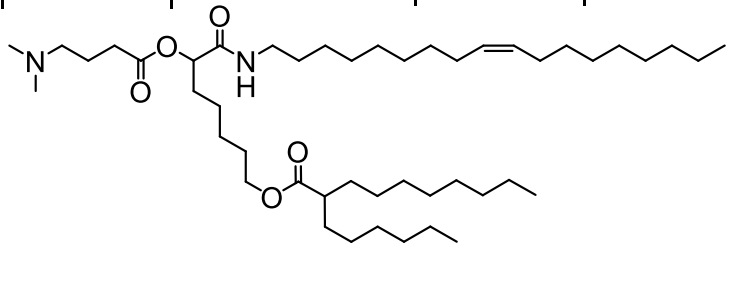
A4B4-S3 is an ionizable lipid studied for mRNA expression, liver Cre-reporter activation and repeated delivery of hEPO mRNA. Published evidence includes an apparent LNP pKa of 6.912, intramuscular reporter comparisons and liver-focused repeat-dose tolerability.
Open full Formulation & Performance →
The 2025 PNAS study evaluates A4B4-S3 separately from H2A4B4 and A4B4-S4. The page distinguishes screening, Cre reporter activation and hEPO expression, and preserves the reported PEG identity uncertainty.
DC60782 refers to A4B4-S3. Its formula C47H90N2O5 and catalog MW 763.246 are retained. H2A4B4 and A4B4-S4 are comparator lipids; their mechanistic data are not automatically assigned to S3.
| Component | DC Chemicals product | Molecular weight | Molar ratio | Mass at 1 µmol total lipid (mg) |
|---|---|---|---|---|
| A4B4-S3 | DC60782 | 763.246 | 50 | 0.381623 |
| DSPC | DC57005 | 790.15 | 10 | 0.079015 |
| Cholesterol | DCD-041 | 386.65 | 38.5 | 0.148860 |
| C14-PEG2000 (source identity unresolved) | Not uniquely mapped | Not established | 1.5 | Not calculable from disclosed data |
Main Methods: A4B4-S3 / DSPC / cholesterol / C14-PEG2000 = 50:10:38.5:1.5 mol%. The source describes a phosphoethanolamine-based C14-PEG identity; a unique commercial mapping was not established. Its MW is therefore blank rather than replaced with DMG-PEG2000 2507. N/P and total lipid:RNA mass ratio are not assigned.
Not all inputs are assigned to a single verified study formulation; unassigned fields are blank. Enter your own values to calculate a research scenario. Molecular weights and ratios are editable. Results are calculated, not measured study data. No N/P or RNA dose is inferred.
| Component | MW | Molar ratio | Mass (mg) | Mass % |
|---|---|---|---|---|
| A4B4-S3 | ||||
| DSPC | ||||
| Cholesterol | ||||
| C14-PEG2000 (source identity unresolved) |
| Study / parameter | Reported evidence | Source / interpretation |
|---|---|---|
| Apparent pKa | 6.912 for A4B4-S3 LNPs | Main Fig. 3k; TNS-based LNP measurement |
| Spacer comparators | H2A4B4 pKa 6.792; A4B4-S4 pKa 7.327 | Main Fig. 3j–l; separate formulations |
| Candidate SI row | H3A4B4 row: MW 763.25; size 130.6 nm; PDI 0.212; EE 91.87% | SI Table S1, printed p.20; source label is H3A4B4 |
| Mapping limit | H3A4B4-to-S3 correspondence is inferred from the three-carbon spacer and formula | These row values are retained as a candidate cross-reference, not unqualified S3 release specifications |
| Study / parameter | Reported evidence | Source / interpretation |
|---|---|---|
| Intramuscular luciferase comparison | 0.05 mg/kg mRNA; 6 h; n = 3 | Main Fig. 3h–i and Methods |
| Expression result | A4B4-S3 outperformed H2A4B4 and A4B4-S4 in the reported experiment | No numerical fold change is inferred from figure heights |
| Cellular viability | WST-8 assay used to assess cytotoxicity | SI Fig. S11; source reports no significant cytotoxicity relative to SM-102 |
| Immune reporter assays | NF-κB-SEAP and IRF-Lucia used to assess immune activation | SI Fig. S11; assay-limited evidence, not universal nonimmunogenicity |
| Study / parameter | Reported evidence | Source / interpretation |
|---|---|---|
| Study design | Ai9 mice; retro-orbital IV Cre mRNA 0.5 mg/kg on days 0 and 3; analysis day 5; n = 3 | Main Fig. 5a–d |
| CD45− / CD31− population | 56% reporter-positive with A4B4-S3 versus 48% with SM-102 | Main Results; marker-defined population, not an independently validated hepatocyte-purity claim |
| Immune cells | 34% versus 28% reporter-positive | Main Results; separate population |
| Other populations | Endothelial and selected immune subtypes showed comparable activity to SM-102 | Main Fig. 5d and SI Fig. S13 |
| Endpoint | Cre-mediated tdTomato activation | Not Cas9 indels or sequence-level disease correction |
| Study / parameter | Reported evidence | Source / interpretation |
|---|---|---|
| Initial comparison | Retro-orbital IV hEPO mRNA 0.25 mg/kg; plasma measurement at 6 h; n = 8 reported in Fig. 5f | A4B4-S3 produced the highest hEPO concentration among S3, S4 and SM-102 |
| Repeat-dose design | 0.25 mg/kg every 7 days for five administrations | Main Fig. 5g |
| Kinetics | Plasma measured over 0–48 h; peak expression was observed after each administration | No persistent five-week plateau is claimed |
| Sampling detail | Methods describe two mice per kinetic collection time, eight across the 6/12/24/48 h points | This is not n = 8 independently sampled at every kinetic point |
| Interpretation | Repeated protein expression supports re-dosing feasibility in this mouse study | Not correction of anemia or a demonstrated clinical effect |
| Study / parameter | Reported evidence | Source / interpretation |
|---|---|---|
| Biochemistry | Serum ALT and AST evaluated after repeated hEPO LNP dosing | SI Fig. S14a–b |
| Histology | Liver H&E sections examined | SI Fig. S14c |
| Reported outcome | No significant biochemical or histological abnormalities reported under tested conditions | Main text and SI Fig. S14 |
| Boundaries | No complete systemic NOAEL, primate study or human safety conclusion established | Cannot extrapolate to every formulation, route or RNA cargo |
Main Figs. 3 and 5: expression, pKa, liver reporter cells and hEPO kinetics — Original source figures.
Supporting Figs. S11–S14: cell assays, flow gating and repeat-dose liver tolerability — Original source figures.
| CAS No. | Not available |
| Chemical Name | Lipid A4B4-S3 |
| Synonyms | Lipid A4B4 S3 |
| SMILES | CCCCCCCC/C=C\CCCCCCCCNC(=O)C(CCCCCOC(=O)C(CCCCCC)CCCCCCCC)OC(=O)CCCN(C)C |
| Formula | C47H90N2O5 |
| M.Wt | 763.246 |
| Purity | >95% by ELSD-HPLC |
| Storage | Pure form: −20 °C, 1 year; In solvent: −80 °C, 6 months; −20 °C, 1 month. Sealed and protected from light. |
| Shipping condition | Ships from Shanghai. Pure lipid is stable during ice-pack transport. |
| Publication |
The product molecular weight is prefilled when available and remains editable. Confirm solvent compatibility and solubility before preparation.
Solvent volumes update from the molecular weight above.
| Mass | 1 mM | 5 mM | 10 mM |
|---|---|---|---|
| 10 mg | 13.1019 mL | 2.6204 mL | 1.3102 mL |
| 25 mg | 32.7548 mL | 6.5510 mL | 3.2755 mL |
| 50 mg | 65.5097 mL | 13.1019 mL | 6.5510 mL |
| 100 mg | 131.0194 mL | 26.2039 mL | 13.1019 mL |
| 250 mg | 327.5484 mL | 65.5097 mL | 32.7548 mL |
Contact our team with the catalog number and requested quantity.