Lipid TOT-5
DC60821
Recommended because it shares a closely related research category or delivery context. Formulation and performance are product- and study-specific.
View product →
Components are supplied separately; this is not a premixed LNP. RNA/cargo, buffer and formulation service are not included.
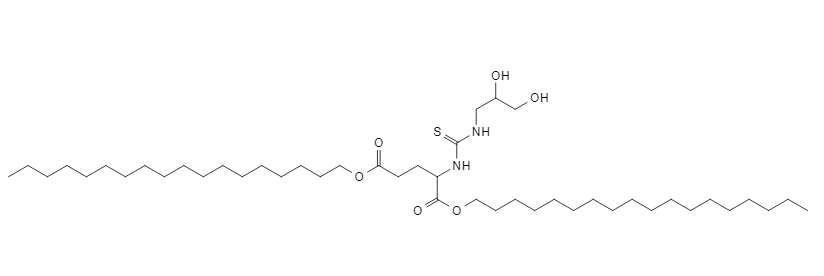
C18 NC-TNP is a noncationic thiourea lipid studied in a two-component mRNA carrier with cholesterol. Published mouse experiments report prolonged expression after subcutaneous injection, lymph-node immune-cell delivery and spleen-associated distribution after intravenous injection.
Open full Formulation & Performance →
C18 NC-TNP uses a noncationic delivery concept. Subcutaneous expression, intravenous distribution and immune responses are reported as distinct endpoints.
Reported performance refers to the complete research formulation and the stated experimental model.
| Component | DC Chemicals product | Molecular weight | Molar ratio | Mass at 1 µmol total lipid (mg) |
|---|---|---|---|---|
| C18 NC-TNP | DC60537 | 785.274 | 60 | 0.471164 |
| Cholesterol | DCD-041 | 386.65 | 40 | 0.154660 |
Noncationic thiourea lipid/cholesterol = 60:40 mol%. Source: main Methods, preparation of NC-TNP. The carrier does not use the four-component SM-102 comparator composition. N/P is not assigned to this hydrogen-bond-based noncationic formulation.
Prefilled proportions follow the source specified above. Molecular weights and ratios are editable. Results are calculated, not measured study data. No N/P or RNA dose is inferred.
| Component | MW | Molar ratio | Mass (mg) | Mass % |
|---|---|---|---|---|
| C18 NC-TNP | ||||
| Cholesterol |
| Experiment / parameter | Study conditions | Result / interpretation |
|---|---|---|
| Composition | Two-component carrier | C18 thiourea lipid and cholesterol; the cited formulation contains no DSPC or PEG lipid. |
| Particle dimensions | Main Fig. 1C | Approximately 100 nm; exact PDI and final encapsulation percentage are not inferred from plots. |
| Study comparator | SM-102/DSPC/cholesterol/DMG-PEG2000 | 50:10:38.5:1.5 mol%. This comparator is not the composition of C18 NC-TNP. |
| Experiment / parameter | Study conditions | Result / interpretation |
|---|---|---|
| Reporter delivery | DC2.4, B16 and 4T1 cells; EGFP mRNA; 1 µg/mL, 48 h | Higher reporter expression than the study LNP comparator was reported (main Fig. 1 and supplementary experiments). |
| Interpretation | Tested cell lines and conditions | The study supports a full-formulation comparison, not guaranteed superiority in all cell types or with every RNA. |
| Experiment / parameter | Study conditions | Result / interpretation |
|---|---|---|
| Luciferase duration | C57BL/6 mice; 0.5 mg/kg mRNA SC; Fig. 4A,B | Signal remained detectable at day 20; the comparator signal persisted for up to approximately 3 days. |
| Expression kinetics | Same SC study | The authors report approximately tenfold longer translation half-life. This is not a pharmacokinetic half-life for the isolated lipid. |
| Lymph-node functional delivery | Ai9 mice; 0.1 mg/kg Cre mRNA SC footpad; 48 h; Fig. 4C | More than 14% of dendritic cells were reporter-positive, approximately twice the comparator. Other immune-cell populations were evaluated separately. |
| Experiment / parameter | Study conditions | Result / interpretation |
|---|---|---|
| Organ distribution | Cy5-labelled carriers; 0.5 mg/kg mRNA IV; Fig. 4D–F | Greater spleen-associated signal than the comparator. Label distribution is not equivalent to productive mRNA expression. |
| Antigen-specific response | OVA mRNA SC; 1 mg/kg; day 14 assessment; Fig. 5 | Enhanced dendritic-cell activation and antigen-specific T-cell responses were reported. |
| Memory response | OVA schedule days 0, 7 and 14; assessment day 60 | Supplementary experiments report memory and recall endpoints. These are antigen-model mouse findings, not clinical protection data. |
| Experiment / parameter | Study conditions | Result / interpretation |
|---|---|---|
| Route-specific inflammation | 20 µg/mouse; intradermal, intramuscular or intravenous; day 3 | The carrier produced lower inflammatory responses than the study LNP comparator under the tested conditions (Figs. 2–3). |
| Storage experiment | Liquid and lyophilized formulations at 4°C for 30 days; Fig. 1E–G | Relative reporter expression and particle changes were evaluated; activity retention was better than the comparator. |
| Scope | Research formulation | Lower measured inflammation does not mean zero toxicity. Storage observations are not the shelf-life specification of the supplied neat lipid. |
Cell expression, inflammation, SC expression and IV distribution: Figures 1–5 — Original source figures.
| CAS No. | Not available |
| Chemical Name | C18 NC-TNP |
| Synonyms | C18 NC TNP , C18NCTNP |
| SMILES | CCCCCCCCCCCCCCCCCCOC(=O)CCC(C(=O)OCCCCCCCCCCCCCCCCCC)NC(NCC(O)CO)=S |
| Formula | C45H88O6N2S |
| M.Wt | 785.274 |
| Purity | >95% by ELSD-HPLC |
| Storage | Pure form: −20 °C, 1 year; In solvent: −80 °C, 6 months; −20 °C, 1 month. Sealed and protected from light. |
| Shipping condition | Ships from Shanghai. Pure lipid is stable during ice-pack transport. |
| Publication |
The product molecular weight is prefilled when available and remains editable. Confirm solvent compatibility and solubility before preparation.
Solvent volumes update from the molecular weight above.
| Mass | 1 mM | 5 mM | 10 mM |
|---|---|---|---|
| 10 mg | 12.7344 mL | 2.5469 mL | 1.2734 mL |
| 25 mg | 31.8360 mL | 6.3672 mL | 3.1836 mL |
| 50 mg | 63.6720 mL | 12.7344 mL | 6.3672 mL |
| 100 mg | 127.3441 mL | 25.4688 mL | 12.7344 mL |
| 250 mg | 318.3602 mL | 63.6720 mL | 31.8360 mL |
Contact our team with the catalog number and requested quantity.