Research-use LNP lipids · Technical support from formulation through scale-up
Home  /  RNA Delivery  /  Spleen-targeted lipids  /  113-AA-C8C14
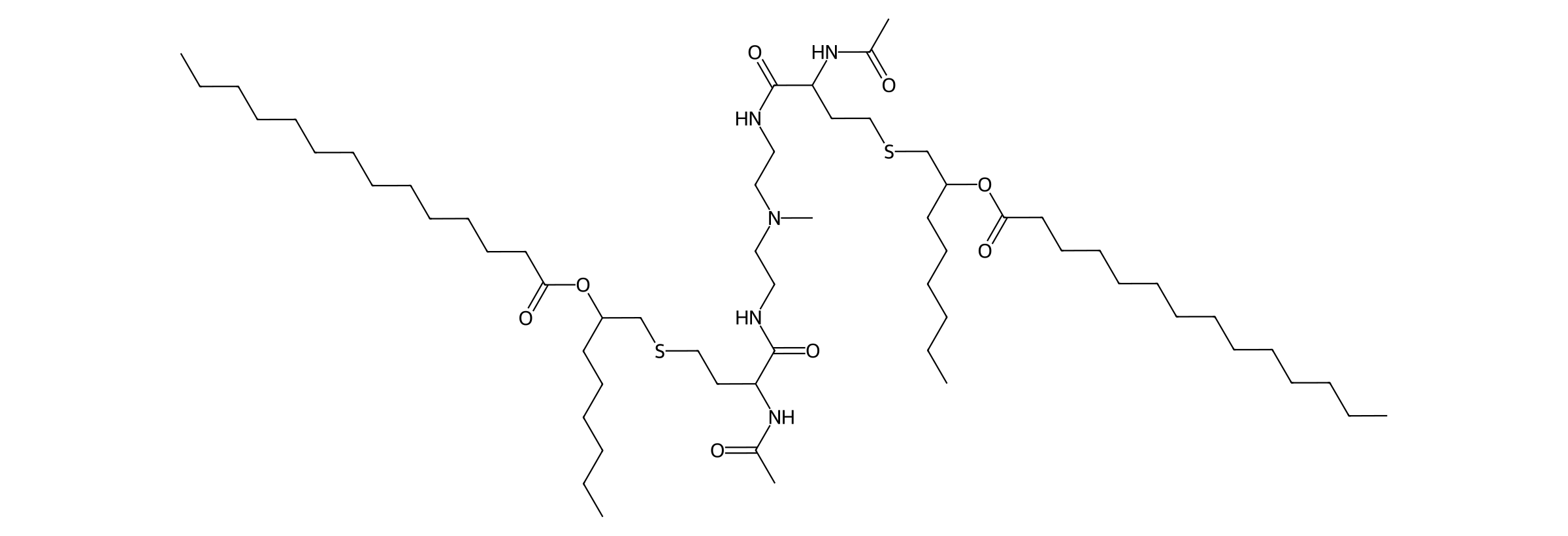
Standardized two-dimensional chemical structure of 113-AA-C8C14 View larger
Literature-verified standardized 2D structure · stereochemistry not specifiedFor research use only. We do not sell to patients.
CAT. NO. DC60942
Featured

113-AA-C8C14

β-Hydroxy thioether-derived ionizable lipid selected for spleen-tropic mRNA delivery and in vivo CAR-T cell engineering research.

Research highlights
Spleen-tropic mRNA deliveryIn vivo CAR-T engineeringβ-Hydroxy thioether designSystemic administration study
Literature-reported LNP dataNot a product specification or performance guarantee.View source

Available sizes & price

USD · research grade
Supporting components
DOPE DC33634 · 100 mg+Cholesterol DCD-041 · 100 mg+DMG-PEG2000 DC40169 · 100 mg

Components are supplied separately; this is not a premixed LNP. RNA/cargo, buffer and formulation service are not included.

SelectedPack size on request × 1
We match the best price and quality on market.
Ships from ShanghaiIce-pack transportPure lipid recommended
Description & Application

Spleen-tropic ionizable lipid for systemic mRNA delivery research

113-AA-C8C14 is a β-hydroxy thioether-derived ionizable lipid identified through a two-stage lipid-library screen. In the cited study, its optimized LNP formulation preferentially delivered mRNA to the spleen after intravenous administration and was evaluated for transient in vivo generation of CD19-targeting CAR T cells. All formulation and performance data below are literature-reported and remain specific to the stated cargo, preparation process, dose, animal model and administration route.

Lead selectionTop performer from a two-stage lipid screen
Formulation contextFour-component B-2 LNP formulation
Organ tropismSpleen-selective delivery after i.v. dosing
RNA cargoLuciferase mRNA and CD19-CAR mRNA
Product data

Technical details and supporting files

Specifications

PropertyValue
CAS No.Not assigned
Chemical Name113-AA-C8C14
SynonymsNot reported
SMILESCCCCCCCCCCCCCC(=O)OC(CCCCCC)CSCCC(NC(C)=O)C(=O)NCCN(C)CCNC(=O)C(CCSCC(CCCCCC)OC(=O)CCCCCCCCCCCCC)NC(C)=O
FormulaC61H117N5O8S2
M.Wt1112.768 g/mol
Purity98%
StoragePure form: −20 °C, 1 year. In solvent: −80 °C, 6 months; −20 °C, 1 month. Keep sealed and protected from light.
Shipping conditionPure lipid, shipped from Shanghai with ice packs.
PublicationGuo Q, Zhang Y, Yang X, et al. β-Hydroxy Thioether-Derived Ionizable Lipids for Spleen-Tropic mRNA Delivery and In Vivo Chimeric Antigen Receptor T Cell Engineering. ACS Nano. 2026;20:14602–14614. DOI: 10.1021/acsnano.6c00706

Documentation

Literature-reported optimized formulation B-2

ComponentMolar ratioRole
113-AA-C8C1435Ionizable lipid
DOPE16Helper phospholipid
Cholesterol46.5Sterol lipid
DMG-PEG20000.5PEG lipid
Ratio reporting noteThe values above are the nominal molar-ratio factors reported for formulation B-2 in Supporting Fig. S12. Their reported total is 98; the calculator below normalizes them automatically while preserving the published relative proportions.

Formulation weight calculator

The B-2 formulation and available component molecular weights are pre-filled. Edit any molecular weight or molar ratio when using a different material.

Literature ratio: 35 : 16 : 46.5 : 0.5. Calculation normalizes the four values to 100 mol%.
ComponentMolecular weight (g/mol)Literature molar ratio
113-AA-C8C14
DOPE
Cholesterol
DMG-PEG2000
Calculated component requirements
ComponentNormalized mol%Amount (μmol)Required weight (mg)
Total100.000%

Calculation aid for research planning. DMG-PEG2000 is polydisperse; confirm the molecular weight stated for the exact material or batch. The result covers lipid component weights only and does not include RNA, buffer, solvent, process loss or N/P ratio.

Not reported in the cited study
Luciferase mRNA / CD19-CAR mRNA
Intravenous, tail vein
Female C57BL/6 mice
0.1 mg/kg · 6 h readout
CD19-Panc02 subcutaneous tumor
0.5 mg/kg (10 µg), 4 i.v. doses
Reported preparation contextThe four lipids were dissolved together in ethanol; mRNA was dissolved in citrate buffer at pH 4. For in vivo studies, the phases were combined with a microfluidic device at a 3:1 ethanol-to-aqueous flow-rate ratio. LNPs were dialyzed in PBS for 6 h using a 20 kDa MWCO cassette before use.

Literature-reported performance for the cited formulation

Fig. S1490.3 ± 3.0%RiboGreen assay
Fig. S1496.7 ± 1.0 nmDLS hydrodynamic size
Fig. S140.09 ± 0.05DLS
Fig. S14−16.7 ± 0.2 mVDLS
Fig. S146.66LNP value · TNS assay
Fig. S1357-foldvs Dlin-MC3-DMA spleen SORT · luciferase mRNA
Fig. S137-foldvs Dlin-MC3-DMA spleen SORT
Fig. 4 / S232.3-foldimprovement vs comparator LNP
Fig. 4H–I2.7× / 3.5×CD8+ / CD4+ infiltration vs comparator
Fig. 4C>50% at day 30comparator median survival: 22 days
Literature Data DisclaimerAll formulation parameters and performance values shown in this section are derived from the cited publication and are provided for reference only. These results were obtained using the specific materials, formulation process, cargo, dose, analytical method, cell or animal model, and administration route described in that study. Unless otherwise stated, the data were not generated or independently verified by DC Chemicals. DC Chemicals supplies the lipid compound only and does not guarantee that customers will reproduce the reported LNP properties or biological performance.

The administration route shown above was used in the cited study and is not a clinical-use instruction or recommendation by DC Chemicals.
Cited literature for this formulation and performance datasetGuo Q, Zhang Y, Yang X, et al. β-Hydroxy Thioether-Derived Ionizable Lipids for Spleen-Tropic mRNA Delivery and In Vivo Chimeric Antigen Receptor T Cell Engineering. ACS Nano. 2026;20:14602–14614. DOI: 10.1021/acsnano.6c00706

Formulation: main text, Experimental Section and Supporting Figs. S11–S12. Physicochemical data: Supporting Fig. S14. In vivo performance: main Fig. 4 and Supporting Figs. S13 and S23–S36.
Lab tools

Solution calculators

Molarity calculator

Mass (g) = Concentration (mol/L) × Volume (L) × Molecular Weight (g/mol)

Pre-filled with the literature-verified average molecular weight: 1112.768 g/mol.

Dilution calculator

Concentration (start) × Volume (start) = Concentration (final) × Volume (final) · C₁V₁ = C₂V₂

Leave exactly one field blank. With the current values, V₁ will be calculated.
Preparing stock solutions

Quick preparation table

Volumes are pre-calculated using the literature-verified average molecular weight of 1112.768 g/mol. Formula: volume (mL) = mass (mg) × 1000 ÷ [molecular weight (g/mol) × concentration (mM)].

Mass1 mM5 mM10 mM
Ethanol is a common starting solvent; confirm product-specific solubility before preparation.
Handling guidance

Shipping, storage and sampling

We generally ship the neat (undissolved) lipid compound rather than an ethanol solution. The neat lipid is stable during transport with ice packs, and shipments originate from Shanghai. Pure form: store at −20 °C for up to 1 year. In solvent: store at −80 °C for up to 6 months or at −20 °C for up to 1 month. Keep sealed and protected from light. Avoid repeated thaw cycles for best results.
Pure lipid is generally more stable during shipping and storage, so we usually recommend the pure form. A solution in ethanol or chloroform can be supplied when required by your workflow. Tell us the intended application, solvent and target concentration so the most suitable format can be confirmed.
Ionizable lipids are often oily liquids or viscous semisolids, so material can be lost during repeated weighing or transfer. For a small pack, dissolve the entire quantity and aliquot it volumetrically. For example, add 1 mL ethanol to 25 mg lipid to prepare a 25 mg/mL stock, then use a pipette to withdraw the required amount. For quantities above 100 mg, direct weighing with an analytical balance may be more practical. Always confirm solvent compatibility and solubility first.
Yes. Share the RNA cargo, target tissue, administration route, formulation method and assay plan. Our team can discuss starting molar ratios, N/P ratio and scale-up requirements for research workflows.

Request 113-AA-C8C14

Tell us the required size, format and intended formulation. We will confirm price, availability and lead time.

Email order@dcchemicals.com