Lipid 8
DC86601
Recommended because it shares a closely related research category or delivery context. Formulation and performance are product- and study-specific.
View product →
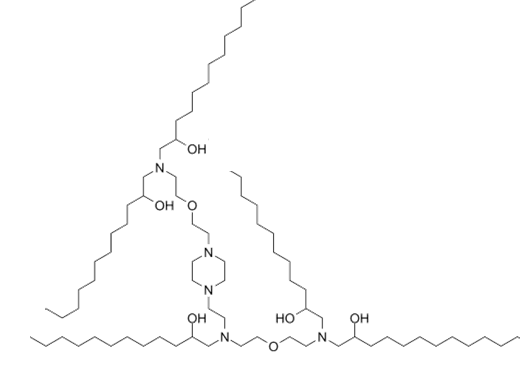
C12-4, mapped to A4 / C12-494 in the cited paper and companion patent, is an ionizable lipid studied for placental mRNA delivery in pregnant mice. A4 LNPs delivered reporter mRNA to trophoblast, endothelial and immune-cell populations and were evaluated with VEGF-A mRNA for placental vascular effects. The studies are preclinical and do not establish reproductive safety or clinical efficacy.
Open full Formulation & Performance →
Main-paper and companion-patent evidence for placental delivery, separated by reporter and therapeutic-protein experiment.
The catalog structure was compared with main Figure 1B. A4 and C12-494 are the evidence-linked names. The older Lipid F3 catalog alias is not independently confirmed by these sources. The original SI remains unavailable in this review.
| Component | DC Chemicals product | Molecular weight | Molar ratio | Mass at 1 µmol total lipid (mg) |
|---|---|---|---|---|
| A4 / C12-494 | DC89101 | 1225.04 | 35 | 0.428764 |
| DOPE | Not uniquely mapped | 744.03 | 16 | 0.119045 |
| Cholesterol | DCD-041 | 386.65 | 46.5 | 0.179792 |
| C14-PEG2000 (14:0 PEG2000 PE) | Not uniquely mapped | Not established | 2.5 | Not calculable from disclosed data |
Standard formulation described in companion patent WO2024081715A2, Materials and Methods, LNP formulation: 35:16:46.5:2.5 molar. Ionizable lipid:mRNA is 10:1 by weight; it is not N/P. C14-PEG2000 PE is not assumed to be DMG-PEG2000. PEG-component MW and commercial mapping remain unassigned.
Not all inputs are assigned to a single verified study formulation; unassigned fields are blank. Enter your own values to calculate a research scenario. Molecular weights and ratios are editable. Results are calculated, not measured study data. No N/P or RNA dose is inferred.
| Component | MW | Molar ratio | Mass (mg) | Mass % |
|---|---|---|---|---|
| A4 / C12-494 | ||||
| DOPE | ||||
| Cholesterol | ||||
| C14-PEG2000 (14:0 PEG2000 PE) |
| Item | Finding | Source |
|---|---|---|
| Particle size | 93.44 ± 1.18 nm for A4; C12-200 comparator 82.11 nm with its own variability. | Main text p. 7; Fig. 1D. |
| PDI, encapsulation, apparent pKa | Displayed graphically in Fig. 1D; exact numbers not transcribed. | No unlabelled visual estimates entered as measured values. |
| Identity | The main Figure 1B structure is consistent with the catalog connectivity. | Original SI analytical records not retrieved; no new batch identity/quality certification is implied. |
| Endpoint | A4 result | Context / source |
|---|---|---|
| Organ share of luminescence | Approximately 81% in placentas; less than 4% in liver. | E16 mice, 0.6 mg/kg luciferase mRNA IV; 6 h; Fig. 4E. Signal fraction is not particle biodistribution. |
| Fetal reporter | No fetal luciferase expression detected in the reported experiment. | Fig. 4; absence of detected signal is not proof of no fetal exposure. |
| Trophoblast mCherry positivity | 4.58%; comparator C12-200 3.02%, PBS 1.57%. | 1 mg/kg mCherry mRNA IV; 12 h; Fig. 5. |
| Endothelial mCherry positivity | 3.34%; comparator C12-200 2.44%, PBS 1.45%. | Same experiment; Fig. 5. |
| Immune-cell mCherry positivity | 4.11%; comparator C12-200 2.99%, PBS 1.68%. | Same experiment; n=5 biological mice with multiple placentas per mouse. |
| Outcome | Finding | Context |
|---|---|---|
| VEGFR1 staining | Increased positive area versus PBS; difference from C12-200 did not reach significance (p=0.10). | E16 healthy pregnant mice; 1 mg/kg VEGF-A mRNA; 48 h; Fig. 7. |
| Vessel area | Larger mean fetal blood-vessel area in placental sections after A4 VEGF-A LNP treatment. | Fig. 7; n=3 mice and multiple images per animal. Images are nested measurements, not independent animals. |
| Interpretation | Evidence of a vascular response in a healthy pregnancy model. | Not a demonstrated cure of pre-eclampsia or another pregnancy disorder. |
| Endpoint | Finding |
|---|---|
| ALT / AST | At 48 h, ALT was not significantly elevated for either A4 or C12-200 vs PBS. C12-200 increased AST relative to PBS and A4. |
| Placental cytokines | Acute elevations at 6 h resolved by 48 h in the measured cytokine panel. |
| Boundary | Short-term findings in healthy pregnant mice do not establish developmental, reproductive or long-term safety. |
| Missing evidence | Original supporting information remains blocked. No exact graph-only particle values or additional SI-only results are invented. |
Main Figures 6-7 and associated text.
Original biological figures 3-7 — Original source figures.
| CAS No. | 2639634-71-0 |
| Chemical Name | C12-4 (Lipid A-4,Lipid F3,C12-494) |
| Synonyms | 2-Dodecanol, 1,1′-[[2-[2-[4-[2-[[2-[2-[bis(2- hydroxydodecyl)amino]ethoxy]ethyl](2- hydroxydodecyl)amino]ethyl]-1-piperazinyl] ethoxy]ethyl]imino]bis-,C12-4 (C12-494,Lipid A-4) ;C124, C12 4 |
| SMILES | CCCCCCCCCCC(O)CN(CCOCCN(CC(O)CCCCCCCCCC)CC(O)CCCCCCCCCC)CCN1CCN(CCOCCN(CC(O)CCCCCCCCCC)CC(O)CCCCCCCCCC)CC1 |
| Formula | C74H153N5O7 |
| M.Wt | 1,225.04 |
| Purity | >95% by ELSD-HPLC |
| Storage | Pure form: −20 °C, 1 year; In solvent: −80 °C, 6 months; −20 °C, 1 month. Sealed and protected from light. |
| Shipping condition | Ships from Shanghai. Pure lipid is stable during ice-pack transport. |
| Publication |
The product molecular weight is prefilled when available and remains editable. Confirm solvent compatibility and solubility before preparation.
Solvent volumes update from the molecular weight above.
| Mass | 1 mM | 5 mM | 10 mM |
|---|---|---|---|
| 10 mg | 8.1630 mL | 1.6326 mL | 816.30 μL |
| 25 mg | 20.4075 mL | 4.0815 mL | 2.0407 mL |
| 50 mg | 40.8150 mL | 8.1630 mL | 4.0815 mL |
| 100 mg | 81.6300 mL | 16.3260 mL | 8.1630 mL |
| 250 mg | 204.0750 mL | 40.8150 mL | 20.4075 mL |
Contact our team with the catalog number and requested quantity.