C12-4 (Lipid A-4,Lipid F3,C12-494)
DC89101
Recommended because it shares a closely related research category or delivery context. Formulation and performance are product- and study-specific.
View product →
Ionizable lipid for LNP and nucleic-acid delivery research.
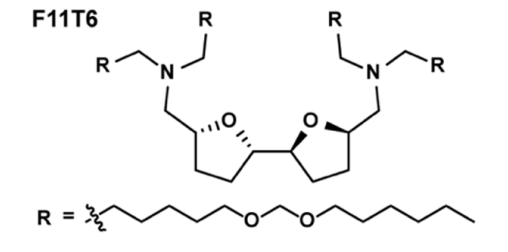
F11T6 is a next-generation lipid nanoparticle (LNP) optimized for ultra-efficient neuron-targeted mRNA delivery, featuring a dual-tetrahydrofuran (THF) core and four pH-responsive acetal tails. Its unique bis-THF architecture enhances lipid bilayer stability and promotes brain-specific biodistribution, achieving 16.4% GFP+ neurons in vivo—the highest reported among CNS-targeting LNPs. Cryo-EM reveals a compact spherical structure (Ø~150 nm) with 93.2% mRNA encapsulation efficiency, while THF-acetal synergy enables rapid endosomal escape (Pearson coefficient: 0.16 vs. 0.27 for F10T5). Preclinical studies show F11T6 leverages meningeal lymphatic transport for brain accumulation, yielding 13.0% neuron-specific tdTomato expression in Ai14 mice, surpassing F10T5 (8.93%) and SM102 (0.1%). Mechanistically, the dual-THF core strengthens interactions with lipoprotein receptors on brain endothelial cells, whereas acetal tails undergo acid-triggered hydrolysis in endosomes, releasing mRNA into the cytoplasm. Despite slightly higher liver/spleen accumulation than F10T5, toxicology assessments confirm no hepatorenal toxicity (BUN/ALT/AST within normal ranges) or histopathological changes. Co-localization analyses demonstrate superior penetration into deep brain regions like the hippocampus, critical for treating neurodegenerative disorders. With a LogD of 12.3, F11T6 balances lipid solubility and biodegradability, outperforming clinical benchmarks in both efficiency (40× SM102) and neuron specificity. This platform holds transformative potential for delivering CRISPR-Cas9, siRNA, or neurotrophic factors, particularly in diseases demanding high-dose CNS transfection with minimal off-target effects.
| CAS No. | Not available |
| Chemical Name | Lipid F11T6 |
| Synonyms | Lipid-F11T6 |
| SMILES | CCCCCCOCOCCCCCCCN(CCCCCCCOCOCCCCCC)C[C@H]1CC[C@@H]([C@@H]2CC[C@H](CN(CCCCCCCOCOCCCCCC)CCCCCCCOCOCCCCCC)O2)O1 |
| Formula | C66H132O10N2 |
| M.Wt | 1,113.79 |
| Purity | 98% |
| Storage | Pure form: −20 °C, 1 year; In solvent: −80 °C, 6 months; −20 °C, 1 month. Sealed and protected from light. |
| Shipping condition | Ships from Shanghai. Pure lipid is stable during ice-pack transport. |
| Publication | Not available |
The product molecular weight is prefilled when available and remains editable. Confirm solvent compatibility and solubility before preparation.
Solvent volumes update from the molecular weight above.
| Mass | 1 mM | 5 mM | 10 mM |
|---|---|---|---|
| 10 mg | 8.9784 mL | 1.7957 mL | 897.84 μL |
| 25 mg | 22.4459 mL | 4.4892 mL | 2.2446 mL |
| 50 mg | 44.8918 mL | 8.9784 mL | 4.4892 mL |
| 100 mg | 89.7835 mL | 17.9567 mL | 8.9784 mL |
| 250 mg | 224.4588 mL | 44.8918 mL | 22.4459 mL |
Contact our team with the catalog number and requested quantity.