Research-use LNP lipids · Technical support from formulation through scale-up
Home  /  RNA Delivery  /  Brain-targeted lipids  /  Lipid TD5
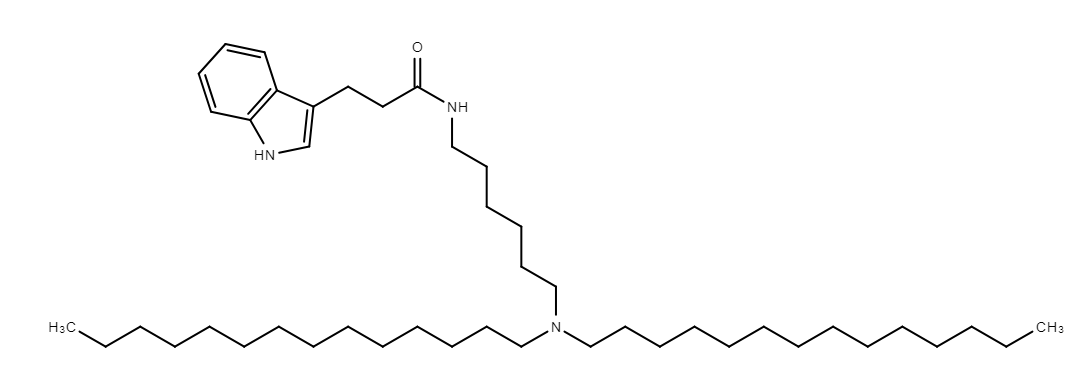
Chemical structure of Lipid TD5 View larger
Verified 2D structureFor research use only. We do not sell to patients.
CAT. NO. DC67521
Featured

Lipid TD5

Tryptamine-derived ionizable lipid studied for brain-targeted LNP mRNA delivery via intrathecal administration.

Research highlights
Brain-targeted mRNA deliveryIntrathecal administration studyNeuronal and astrocyte transfectionTryptamine-derived ionizable lipid
Literature-reported LNP dataNot a product specification or performance guarantee.View source

Available sizes & price

USD · research grade
Supporting components
DOPE DC33634 · 100 mg+Cholesterol DCD-041 · 100 mg+DMG-PEG2000 DC40169 · 100 mg

Components are supplied separately; this is not a premixed LNP. RNA/cargo, buffer and formulation service are not included.

Selected · total price25 mg × 1 · $700
We match the best price and quality on market.
Ships from ShanghaiIce-pack transportPure lipid recommended
Description & Application

Brain-targeted ionizable lipid for CNS mRNA research

TD5 is a tryptamine-derived ionizable cationic lipid used to prepare LNPs for mRNA delivery. In the reported formulation, TD5 supported pH-dependent mRNA encapsulation and CNS delivery after intrathecal administration. Reported performance values below remain tied to the stated formulation and study conditions; they should not be compared across methods without reviewing those conditions.

Formulation contextFour-component LNP reported
Defined structureC₄₅H₈₁N₃O · MW 680.16
CNS researchIntrathecal administration studied
RNA cargomRNA and gene-editing workflows
Core parameter · pKa

The TD5 pH switch

An apparent pKa of 7.30 was reported for the formulated LNP. The value is presented with its measurement context in Product data.

Bloodstream · pH 7.4

Near-neutral surface

Reduced nonspecific electrostatic interactions while the nanoparticle travels through biological fluid.

Endosome · acidic pH

Progressive protonation

Ionizable amines gain charge as pH falls, supporting interaction with endosomal membranes.

Cytosol

Cargo release

Membrane disruption and escape allow encapsulated RNA to reach the cytosol for expression.

Product data

Technical details and supporting files

Specifications

PropertyValue
CAS No.2855180-86-6
Chemical NameLipid TD5
SynonymsLipid-TD5; TD5; TD-5
SMILESCCCCCCCCCCCCCCN(CCCCCCCCCCCCCC)CCCCCCNC(=O)CCC1=CNC2=CC=CC=C12
FormulaC45H81N3O
M.Wt680.16 g/mol
Purity>98%
StoragePure form: −20 °C, 1 year. In solvent: −80 °C, 6 months; −20 °C, 1 month. Keep sealed and protected from light.
Shipping conditionPure lipid, shipped from Shanghai with ice packs.
PublicationXue Y, et al. Lipid Nanoparticles Enhance mRNA Delivery to the Central Nervous System Upon Intrathecal Injection. Advanced Materials. 2025;37(27):2417097. DOI: 10.1002/adma.202417097

Documentation

Literature-reported formulation composition

Componentmol%Role
TD550.0Ionizable lipid
DOPE10.0Helper phospholipid
Cholesterol38.5Membrane support
DMG-PEG20001.5PEG lipid
Total100.0

Formulation weight calculator

The literature-reported TD5 formulation and component molecular weights are pre-filled. Edit any molecular weight or molar ratio when using a different material.

Literature ratio: 50 : 10 : 38.5 : 1.5. The four components total 100 mol%.
ComponentMolecular weight (g/mol)Literature molar ratio
TD5
DOPE
Cholesterol
DMG-PEG2000
Calculated component requirements
ComponentNormalized mol%Amount (μmol)Required weight (mg)
Total100.000%

Calculation aid for research planning. Confirm the molecular weight for the exact PEG-lipid material or batch. The result covers lipid component weights only and does not include RNA, buffer, solvent, process loss or N/P ratio.

Not reported in accessible source
mRNA
Intrathecal injection (IT)
Mouse
0.135 mg mRNA/kg
See cited study

Literature-reported performance for the cited formulation

Literature-reported81.7%mRNA · reported mean
Literature-reported107.5 nmhydrodynamic · reported mean
Literature-reported7.30TNS assay · LNP value
Literature-reported80.8%SH-SY5Y cells
Literature-reported29.6%GFP-positive · single IT injection
Literature-reported38.1%GFP-positive · single IT injection
Literature Data DisclaimerAll formulation parameters and performance values shown in this section are derived from the cited publication and are provided for reference only. These results were obtained using the specific materials, formulation process, cargo, dose, analytical method, cell or animal model, and administration route described in that study. Unless otherwise stated, the data were not generated or independently verified by DC Chemicals. DC Chemicals supplies the lipid compound only and does not guarantee that customers will reproduce the reported LNP properties or biological performance.

The administration route shown above was used in the cited study and is not a clinical-use instruction or recommendation by DC Chemicals.
Cited literature for this formulation and performance datasetXue Y, et al. Lipid Nanoparticles Enhance mRNA Delivery to the Central Nervous System Upon Intrathecal Injection. Advanced Materials. 2025;37(27):2417097. DOI: 10.1002/adma.202417097 · Read full text
Lab tools

Solution calculators

Molarity calculator

Mass (g) = Concentration (mol/L) × Volume (L) × Molecular Weight (g/mol)

Molecular weight is prefilled from this product and can be edited.

Dilution calculator

Concentration (start) × Volume (start) = Concentration (final) × Volume (final) · C₁V₁ = C₂V₂

Leave exactly one field blank. With the current values, V₁ will be calculated.
Preparing stock solutions

Quick preparation table

Enter the molecular weight above to generate solvent volumes. Formula: volume (mL) = mass (mg) × 1000 ÷ [molecular weight (g/mol) × concentration (mM)].

Mass1 mM5 mM10 mM
Ethanol is a common starting solvent; confirm product-specific solubility before preparation.
Handling guidance

Shipping, storage and sampling

We generally ship the neat (undissolved) lipid compound rather than an ethanol solution. The neat lipid is stable during transport with ice packs, and shipments originate from Shanghai. Pure form: store at −20 °C for up to 1 year. In solvent: store at −80 °C for up to 6 months or at −20 °C for up to 1 month. Keep sealed and protected from light. Avoid repeated thaw cycles for best results.
Pure lipid is generally more stable during shipping and storage, so we usually recommend the pure form. A solution in ethanol or chloroform can be supplied when required by your workflow. Tell us the intended application, solvent and target concentration so the most suitable format can be confirmed.
Ionizable lipids are often oily liquids or viscous semisolids, so material can be lost during repeated weighing or transfer. For a small pack, dissolve the entire quantity and aliquot it volumetrically. For example, add 1 mL ethanol to 25 mg lipid to prepare a 25 mg/mL stock, then use a pipette to withdraw the required amount. For quantities above 100 mg, direct weighing with an analytical balance may be more practical. Always confirm solvent compatibility and solubility first.
Yes. Share the RNA cargo, target tissue, administration route, formulation method and assay plan. Our team can discuss starting molar ratios, N/P ratio and scale-up requirements for research workflows.

Request Lipid TD5

Tell us the required size, format and intended formulation. We will confirm price, availability and lead time.

Email order@dcchemicals.com