Lipid F10T5
DC60840
Recommended because it shares a closely related research category or delivery context. Formulation and performance are product- and study-specific.
View product →
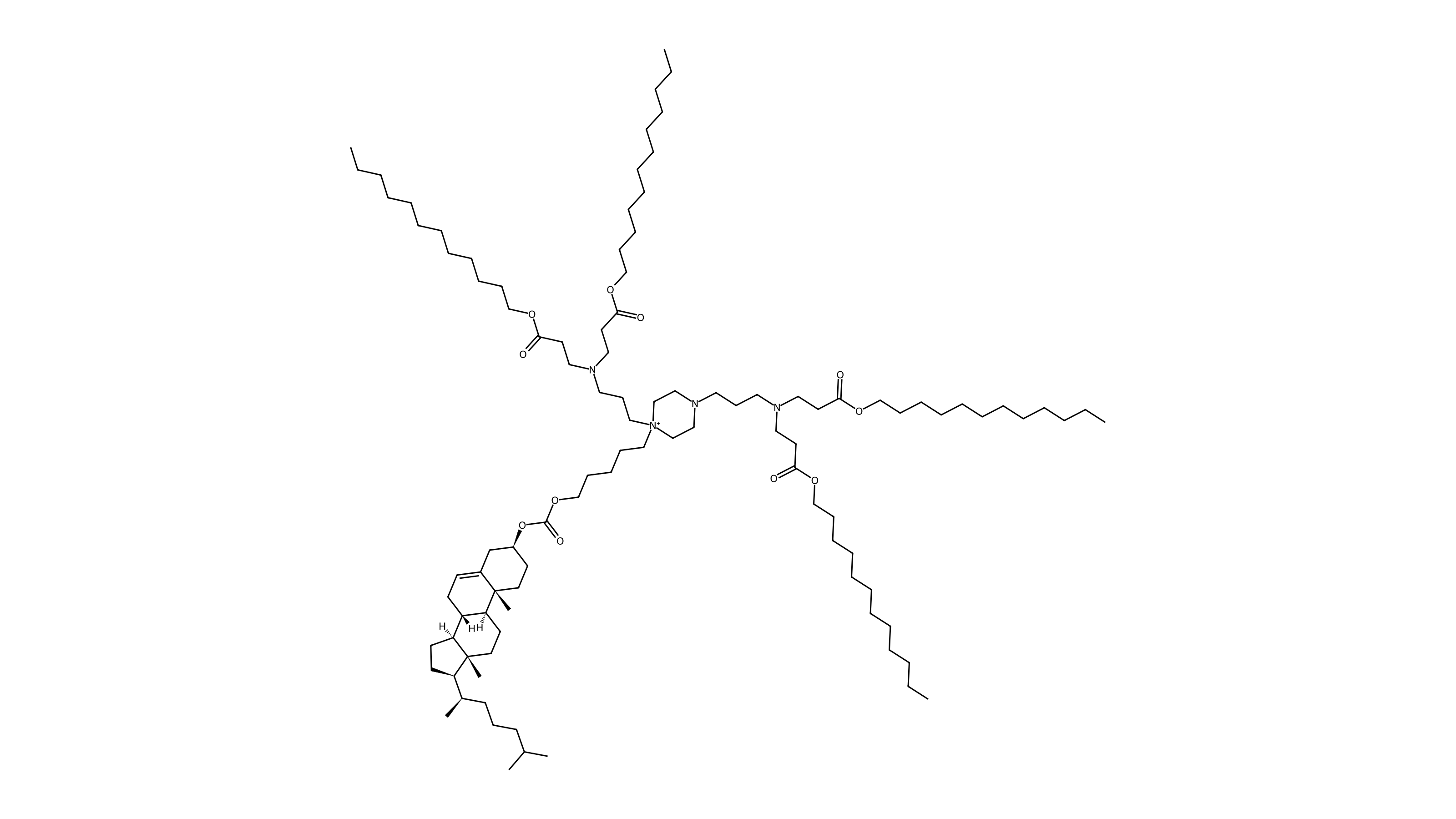
Ionizable lipid for LNP and nucleic-acid delivery research.
C6O2B2 is a cholesterol-conjugated cationic/ionizable lipid developed for ligand-free mRNA delivery to brain endothelial cells following intravenous administration. Its architecture combines a piperazine-containing polyamine core, four degradable ester-linked hydrophobic tails, and a covalently attached cholesterol moiety through a flexible five-carbon spacer. Among 51 newly synthesized cholesterol-based lipids, C6O2B2 produced the strongest brain luciferase expression. An optimized LNP formulation containing C6O2B2, DODAP, DSPC, and DMG-PEG enabled efficient functional mRNA expression throughout the cerebral vascular network, with preferential transfection of CD31-positive brain endothelial cells and minimal detectable neuronal or glial expression. The formulation preserved BBB integrity in Evans blue and contrast-enhanced MRI assessments. Mechanistic studies associated its activity with improved membrane fusion, enhanced endosomal escape, and ApoA-I enrichment in the protein corona. Delivery of IL-10 mRNA also reduced vascular leakage and inflammatory cytokines in a mouse model of acute neuroinflammation. C6O2B2 remains a preclinical research lipid requiring further pharmacokinetic and repeat-dose evaluation.
| CAS No. | Not available |
| Chemical Name | C6O2B2 |
| Synonyms | Not available |
| SMILES | Not available |
| Formula | Not available |
| M.Wt | Not available |
| Purity | >98% |
| Storage | Pure form: −20 °C, 1 year; In solvent: −80 °C, 6 months; −20 °C, 1 month. Sealed and protected from light. |
| Shipping condition | Ships from Shanghai. Pure lipid is stable during ice-pack transport. |
| Publication | Tian Z, Wang X, Pacheco Benitez A, Guerrero E, Duan Y, Wei J, Farbiak L, Siegwart DJ. Esterified Cholesterol Conjugates Enable LNP-Mediated mRNA Delivery to the Blood–Brain Barrier Following Intravenous Administration. Advanced Materials. |
The product molecular weight is prefilled when available and remains editable. Confirm solvent compatibility and solubility before preparation.
Solvent volumes update from the molecular weight above.
| Mass | 1 mM | 5 mM | 10 mM |
|---|---|---|---|
| 10 mg | Enter molecular weight | Enter molecular weight | Enter molecular weight |
| 25 mg | Enter molecular weight | Enter molecular weight | Enter molecular weight |
| 50 mg | Enter molecular weight | Enter molecular weight | Enter molecular weight |
| 100 mg | Enter molecular weight | Enter molecular weight | Enter molecular weight |
| 250 mg | Enter molecular weight | Enter molecular weight | Enter molecular weight |
Contact our team with the catalog number and requested quantity.