Lipid 8
DC86601
Recommended because it shares a closely related research category or delivery context. Formulation and performance are product- and study-specific.
View product →
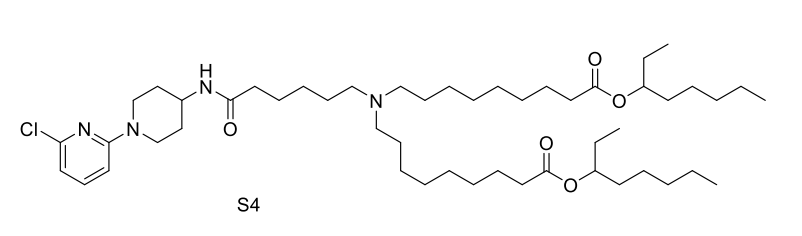
Lipid S4 is an advanced ionizable lipid engineered for systemic mRNA delivery to the brain, leveraging SR-57227—a high-affinity 5-HT3 receptor ligand—as its core head group to enable targeted blood-brain barrier (BBB) penetration via receptor-mediated transcytosis, while incorporating amino linkers for pH-responsive ionization and biodegradable branched ester tails to facilitate efficient endosomal escape and intracellular mRNA release; optimized through orthogonal screening into OS4 LNP (formulated at S4/DOPE/Chol/DMG-PEG2k = 40:40:60:0.75 molar ratio), it demonstrated a 13.3-fold increase in brain mRNA expression compared to FDA-approved MC3 LNPs, and further conjugation with the Tat cell-penetrating peptide yielded OS4T LNP, boosting delivery efficiency by 12.7-fold over OS4 alone and enabling broad mRNA expression across neurons, astrocytes, microglia, and endothelial cells; validated in orthotopic glioblastoma models, OS4T delivered engineered IL-12 mRNA, suppressing tumor growth and extending median survival to 37 days (vs. 17 days for controls) with minimal systemic toxicity, positioning S4-based LNPs as a robust, translatable platform for CNS-targeted therapeutics.
Lipid S4 is an SR-57227-derived ionizable lipid studied for systemic mRNA delivery to the mouse brain. Initial S4, optimized OS4 and Tat-conjugated OS4T are distinct research formulations. The highest reported brain expression and glioblastoma treatment results used OS4T. These are formulation-specific preclinical results.
| Component | Initial S4 mol% | OS4 mol% | MW used (g/mol) |
|---|---|---|---|
| Lipid S4 | 45.8891 | 28.4192 | 861.65 |
| DOPE | 22.9446 | 28.4192 | 744.03 |
| Cholesterol | 30.5927 | 42.6288 | 386.65 |
| DMG-PEG2k | 0.5736 | 0.5329 | 2509.20 |
Original molar parts: initial S4 = 60:30:40:0.75 (sum 130.75); OS4 = 40:40:60:0.75 (sum 140.75). mol% = parts / sum of parts × 100; rounding can produce a 0.0001% display difference. Calculations use unrounded parts. OS4 corresponds to formulation 24 in Fig. 2A. [1: pp. 3–4]
S4 MW is fixed at 861.65 g/mol. Choose a reported formulation and the mass basis for your calculation.
| Component | MW (g/mol) | Molar parts | Stock concentration (mM) |
|---|---|---|---|
| Lipid S4 | 861.65 | 40 | |
| DOPE | 744.03 | 40 | |
| Cholesterol | 386.65 | 60 | |
| DMG-PEG2k | 2509.20 | 0.75 |
Default 10 mM stock concentrations are calculation inputs, not reported formulation concentrations or measured solubility. Calculations use unrounded molar parts; the paper does not specify an aqueous/ethanol volume ratio.
Replace DMG-PEG2k with DSPE-PEG2000-maleimide, then attach the cysteine-containing Tat peptide shown in Fig. 3A: GRKKRRQRRRPPQC. The Methods describe PEG replacement in the OS4 formulation; they do not list a separate numerical OS4T ratio. Do not substitute unconjugated OS4 for OS4T.
The paper does not explicitly define whether “lipid” in the 10:1 mass ratio means S4 alone or all lipids. N/P, mixing device, flow rates, aqueous/ethanol volume ratio, formulation-buffer pH, post-coupling purification and measured Tat coupling yield are not specified in the supplied documents. Derived component weights and stock volumes are provided below; the RNA mass basis remains unresolved. [1: pp. 5, 10]
| Formulation | Size | PDI | Encapsulation | Zeta potential | Source |
|---|---|---|---|---|---|
| Initial S4 | ~120 nm | ~0.10 | ~83% | ~−7 mV | SI p. 7, Figs. S2–S3 |
| OS4 | ~100 nm | ~0.03 | Not individually stated | ~−7 mV | Main p. 5, Fig. 3B; SI p. 8, Fig. S5 |
| OS4T | ~130 nm | ~0.20 | Not individually stated | ~+17 mV | Main p. 5, Fig. 3B; SI p. 8, Fig. S5 |
All approximate numbers in this table are visual estimates of plotted means, not author-tabulated values or release specifications. n = 3 in the cited characterization plots. Error bars were not digitized. Exact means/SDs and apparent pKa are not provided in the supplied text. Initial S4 encapsulation must not be assigned to OS4 or OS4T.
| Formulation / assay | Experimental conditions | Reported result | Source |
|---|---|---|---|
| OS4 · brain FLuc | C57BL/6J mice; IV 0.6 mg mRNA/kg; 6 h; n = 3 | 13.3-fold MC3, 12.5-fold SM-102, 9.6-fold ALC-0315, and 2-fold initial S4. | Main pp. 3–4, Fig. 2D–E |
| OS4T · brain FLuc | Same dose and endpoint; separate comparator panels; n = 3 | 12.7-fold OS4 in Fig. 3C. In Fig. 3D–E, 59.1-fold MC3 and 17.2-fold MC3T. | Main pp. 3, 5, Fig. 3C–E |
| OS4 / OS4T · brain-cell GFP | C57BL/6J mice; IV 1 mg mRNA/kg; 12 h; n = 3 | OS4 improved GFP-positive fractions versus MC3 by about 8× in neurons, 4× in astrocytes, 6× in microglia and 3× in BCECs. OS4T further improved neurons, microglia and BCECs. | Main p. 6, Fig. 4A |
| OS4T · Cre reporter activation | Ai14 mice; one IV dose, 1 mg Cre mRNA/kg; Results specify day 7 | tdTomato-positive neurons 13.1 ± 1.2%; astrocytes 9.9 ± 1.2%; microglia 10.2 ± 0.4%; BCECs 11.6 ± 1.6%. MC3: <2%. | Main pp. 6–7, Fig. 4B–C |
| OS4T–eIL-12 · orthotopic GBM | CT-2A-Luc tumors in C57BL/6J mice; IV 1 mg mRNA/kg on days 3, 8 and 13; survival n = 7 | Median survival 37 days versus 17 days for PBS. This result requires Tat-conjugated OS4T and engineered IL-12 mRNA. | Main pp. 7–8, Fig. 5D–F |
| OS4 / OS4T · acute tolerability | IV FLuc mRNA 1 mg/kg; AST/ALT/BUN at 24 and 48 h; n = 3; histology at 48 h | Biomarkers were comparable to PBS; no notable tissue pathology in the reported short-term mouse experiment. | Main pp. 5–6, 10; SI p. 12, Fig. S11 |
Fold changes compare complete LNP formulations in their own experimental panels. Do not multiply fold changes across panels. MC3 and SM-102 controls used DSPC and 50:10:38.5:1.5; ALC-0315 used DSPC/ALC-0159 and 45.8:10.4:42.2:1.6. MC3T denotes the peptide-modified comparator. BCECs = brain capillary endothelial cells. [1: p. 10]
Preparation molecular weight: 861.65 g/mol. The catalog formula field omits chlorine present in the supplied paper structure and catalog SMILES; formula verification remains open. All S4 mass-to-mole calculations in this guide use 861.65 g/mol.
Follow the vial storage conditions. Keep pure lipid tightly sealed and protected from light; the product-page storage period is 1 year at −20 °C. Prepare fresh solutions where possible; if stored, use tightly sealed aliquots and avoid repeated freeze–thaw cycles. The product page lists solutions at −80 °C for 6 months or −20 °C for 1 month. These are supplier handling statements, not stability data for OS4/OS4T LNPs. Use 861.65 g/mol for S4 molar stocks and confirm complete dissolution.
S4 molecular weight = 861.65 g/mol. 1 mg = 1.160564 μmol; 1 mM = 0.86165 mg/mL; 5 mM = 4.30825 mg/mL; 10 mM = 8.6165 mg/mL.
| S4 mass | Amount (μmol) | Final volume: 1 mM | Final volume: 5 mM | Final volume: 10 mM |
|---|---|---|---|---|
| 10 mg | 11.6056 | 11.6056 mL | 2.3211 mL | 1.1606 mL |
| 25 mg | 29.0141 | 29.0141 mL | 5.8028 mL | 2.9014 mL |
| 50 mg | 58.0282 | 58.0282 mL | 11.6056 mL | 5.8028 mL |
| 100 mg | 116.0564 | 116.0564 mL | 23.2113 mL | 11.6056 mL |
| 250 mg | 290.1410 | 290.1410 mL | 58.0282 mL | 29.0141 mL |
V (mL) = mass (mg) × 1000 / [861.65 × concentration (mM)]. These are final solution volumes, not measured solubility limits. Dissolve in compatible solvent and make up to the stated final volume. Ethanol is the lipid-phase solvent in the paper; verify complete dissolution.
| Formulation | S4 (mg) | DOPE (mg) | Cholesterol (mg) | DMG-PEG2k (mg) | Total lipid (mg) |
|---|---|---|---|---|---|
| Initial S4 | 25.0000 | 10.7937 | 7.4789 | 0.9100 | 44.1826 |
| OS4 | 25.0000 | 21.5874 | 16.8275 | 1.3650 | 64.7799 |
Derived from the reported molar ratios, using S4 861.65, DOPE 744.03, cholesterol 386.65 and DMG-PEG2k average MW 2509.2 g/mol. These are calculated planning values, not author-reported weighed batches. For another S4 mass, multiply every mass by target S4 mass / 25. RNA, buffer, peptide and process losses are excluded.
| Component | Calculated mol% | Amount (μmol) | Mass (mg) | 10 mM stock aliquot (mL) |
|---|---|---|---|---|
| Lipid S4 | 28.4192 | 4.4789 | 3.8592 | 0.4479 |
| DOPE | 28.4192 | 4.4789 | 3.3324 | 0.4479 |
| Cholesterol | 42.6288 | 6.7183 | 2.5976 | 0.6718 |
| DMG-PEG2k | 0.5329 | 0.0840 | 0.2107 | 0.0084 |
Total lipid = 10.0000 mg; total amount = 15.7600 μmol. The stock concentrations are a calculation example, not a concentration specified by the paper. Vi (mL) = ni (μmol) / Ci (mM). Stock aliquots do not set the final LNP concentration or aqueous/ethanol mixing ratio.
At 25 mg S4, retaining OS4 molar parts 40:40:60:0.75 while replacing DMG-PEG2k with DSPE-PEG2000-maleimide gives 0.544014 μmol maleimide PEG lipid. The reported cysteine:maleimide feed ratio 2:1 corresponds to 1.088029 μmol Tat peptide, assuming one cysteine per peptide and one maleimide per PEG lipid. The sequence shown is GRKKRRQRRRPPQC.
This is a stoichiometric planning calculation based on the Methods description of PEG replacement; a separate numerical OS4T ratio is not tabulated. DSPE-PEG2000-maleimide mass (mg) = PEG-lipid amount (μmol) × its supplier average MW / 1000. Peptide mass uses the exact supplied peptide/salt MW in the same way. Do not use DMG-PEG2k MW 2509.2 for DSPE-PEG2000-maleimide. Feed stoichiometry does not establish coupling yield, accessible maleimide or final peptide loading.
The paper reports lipid:mRNA = 10:1 by mass without explicitly defining whether lipid means S4 alone or total lipid. For the 10 mg total-lipid OS4 example above, assuming total lipid:mRNA = 10:1 gives 1.0000 mg RNA; assuming S4:mRNA = 10:1 gives 0.3859 mg RNA. These are alternative calculations, not a resolved literature recipe.
N/P, pKa, particle size, encapsulation and delivery performance cannot be determined from S4 molecular weight. Literature results remain in their separate experimental sections.
[1] Cao D et al. Lipid nanoparticles for mRNA delivery in brain via systemic administration. Science Advances 11, eadw0730 (2025). DOI: 10.1126/sciadv.adw0730. Main article PDF: 14 supplied pages, with article content on pp. 1–13.
[2] User-supplied Supplementary Materials, 18 PDF pages. Page references count from the first PDF page. Structure/HRMS: pp. 2–3; particle properties: p. 7; CPP zeta potential: p. 8; safety: Fig. S11. Values labeled calculated or estimated are distinguished from directly reported results.
| CAS No. | Not available |
| Chemical Name | Lipid S4 |
| Synonyms | S-4,Lipid-S4,LipidS 4 |
| SMILES | CCCCCC(CC)OC(=O)CCCCCCCCN(CCCCCCCCC(=O)OC(CC)CCCCC)CCCCCC(=O)NC1CCN(C2=CC=CC(Cl)=N2)CC1 |
| Formula | C50H88N4O5 |
| M.Wt | 861.65 |
| Purity | ELSD-HPLC>95% |
| Storage | Pure form: −20 °C, 1 year; In solvent: −80 °C, 6 months; −20 °C, 1 month. Sealed and protected from light. |
| Shipping condition | Ships from Shanghai. Pure lipid is stable during ice-pack transport. |
| Publication | Lipid nanoparticles for mRNA delivery in brain via systemic administration- SCIENCE ADVANCES VOL. 11, NO. 33,2025 |
S4 molecular weight is fixed at 861.65 g/mol. Calculate mass, concentration or final solution volume; confirm complete dissolution in the selected solvent.
Final solution volumes calculated with S4 MW 861.65 g/mol. Make up to the stated volume after dissolution; the values do not establish solubility.
| Mass | 1 mM | 5 mM | 10 mM |
|---|---|---|---|
| 10 mg | 11.6056 mL | 2.3211 mL | 1.1606 mL |
| 25 mg | 29.0141 mL | 5.8028 mL | 2.9014 mL |
| 50 mg | 58.0282 mL | 11.6056 mL | 5.8028 mL |
| 100 mg | 116.0564 mL | 23.2113 mL | 11.6056 mL |
| 250 mg | 290.1410 mL | 58.0282 mL | 29.0141 mL |
Contact our team with the catalog number and requested quantity.