For research use only. We do not sell to patients.
Ionizable lipids / AMG514
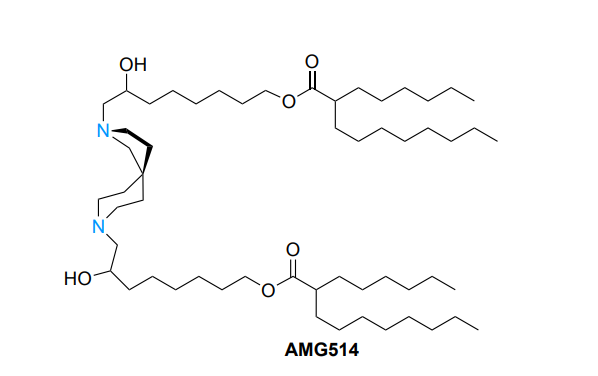
AMG514 chemical structure
Product imageResearch use only
CAT. NO. DC68141Featured

AMG514

Ionizable lipid for LNP and nucleic-acid delivery research.

Research highlights
Spleen-biased mRNA deliverySplenic dendritic-cell and macrophage transfectionImmune-remodeling mRNA researchPreclinical RNA cancer-vaccine studies
Derived from the cited study; not a product specification or performance guarantee.

Pack size & price

USD
Supporting components
DOPE DC33634 · 100 mg+Cholesterol DCD-041 · 100 mg+DMG-PEG2k DC40169 · 100 mg

Components are supplied separately; this is not a premixed LNP. RNA/cargo, buffer and formulation service are not included.

TotalUS$850
We match the best price and quality on market.
Ships from ShanghaiIce-pack transportPure lipid recommended
Product overview

Description & Application

AMG514 is a spirocyclic diamine ionizable lipid developed for spleen-biased mRNA delivery. In the cited mouse experiments, AMG514 LNPs produced approximately four-fold higher splenic reporter expression than a cKK-E12 comparator, transfected splenic dendritic cells and macrophages, and were evaluated for co-delivery of antigen and immune-remodeling mRNAs. The authors associated its approximately 7.5 apparent LNP pKa and serum- or plasma-derived protein-corona profile with the observed biodistribution, but did not establish a single causal targeting mechanism. All formulation and performance information shown below is literature-derived study evidence, not a product specification or a guarantee of reproducible LNP performance.

CAS No.Not available
Chemical NameAMG514
SynonymsAMG-514, AMG 514
SMILESCCCCCCCCC(CCCCCC)C(=O)OCCCCCCC(O)CN1CCC2(CC1)CCN(CC(O)CCCCCCOC(=O)C(CCCCCC)CCCCCCCC)C2
FormulaC56H108N2O6
M.Wt905.49
PurityELSD>95%
StoragePure form: −20 °C, 1 year; In solvent: −80 °C, 6 months; −20 °C, 1 month. Sealed and protected from light.
Shipping conditionShips from Shanghai. Pure lipid is stable during ice-pack transport.
PublicationGupta A, Das R, Reed K, et al. Immune-remodeling mRNAs expressing IRF8 or NIK generate durable antitumor immunity in multiple cancer models. Nature Biotechnology. Published online 13 May 2026.

Literature-reported formulation composition

Componentmol%Role
AMG51435Ionizable lipid
DOPE16Helper phospholipid
Cholesterol46.5Sterol
DMG-PEG2k2.5PEG lipid
Reported total100Source values retained

Formulation weight calculator

The cited formulation and available component molecular weights are pre-filled. Enter the exact molecular weight for any substituted material before calculating.

The 4 reported lipid components total 100 mol%.
ComponentMolecular weight (g/mol)Literature molar ratio
AMG514
DOPE
Cholesterol
DMG-PEG2k
Calculated component requirements
ComponentNormalized mol%Amount (µmol)Required weight (mg)
Total100.000%

Research planning aid only. Results cover lipid component weights and do not include RNA, buffer, solvent, process loss or an N/P ratio.

Not reported in the cited article
10:1 ionizable lipid:RNA (w/w); this is not an N/P ratio
133 ng/microliter mRNA in 10 mM citrate, pH 3.0; final PBS after buffer exchange, pH 7-7.5
Firefly luciferase mRNA
Intravenous injection
1 microgram FLuc mRNA, single dose
Mouse; strain not stated for the initial reporter-delivery screen
Staggered-herringbone microfluidic mixing at 3:1 aqueous:lipid-phase volume ratio and 1.2 mL/min total flow. LNPs were diluted at least four-fold with PBS and concentrated through 100 kDa filters for three exchange cycles.

Literature-reported performance for the cited formulation

Literature-reported97%Post-formulation characterization · Representative cKK-E12 LNP: 56%Supplementary Table 2, internal p. 25 / PDF p. 26
Literature-reported102.7 nmPost-formulation characterization · Representative cKK-E12 LNP: 86.0 nmSupplementary Table 2, internal p. 25 / PDF p. 26
Literature-reported0.133Post-formulation characterization · Representative cKK-E12 LNP: 0.155Supplementary Table 2, internal p. 25 / PDF p. 26
Literature-reportedapproximately 7.5Post-formulation characterization · Approximately 6.5 is described as characteristic of the cited liver-tropic formulationsMain text p. 11; Supplementary Figure 21b
Literature-reportedapproximately four-fold higher6 h after a single 1 microgram IV FLuc-mRNA dose · Versus cKK-E12 LNP; reduced liver signal was also reportedMain text p. 9; Extended Data Figure 4c,d

Additional reported findings

Splenic antigen-presenting-cell transfection

In the Ai14/Cre reporter experiment, the plotted fractions were approximately 67% versus 40% tdTomato-positive dendritic cells and approximately 60% versus 40% tdTomato-positive macrophages for AMG514 versus cKK-E12.

Cre mRNA, IV, n=4-5; the figure caption reports 5 micrograms and 48 h, while Methods report 0.25 mg/kg and 72 h · Extended Data Figure 4e and Methods
Antigen-specific CD8 T-cell response

AMG514-formulated NIK plus OVA generated approximately 15% OVA-tetramer-positive CD8 T cells after boosting, compared with approximately 6% for the cKK-E12 formulation.

C57BL/6J mice; total 3 micrograms RNA; days 0 and 14; n=5; route not stated for this experiment · Main Figure 6f-h and text p. 11
B16-OVA tumor challenge

AMG514 NIK plus OVA produced complete rejection in five of five mice, compared with three of five for cKK-E12 NIK plus OVA and one of five for AMG514 OVA alone. The authors state that the AMG514 advantage over cKK-E12 was not statistically significant.

Preclinical prophylactic vaccine and tumor-challenge study · Main Figure 6i,j and text p. 11
Protein-corona profile

The reported AMG514 corona was enriched in vitronectin, coagulation proteins and selected apolipoproteins. This association does not by itself prove a receptor-mediated targeting mechanism.

The main text refers to plasma, while the Supplementary Figure 21 caption refers to serum · Main text p. 11 and Supplementary Figure 21
Literature Data DisclaimerAll formulation parameters and performance values shown in this section are derived from the cited publication and are provided for reference only. These results were obtained using the specific materials, formulation process, cargo, dose, analytical method, model and administration route described in that study. Unless otherwise stated, the data were not generated or independently verified by DC Chemicals. DC Chemicals supplies the lipid compound only and does not guarantee that customers will reproduce the reported LNP properties or biological performance.

The administration route shown above was used in the cited study and is not a clinical-use instruction or recommendation by DC Chemicals.
Cited literature for this formulation and performance datasetGupta A, Das R, Reed K, et al. Immune-remodeling mRNAs expressing IRF8 or NIK generate durable antitumor immunity in multiple cancer models. Nature Biotechnology. Published online 13 May 2026. DOI: 10.1038/s41587-026-03115-2
Structure and analytical identity: Extended Data Figure 4a and Supplementary chemical-characterization section; formulation and preparation: Supplementary Table 1 and Methods; reporter delivery: Extended Data Figure 4; vaccination and tumor-challenge findings: Figure 6; protein corona and apparent pKa: main text and Supplementary Figure 21.
Laboratory planning

Solution Calculators

The product molecular weight is prefilled when available and remains editable. Confirm solvent compatibility and solubility before preparation.

Mass = concentration × volume × molecular weight
Enter any three values to calculate the fourth.
C₁V₁ = C₂V₂
Enter any three values to calculate the fourth.
Preparing stock solutions

Quick preparation table

Solvent volumes update from the molecular weight above.

Mass1 mM5 mM10 mM
10 mg11.0437 mL2.2087 mL1.1044 mL
25 mg27.6094 mL5.5219 mL2.7609 mL
50 mg55.2187 mL11.0437 mL5.5219 mL
100 mg110.4374 mL22.0875 mL11.0437 mL
250 mg276.0936 mL55.2187 mL27.6094 mL

Need a different pack size or technical document?

Contact our team with the catalog number and requested quantity.

Contact us
Handling guidance

Shipping, storage and sampling

How is the lipid shipped, and how should I store it?
We generally ship the neat (undissolved) lipid compound rather than an ethanol solution. The neat lipid is stable during transport with ice packs, and shipments originate from Shanghai. Pure form: store at −20 °C for up to 1 year. In solvent: store at −80 °C for up to 6 months or at −20 °C for up to 1 month. Keep sealed and protected from light. Avoid repeated thaw cycles for best results.
Pure lipid or solution — which should I choose?
Pure lipid is generally more stable during shipping and storage, so we usually recommend the pure form. A solution in ethanol or chloroform can be supplied when required by your workflow. Tell us the intended application, solvent and target concentration so the most suitable format can be confirmed.
How should I measure a small amount of oily or viscous lipid?
Ionizable lipids are often oily liquids or viscous semisolids, so material can be lost during repeated weighing or transfer. For a small pack, dissolve the entire quantity and aliquot it volumetrically. For example, add 1 mL ethanol to 25 mg lipid to prepare a 25 mg/mL stock, then use a pipette to withdraw the required amount. For quantities above 100 mg, direct weighing with an analytical balance may be more practical. Always confirm solvent compatibility and solubility first.
Can you support formulation optimization and scale-up?
Yes. Share the RNA cargo, target tissue, administration route, formulation method and assay plan. Our team can discuss starting molar ratios, N/P ratio and scale-up requirements for research workflows.