CICL-207
DC67515
Recommended because it shares a closely related research category or delivery context. Formulation and performance are product- and study-specific.
View product →
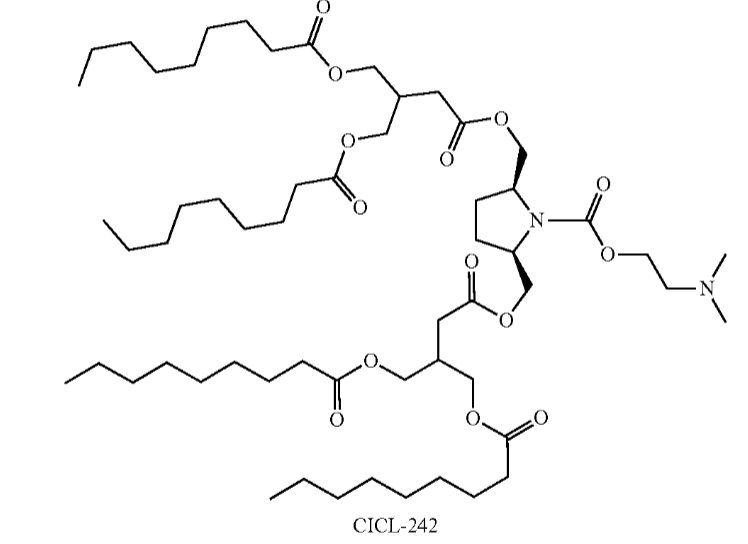
Ionizable lipid for LNP and nucleic-acid delivery research.
CICL-242 is a constrained ionizable cationic lipid highlighted in patent US 20250127728A1 developed by Capstan as a promising candidate for advanced therapeutic delivery, particularly in stem cell and gene editing applications. Its structure features a rigid amine headgroup similar to CICL-207, which likely facilitates efficient endosomal escape and reduces non-specific uptake, enhancing targeted nucleic acid delivery. Although detailed performance data is not fully disclosed in the patent, CICL-242 is explicitly synthesized and included in gene editing experimental systems (e.g., CRISPR-Cas9 workflows), suggesting its potential for high-efficiency transfection in hard-to-transfect cells like hematopoietic stem cells (CD34⁺). This makes it a strong candidate for ex vivo cell engineering and regenerative medicine, where precision and low off-target effects are critical. While further validation is needed to quantify its efficacy and safety profile, CICL-242 represents a strategic innovation in the lipid library for next-generation genetic therapies.
| CAS No. | Not available |
| Chemical Name | CICL-242 |
| Synonyms | CICL 242,CICL242 |
| SMILES | CCCCCCCCC(=O)OCC(COC(=O)CCCCCCCC)CC(=O)OC[C@@H]1CC[C@H](COC(=O)CC(COC(=O)CCCCCCCC)COC(=O)CCCCCCCC)N1C(=O)OCCN(C)C |
| Formula | C57H102O14N2 |
| M.Wt | 1,039.44 |
| Purity | ELSD-HPLC:95% |
| Storage | Pure form: −20 °C, 1 year; In solvent: −80 °C, 6 months; −20 °C, 1 month. Sealed and protected from light. |
| Shipping condition | Ships from Shanghai. Pure lipid is stable during ice-pack transport. |
| Publication | Not available |
The product molecular weight is prefilled when available and remains editable. Confirm solvent compatibility and solubility before preparation.
Solvent volumes update from the molecular weight above.
| Mass | 1 mM | 5 mM | 10 mM |
|---|---|---|---|
| 10 mg | 9.6206 mL | 1.9241 mL | 962.06 μL |
| 25 mg | 24.0514 mL | 4.8103 mL | 2.4051 mL |
| 50 mg | 48.1028 mL | 9.6206 mL | 4.8103 mL |
| 100 mg | 96.2056 mL | 19.2411 mL | 9.6206 mL |
| 250 mg | 240.5141 mL | 48.1028 mL | 24.0514 mL |
Contact our team with the catalog number and requested quantity.