E8i-200
DC13058
Recommended because it shares a closely related research category or delivery context. Formulation and performance are product- and study-specific.
View product →
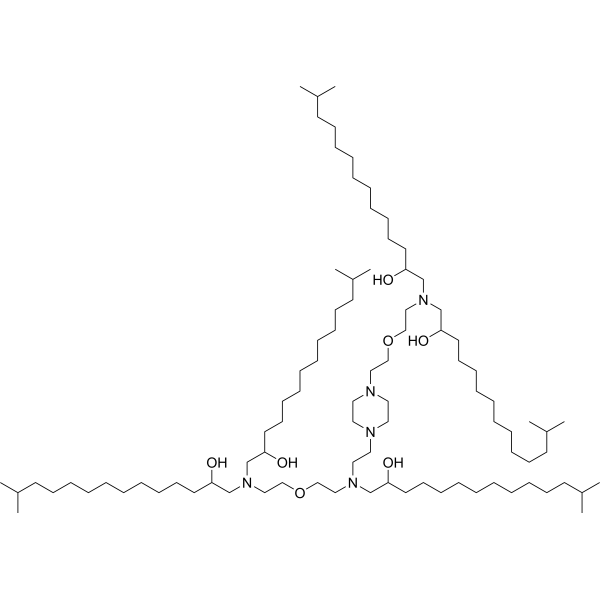
Ionizable lipid for LNP and nucleic-acid delivery research.
E10i-494 is a branched ionizable lipid designed to enhance the delivery of mRNA and CRISPR-Cas9 ribonucleoprotein (RNP) complexes. It belongs to the Branched Endosomal Disruptor (BEND) lipid family, which features terminal branching to improve endosomal escape and cellular uptake.E10i-494 demonstrated exceptional performance in T cell engineering, achieving >80% transfection efficiency in primary human T cells. This is significantly higher than the ~70% efficiency achieved by the linear lipid C14-494.The isopropyl branch enhances the lipid's ability to penetrate and disrupt endosomal membranes, leading to improved release of mRNA and RNPs into the cytoplasm.Despite its high efficiency, E10i-494 exhibits low cytotoxicity, making it suitable for therapeutic applications.E10i-494 is particularly effective for delivering mRNA to T cells, making it a promising tool for CAR-T cell therapy and other immunotherapies.Its ability to deliver CRISPR-Cas9 RNPs efficiently also makes it suitable for in vivo gene editing applications.
| CAS No. | Not available |
| Chemical Name | E10i-494 |
| Synonyms | E10i494, E10i 494 |
| SMILES | OC(CCCCCCCCCCC(C)C)CN(CCOCCN(CCN(CC1)CCN1CCOCCN(CC(CCCCCCCCCCC(C)C)O)CC(CCCCCCCCCCC(C)C)O)CC(O)CCCCCCCCCCC(C)C)CC(O)CCCCCCCCCCC(C)C |
| Formula | C89H183N5O7 |
| M.Wt | 1,435.5 |
| Purity | >98% |
| Storage | Pure form: −20 °C, 1 year; In solvent: −80 °C, 6 months; −20 °C, 1 month. Sealed and protected from light. |
| Shipping condition | Ships from Shanghai. Pure lipid is stable during ice-pack transport. |
| Publication | Not available |
The product molecular weight is prefilled when available and remains editable. Confirm solvent compatibility and solubility before preparation.
Solvent volumes update from the molecular weight above.
| Mass | 1 mM | 5 mM | 10 mM |
|---|---|---|---|
| 10 mg | 6.9662 mL | 1.3932 mL | 696.62 μL |
| 25 mg | 17.4155 mL | 3.4831 mL | 1.7416 mL |
| 50 mg | 34.8311 mL | 6.9662 mL | 3.4831 mL |
| 100 mg | 69.6621 mL | 13.9324 mL | 6.9662 mL |
| 250 mg | 174.1553 mL | 34.8311 mL | 17.4155 mL |
Contact our team with the catalog number and requested quantity.