E10i-494
DC13101
Recommended because it shares a closely related research category or delivery context. Formulation and performance are product- and study-specific.
View product →
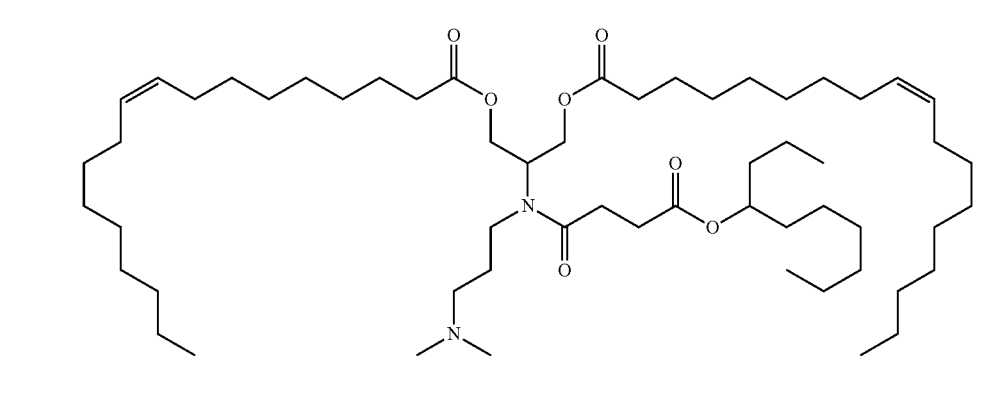
Sanofi Lipid 15 is an ionizable lipid investigated in CD8-targeted mRNA-LNPs for transient in vivo CAR-T-cell generation. Published studies report human T-cell transfection, CD22-directed tumor-cell killing, repeat dosing and tumor-burden reduction in humanized mice.
Open full Formulation & Performance →
The reported CAR-T performance belongs to a complete targeted LNP containing Lipid 15, DPG-PEG and a CD8-binding surface conjugate. It is not a property of the isolated lipid or an untargeted four-component LNP.
Lipid 15 is the named ionizable lipid in Lemgart et al. Targeting conjugates and encoded CAR payloads are additional components of the biological platform.
| Component | DC Chemicals product | Molecular weight | Molar ratio | Mass at 1 µmol total lipid (mg) |
|---|---|---|---|---|
| Sanofi Lipid 15 | DC67601 | 945.51 | 49 | 0.463300 |
| Cholesterol | DCD-041 | 386.65 | 39 | 0.150793 |
| DSPC | DC57005 | 790.15 | 10 | 0.079015 |
| DPG-PEG2000 | Not uniquely mapped | Not established | 2 | Not calculable from disclosed data |
Base lipid blend: Lipid 15/cholesterol/DSPC/DPG-PEG2000 = 49:39:10:2 mol%. DPG-PEG is not DMG-PEG2000; 2507 is therefore not assigned to it. The reported N/P design range is 4–6. CD8-targeting VHH conjugate is introduced separately and is not represented as a fifth prefilled bulk-lipid percentage.
Not all inputs are assigned to a single verified study formulation; unassigned fields are blank. Enter your own values to calculate a research scenario. Molecular weights and ratios are editable. Results are calculated, not measured study data. No N/P or RNA dose is inferred.
| Component | MW | Molar ratio | Mass (mg) | Mass % |
|---|---|---|---|---|
| Sanofi Lipid 15 | ||||
| Cholesterol | ||||
| DSPC | ||||
| DPG-PEG2000 |
| Study / condition | Result | Interpretation |
|---|---|---|
| Lipid 15 / DPG-PEG LNP before targeting insertion | 86 nm; PDI 0.11 | SI Table S6, initial MBS measurement. |
| After Nb8 VHH conjugate insertion | 90 nm; PDI 0.12 | Targeted particle, not the bare lipid. |
| After freeze/thaw | 94 nm; PDI 0.11 | One tested processing condition; not a shelf-life claim. |
| Conjugate identity | Anti-CD8 Nb8 VHH displayed through a PEG-phospholipid tether | Separate from the DPG-PEG2000 in the base mixture. |
Supplementary Table S6 (printed p. 37) and targeted-LNP methods. Earlier KC2/PEG-content screens are not the final Lipid 15 recipe.
| Study / condition | Result | Interpretation |
|---|---|---|
| Human PBMCs from four healthy donors | Average approximately 50% CAR-positive CD8+ T cells | Main Fig. 4; donor variability is retained in the original graph. |
| CD8-targeted versus CD3-targeted formulations | CD8 targeting supported selective transfection with less nonspecific activation in the tested comparisons | Targeting ligand and LNP architecture contribute to this result. |
| Transient expression | CAR expression peaked near 24 h and decreased over subsequent days | Detectability and functional tumor killing have different time courses. |
Main Figs. 3–4; Supplementary Figs. S16 and S37–S39.
| Study / condition | Result | Interpretation |
|---|---|---|
| CD22 CAR delivery to T cells | Killing of CD22-positive tumor targets | Antigen-negative and CD22 knockout controls test specificity. |
| Repeated target challenge after a single transfection | Killing persisted for up to 8 days in the tested assay | Two tumor-cell additions; not permanent CAR expression. |
| Repeated transfection setting | Killing maintained for up to 10 days | Five tumor-cell additions; distinct from the single-transfection experiment. |
| Flow cytometry at 120 h | Surface CAR became undetectable by the stated method while killing could remain functional | An assay detection limit is not proof of zero residual receptor. |
Main Fig. 5 and Supplementary Fig. S39.
| Study / condition | Result | Interpretation |
|---|---|---|
| Human-PBMC-engrafted NSG mice; 0.3 mg mRNA/kg IV; 24 h | >20% CAR-positive human CD8+ T cells in blood, spleen and bone marrow | Main Fig. 6; this is a humanized mouse experiment. |
| Four doses over 2 weeks | Similar blood CD8+ CAR expression after the first and fourth doses; near-complete B-cell depletion in spleen and bone marrow | Repeat administration and functional activity in this model. |
| Nalm6 humanized tumor model; five IV doses of 0.3 mg/kg every 3–4 days | Reduced tumor burden over 26 days versus vehicle/control LNP | Not a Raji tumor experiment and not a clinical response rate. |
| Day-26 tissue examination | CD22-positive tumor cells were reported eliminated from examined spleen and liver sections | A tissue finding does not establish whole-body cure or survival benefit. |
Main Figs. 6–8 and Supplementary Tables S10–S11.
| Study / condition | Result | Interpretation |
|---|---|---|
| Four-dose mouse study | No significant differences in body weight or spleen weight versus controls | Limited endpoints; not a comprehensive long-term toxicology study. |
| Human MIMIC immune model | Some cytokines increased even with reporter-payload LNPs | The platform was not immunologically inert. |
| CAR versus reporter payload | Additional cytokine release accompanied CAR target engagement | Payload pharmacology and carrier-mediated effects must be distinguished. |
| RNA quality | Cytokine responses depended on double-stranded-RNA impurities | Reported biological performance assumes the study RNA quality and targeting construct. |
Main Fig. 5 and Supplementary Fig. S42; results do not establish human clinical safety.
Original biological figures and supporting information — Original source figures.
| CAS No. | 3024023-96-6 |
| Chemical Name | Sanofi Lipid 15 |
| Synonyms | Sanofi Lipid-15, Lipid15, Lipid 15 |
| SMILES | CCCCCCCC/C=C\CCCCCCCC(=O)OCC(COC(=O)CCCCCCC/C=C\CCCCCCCC)N(CCCN(C)C)C(=O)CCC(=O)OC(CCC)CCCCCC |
| Formula | C58H108O7N2 |
| M.Wt | 945.51 |
| Purity | >95% by ELSD-HPLC |
| Storage | Pure form: −20 °C, 1 year; In solvent: −80 °C, 6 months; −20 °C, 1 month. Sealed and protected from light. |
| Shipping condition | Ships from Shanghai. Pure lipid is stable during ice-pack transport. |
| Publication |
The product molecular weight is prefilled when available and remains editable. Confirm solvent compatibility and solubility before preparation.
Solvent volumes update from the molecular weight above.
| Mass | 1 mM | 5 mM | 10 mM |
|---|---|---|---|
| 10 mg | 10.5763 mL | 2.1153 mL | 1.0576 mL |
| 25 mg | 26.4408 mL | 5.2882 mL | 2.6441 mL |
| 50 mg | 52.8815 mL | 10.5763 mL | 5.2882 mL |
| 100 mg | 105.7630 mL | 21.1526 mL | 10.5763 mL |
| 250 mg | 264.4076 mL | 52.8815 mL | 26.4408 mL |
Contact our team with the catalog number and requested quantity.