Lipid 2308
DC67556
Recommended because it shares a closely related research category or delivery context. Formulation and performance are product- and study-specific.
View product →
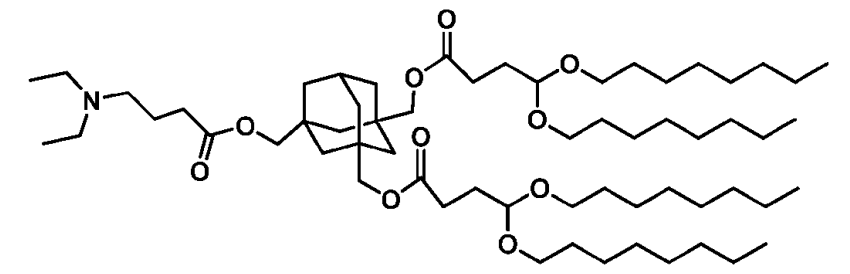
Ionizable lipid for LNP and nucleic-acid delivery research.
AX6 is an ionizable lipid in the F32 LNP formulation, engineered by ReNAgade/Orna Therapeutics for targeted mRNA delivery to T cells. AX-6's unique bridged bicyclic/polycyclic core with a tertiary amine group enables pH-dependent protonation and endosomal escape, while C14-C18 hydrophobic tails (optionally branched/fluorinated) enhance bilayer stability and mRNA encapsulation. Demonstrating exceptional T-cell tropism, AX6 achieves high transfection efficiency in CD4+/CD8+ T cells (validated in NHP/humanized models) with minimal toxicity. Compared to clinical benchmarks (SM-102, ALC-0315), its rigid core offers superior serum stability and immune-cell specificity, positioning it as an ideal candidate for CAR-T/NK therapies and next-gen vaccines. The F32 LNP system's proven efficacy (e.g., in vivo B-cell depletion) underscores AX 6's transformative potential for cell engineering and immunotherapies.
| CAS No. | Not available |
| Chemical Name | ORNA Lipid AX-6 |
| Synonyms | ORNA Lipid AX 6,AX6 |
| SMILES | CCCCCCCCOC(CCC(=O)OCC12CC3CC(COC(=O)CCCN(CC)CC)(C1)CC(COC(=O)CCC(OCCCCCCCC)OCCCCCCCC)(C3)C2)OCCCCCCCC |
| Formula | C61H113O10N |
| M.Wt | 1,020.57 |
| Purity | ELSD-HPLC>95% |
| Storage | Pure form: −20 °C, 1 year; In solvent: −80 °C, 6 months; −20 °C, 1 month. Sealed and protected from light. |
| Shipping condition | Ships from Shanghai. Pure lipid is stable during ice-pack transport. |
| Publication | Not available |
The product molecular weight is prefilled when available and remains editable. Confirm solvent compatibility and solubility before preparation.
Solvent volumes update from the molecular weight above.
| Mass | 1 mM | 5 mM | 10 mM |
|---|---|---|---|
| 10 mg | 9.7984 mL | 1.9597 mL | 979.84 μL |
| 25 mg | 24.4961 mL | 4.8992 mL | 2.4496 mL |
| 50 mg | 48.9922 mL | 9.7984 mL | 4.8992 mL |
| 100 mg | 97.9845 mL | 19.5969 mL | 9.7984 mL |
| 250 mg | 244.9611 mL | 48.9922 mL | 24.4961 mL |
Contact our team with the catalog number and requested quantity.