DMA4-H228
DC60856
Recommended because it shares a closely related research category or delivery context. Formulation and performance are product- and study-specific.
View product →
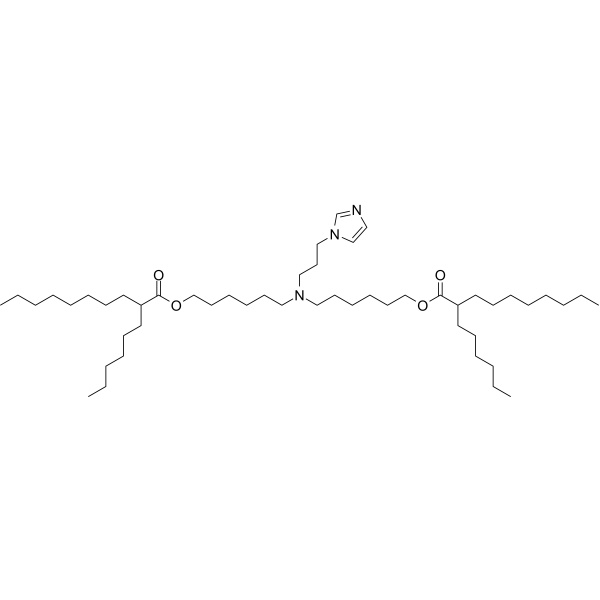
Ionizable lipid for LNP and nucleic-acid delivery research.
Lipid 10a-26 is an ionizable lipid developed by Orna Therapeutics for lipid nanoparticle (LNP) formulations. Lipid 10a-26 is a key ionizable lipid in the LNP-6 formulation. Through structural modification, it exhibits reduced binding to ApoE proteins and lowered liver affinity compared to traditional ionizable lipids. Instead, Lipid 10a-26 demonstrates strong splenic tropism—in non-human primate studies, it effectively delivers payloads to the spleen and immune cells in peripheral blood, such as T cells, NK cells, and macrophages, enabling the possibility of "in vivo CAR-T" therapy. Its pKa is tuned to approximately 6.0–6.5, allowing rapid protonation in the acidic endosomal environment, which promotes endosomal membrane disruption and efficient cytosolic release of circular RNA.
| CAS No. | Not available |
| Chemical Name | Lipid 10a-26 |
| Synonyms | Decanoic acid, 2-hexyl-, 1,1′-[[[3-(1H -imidazol-1-yl)propyl]imino]di-6, 1-hexanediyl] ester (ACI),Lipid A26,ORNA Lipid 10a26 |
| SMILES | O=C(OCCCCCCN(CCCN1C=NC=C1)CCCCCCOC(=O)C(CCCCCC)CCCCCCCC)C(CCCCCC)CCCCCCCC |
| Formula | C50H95N3O4 |
| M.Wt | 802.31 |
| Purity | ELSD-HPLC>95% |
| Storage | Pure form: −20 °C, 1 year; In solvent: −80 °C, 6 months; −20 °C, 1 month. Sealed and protected from light. |
| Shipping condition | Ships from Shanghai. Pure lipid is stable during ice-pack transport. |
| Publication | Circular RNA compositions for targeted and efficient therapeutic protein expression in immune cells for treating cancer or autoimmune disease By: Wesselhoeft, Alex; Goodman, Brian-WO2021189059 A2 2021-09-23 |
The product molecular weight is prefilled when available and remains editable. Confirm solvent compatibility and solubility before preparation.
Solvent volumes update from the molecular weight above.
| Mass | 1 mM | 5 mM | 10 mM |
|---|---|---|---|
| 10 mg | 12.4640 mL | 2.4928 mL | 1.2464 mL |
| 25 mg | 31.1600 mL | 6.2320 mL | 3.1160 mL |
| 50 mg | 62.3201 mL | 12.4640 mL | 6.2320 mL |
| 100 mg | 124.6401 mL | 24.9280 mL | 12.4640 mL |
| 250 mg | 311.6003 mL | 62.3201 mL | 31.1600 mL |
Contact our team with the catalog number and requested quantity.