C12-200
DC58046
Recommended because it shares a closely related research category or delivery context. Formulation and performance are product- and study-specific.
View product →
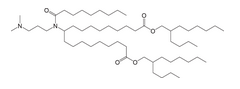
Acuitas A9 is an ionizable lipid corresponding to Compound 9 in US10221127B2. Published mouse studies report hepatic mRNA expression and formulation-dependent inflammatory and tolerability findings. Patent and peer-reviewed data use different LNP compositions and are presented separately.
Open full Formulation & Performance →
The evidence combines a patent luciferase-mRNA study with a peer-reviewed comparison of protein expression, particle properties and tolerability. Compound 9 supported liver expression, while the later comparison also identified inflammatory responses and dose-dependent tolerability limitations.
Holland et al. identify Acuitas Compound 9 in Supporting Information Figure S1 and the Compound 9 entry, with formula C57H112N2O5 and an explicit reference to US10221127B2. The illustrated connectivity matches the catalog structure. This identity does not establish that A9 is the exact lipid used in a particular clinical vaccine.
| Component | DC Chemicals product | Molecular weight | Molar ratio | Mass at 1 µmol total lipid (mg) |
|---|---|---|---|---|
| Acuitas A9 / Compound 9 | DC57100 | 905.51 | 50 | Not calculable from disclosed data |
| DSPC | DC57005 | 790.15 | 10 | Not calculable from disclosed data |
| Cholesterol | DCD-041 | 386.65 | 38.5 | Not calculable from disclosed data |
| PEG-DMA (ditetradecylacetamide PEG lipid) | Not uniquely mapped | Not established | 1.5 | Not calculable from disclosed data |
This table follows US10221127B2, Example 29, Table 3. Its amide-based PEG-DMA is not the PEG-DMG used in Table 2. Holland et al. later report ionizable lipid:DSPC:cholesterol:PEG lipid = 54.6:10.9:32.8:1.6 (rounded total 99.9). A specific commercial PEG identity and a single Compound 9 N/P value were not confirmed. Supporting Information Table S2 names mPEG-DMA in the GVS-18-B6 formulation, but that table is not an A9-specific post-formulation composition measurement.
Not all inputs are assigned to a single verified study formulation; unassigned fields are blank. Enter your own values to calculate a research scenario. Molecular weights and ratios are editable. Results are calculated, not measured study data. No N/P or RNA dose is inferred.
| Component | MW | Molar ratio | Mass (mg) | Mass % |
|---|---|---|---|---|
| Acuitas A9 / Compound 9 | ||||
| DSPC | ||||
| Cholesterol | ||||
| PEG-DMA (ditetradecylacetamide PEG lipid) |
| Record | Reported result | Interpretation |
|---|---|---|
| Composition | Compound 9:DSPC:cholesterol:PEG-DMA = 50:10:38.5:1.5 mol% | Example 29, Table 3; do not substitute the Table 2 PEG-DMG formulation |
| Model | Female C57BL/6 mice, 6–8 weeks; intravenous FLuc-mRNA LNP; liver readout at 4 h | Reporter-protein expression, not a clinical outcome |
| Compound 9 at 0.3 mg/kg mRNA | 2381 ± 1162 ng luciferase/g liver | Exact Table 3 row; uncertainty measure and replicate count are not defined in that table |
| Compound 9 at 1.0 mg/kg mRNA | 17157 ± 2470 ng luciferase/g liver | Same table, higher RNA dose |
| MC3 at 0.3 and 1.0 mg/kg | 603 ± 150 and 2876 ± 622 ng luciferase/g liver | Matched Table 3 comparator; Table 2 MC3 values differ |
| Apparent pKa | 6.27 | Formulated-lipid TNS assay; not an intrinsic constant of neat lipid |
US10221127B2, Examples 28–30, Table 3. The generic preparation section gives a lipid:RNA mass-ratio range, not a uniquely identified Compound 9 batch value.
| Record | Reported result | Interpretation |
|---|---|---|
| Composition | Ionizable lipid:DSPC:cholesterol:PEG lipid = 54.6:10.9:32.8:1.6 | Holland et al., Methods; rounded values total 99.9 |
| Particle diameter / PDI | 90 nm / 0.06 | Table 1, complete EGFP-mRNA LNP |
| Encapsulation efficiency | 96% | Complete formulation |
| Apparent pKa | 6.20 | Different formulation/assay context from patent value 6.27 |
| Zeta potential | 2.03 mV at pH 5.5; 1.07 mV at pH 7.5 | Particle measurement |
Holland et al. ACS Nano (2024), Table 1 and LNP Production. Controlled mixing and buffer exchange are described; a unique Compound 9 N/P or mass ratio was not established from the inspected main text.
| Record | Reported result | Interpretation |
|---|---|---|
| Screen | Single 0.5 mg/kg RNA dose; tissue EGFP at 24 h | Complete reporter-mRNA LNP |
| Liver EGFP | 2.64 in the reported 10E7 pg/g-liver column | MC3 2.07; GVS-18-B6 5.30 in the same column |
| Spleen EGFP | 1.15 in the reported 10E6 pg/g-spleen column | MC3 1.10; GVS-18-B6 0.58 |
| Plasma MCP-1 / CCL2 | 3152 pg/mL | MC3 159; GVS-18-B6 81 pg/mL |
| Confirmatory study | Intravenous EGFP-mRNA LNP; n=3 BALB/c mice/group; liver EGFP at 24 h and MCP-1 at 6 h | Figure 2; figure bars were not digitized |
Holland et al., Table 1 and Figure 2. Scientific-notation column labels are retained as printed. MCP-1 and CCL2 denote the same chemokine.
| Record | Reported result | Interpretation |
|---|---|---|
| Study | BALB/c mice, n=4/group; intravenous nonstimulatory-siRNA LNP; 1, 2, 4 and 6 mg/kg RNA | Distinct from the EGFP-mRNA screen |
| Timing | MCP-1 and IL-6 at 6 h; ALT, AST and body weight at 24 h | Different endpoint collection times |
| Compound 9 findings | Higher-dose groups showed more pronounced inflammatory/liver-enzyme responses and weight loss than the better-tolerated comparators described in the paper | No exact threshold, NOAEL or weight-loss percentage inferred from prose |
| Clearance | Compound 9 caused higher cytokine/enzyme responses despite faster clearance than MC3 | Clearance alone does not establish safety |
| Monkey studies | NHP data in the paper concern GVS-18-B6 | Not A9-specific evidence |
Holland et al., Figure 3 and Discussion. The figure caption flags early termination of moribund animals; exact lipid/dose attribution requires reading the original panel.
| Record | Reported result | Interpretation |
|---|---|---|
| Clinical platforms | Review articles describe probable lipid classes | Do not present A9 as a verified clinical vaccine ingredient |
| Missing information | Validated human safety, compound-specific NHP data and a unique N/P value | Not established by these records |
| Original figures | 2024 article is CC BY-NC-ND 4.0 | Link to source; do not reproduce its figures commercially without permission |
Primary data and review-level inference are kept separate.
The product molecular weight is prefilled when available and remains editable. Confirm solvent compatibility and solubility before preparation.
Solvent volumes update from the molecular weight above.
| Mass | 1 mM | 5 mM | 10 mM |
|---|---|---|---|
| 10 mg | 11.0435 mL | 2.2087 mL | 1.1044 mL |
| 25 mg | 27.6088 mL | 5.5218 mL | 2.7609 mL |
| 50 mg | 55.2175 mL | 11.0435 mL | 5.5218 mL |
| 100 mg | 110.4350 mL | 22.0870 mL | 11.0435 mL |
| 250 mg | 276.0875 mL | 55.2175 mL | 27.6088 mL |
Contact our team with the catalog number and requested quantity.