DLin-MC3-DMA
DC10800
Recommended because it shares a closely related research category or delivery context. Formulation and performance are product- and study-specific.
View product →
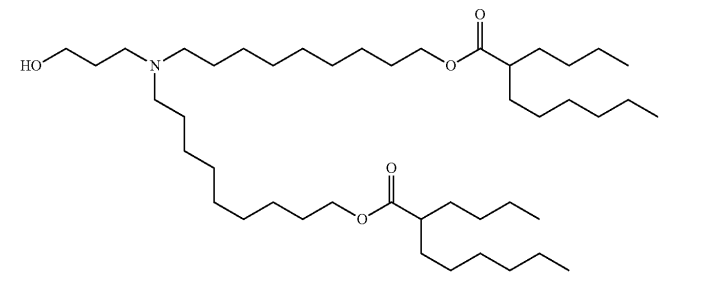
ALC-0366 is the ionizable lipid explicitly listed in the BNT142 RNA-LNP formulation disclosed in US20250009780A1. The patent reports formulation composition, in vivo production of a CLDN6×CD3-binding antibody and bounded preclinical tolerability data.
Research category: Ionizable lipids for in vivo T-cell engager
ALC-0366 is explicitly listed in the BNT142 formulation encoding the CLDN6/CD3 engager RiboMab02.1; the patent reports in vivo expression and pharmacokinetic studies. Route: Intravenous.
Open full Formulation & Performance →
BNT142 delivers RNA encoding RiboMab02.1. Its formulation and animal expression results provide a product-specific evidence record for ALC-0366, with patent evidence distinguished from peer-reviewed comparative lipid research.
Example 1, Table 2 explicitly names ALC-0366 and gives its chemical identity as ((3-hydroxypropyl)azanediyl)bis(nonane-9,1-diyl) bis(2-butyloctanoate). This is a direct match, not an inferred platform association.
| Component | DC Chemicals product | Molecular weight | Reported mg/mL | Calculated mass % |
|---|---|---|---|---|
| ALC-0366 | DC60478 | 724.2 | 10.64 | 54.90% |
| ALC-0159 | DC52020 | Not established | 1.35 | 6.97% |
| DSPC | DC57005 | 790.15 | 2.43 | 12.54% |
| Cholesterol | DCD-041 | 386.65 | 4.96 | 25.59% |
Table 2 reports mass concentrations, not molar percentages. RNA drug substance is 1.0 mg/mL. Calculated total lipid is 19.38 mg/mL, giving total lipid:RNA 19.38:1 by mass. An exact ALC-0159 molecular-weight convention is not supplied, so an exact molar conversion is not asserted.
Scales the patent mass concentrations to a selected dispersion volume. This calculation does not establish molar percentages or N/P.
| Component | Concentration (mg/mL) | Calculated mass (mg) |
|---|---|---|
| ALC-0366 | ||
| ALC-0159 | ||
| DSPC | ||
| Cholesterol |
| Component | Concentration | Basis |
|---|---|---|
| RNA drug substance | 1.0 mg/mL | Published Table 2 |
| ALC-0366 | 10.64 mg/mL | Published Table 2 |
| ALC-0159 | 1.35 mg/mL | Published Table 2 |
| DSPC | 2.43 mg/mL | Published Table 2 |
| Cholesterol | 4.96 mg/mL | Published Table 2 |
| Total lipid:RNA | 19.38:1 by mass | Calculated from Table 2; not N/P |
US20250009780A1, Example 1, [0681], PDF p86 / printed p70.
| Parameter | Patent description | Interpretation |
|---|---|---|
| Particle size | Approximately 50–100 nm | Product range, not a measured single-batch mean |
| PDI | ≤0.2 | Described product range |
| pH | 6.9–7.9 | Dispersion specification range |
| Osmolality | 425–625 mOsmol/kg | Dispersion specification range |
Example 1, [0682], PDF p86 / printed p70.
| System | Finding | Interpretation |
|---|---|---|
| Human PBMC/target-cell assays | RiboMab02.1-containing serum from BNT142-treated mice induced target-dependent T-cell activation with CLDN6-positive cells; high concentrations also produced off-target activation. | Patent [0694]–[0695], Figure 5; payload activity after delivery, not intrinsic free-lipid cytotoxicity |
| Humanized OV-90 xenograft model | BNT142-treated groups showed tumor regression accompanied by greater T-cell infiltration and reduced tumor CLDN6 positivity relative to negative controls. | Patent [0696]–[0699], Figure 6; preclinical formulation-plus-payload outcome, not a comparison isolating ALC-0366 performance |
PDF p88 / printed p72. These assays support functionality of the expressed antibody; they do not establish that ALC-0366 alone causes tumor-cell killing.
| Study | Reported result | Source |
|---|---|---|
| Five weekly administrations in mice | No loss of translation reported across administrations; final peak serum antibody levels up to 7.4 and 46 μg/mL in the 10 and 30 μg RNA groups | [0730], Figure 11; PDF p91 / printed p75 |
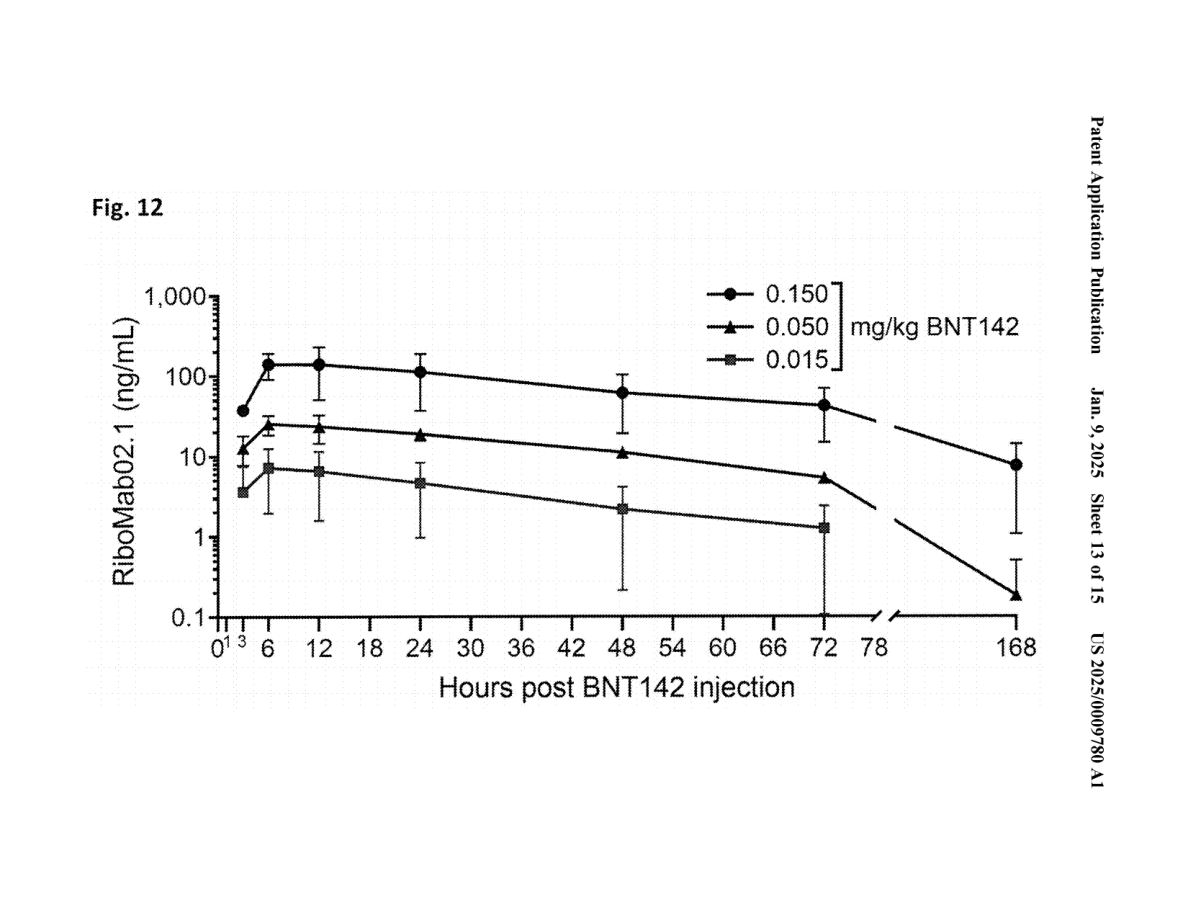
| Female cynomolgus monkeys, n=3/group | 0.015, 0.05 and 0.15 mg/kg IV BNT142 produced mean RiboMab02.1 Cmax values of 7.3, 27.5 and 155.0 ng/mL; median Tmax 6 hours | [0731], Figure 12, Table 4; PDF pp91–92 |
| Protein duration | Detectable to 72 h in the low group and 168 h in the two higher groups; effective half-life 27–37 h | Lower-dose estimates affected by assay LLOQ 0.1 ng/mL |
These are concentrations of the encoded antibody after BNT142 administration; they are not free ALC-0366 concentrations.
| Context | Reported observation | Boundary |
|---|---|---|
| Single-dose monkey assessment | Up to 0.15 mg/kg tolerated without treatment-associated changes in the reported clinical, clinical-pathology, cardiovascular or cytokine assessments | Patent non-GLP study; finite dose and observation window |
| Higher-dose mouse RNA-LNP studies | Cytokine elevations and liver/spleen effects occurred; most findings reversed or improved during recovery | Some studies used luciferase-RNA surrogates; cannot describe ALC-0366 as universally nontoxic |
| Payload relevance | Encoded antibody was not pharmacologically active in the evaluated animal species | The animal RNA-LNP safety assessment does not fully test antibody-mediated human effects |
PDF pp94–95 / printed pp78–79, Single-Dose Pharmacokinetic and Tolerability Study and Summary of Toxicology Studies.
| CAS No. | Not available |
| Chemical Name | ALC-0366 |
| Synonyms | ALC0366, ALC 0366,ALC366, ALC 366, ALC-366 |
| SMILES | OCCCN(CCCCCCCCCOC(C(CCCC)CCCCCC)=O)CCCCCCCCCOC(C(CCCC)CCCCCC)=O |
| Formula | C45H89NO5 |
| M.Wt | 724.2 |
| Purity | >95% by ELSD-HPLC |
| Storage | Pure form: −20 °C, 1 year; In solvent: −80 °C, 6 months; −20 °C, 1 month. Sealed and protected from light. |
| Shipping condition | Ships from Shanghai. Pure lipid is stable during ice-pack transport. |
| Publication |
The product molecular weight is prefilled when available and remains editable. Confirm solvent compatibility and solubility before preparation.
Solvent volumes update from the molecular weight above.
| Mass | 1 mM | 5 mM | 10 mM |
|---|---|---|---|
| 10 mg | 13.8083 mL | 2.7617 mL | 1.3808 mL |
| 25 mg | 34.5209 mL | 6.9042 mL | 3.4521 mL |
| 50 mg | 69.0417 mL | 13.8083 mL | 6.9042 mL |
| 100 mg | 138.0834 mL | 27.6167 mL | 13.8083 mL |
| 250 mg | 345.2085 mL | 69.0417 mL | 34.5209 mL |
Contact our team with the catalog number and requested quantity.