C18 NC-TNP
DC60537
Recommended because it shares a closely related research category or delivery context. Formulation and performance are product- and study-specific.
View product →
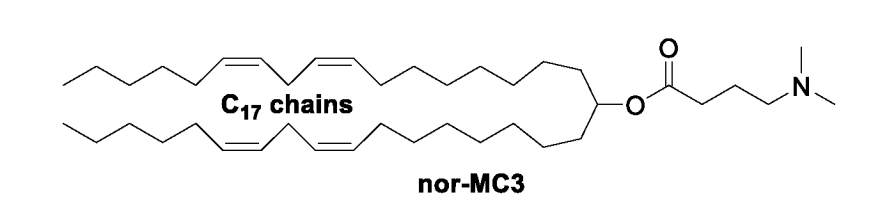
Ionizable lipid for LNP and nucleic-acid delivery research.
nor-MC3 is a novel ionizable lipid develoed by Nanovation, derived from the MC3 structural framework, characterized by two C17 alkyl chains (each containing two Z-geometry double bonds) conjugated to a 4-(dimethylamino)butanoate headgroup. Synthesized via a streamlined route involving Claisen condensation of methyl linoleate, hydrolysis/decarboxylation to generate a C17 ketone, reduction to the corresponding alcohol, and final esterification with 4-(dimethylamino)butanoic acid, nor-MC3 retains the ionizable amine functionality critical for pH-dependent nucleic acid binding and endosomal escape. Compared to the benchmark lipid MC3 (C18 chains), nor-MC3 demonstrates superior mRNA delivery efficiency in vitro (2-fold higher luciferase expression at 10 μg/mL mRNA) and enhanced in vivo biodistribution (higher liver and spleen targeting in mice). Notably, its shortened C17 chains challenge conventional assumptions about optimal hydrophobic chain length, offering improved synthetic scalability while maintaining or exceeding MC3's encapsulation efficiency (~95%), nanoparticle size (~80 nm), and low polydispersity (PDI ~0.08). For siRNA delivery, nor-MC3 achieves comparable EC₅₀ values (0.1644 μg/mL vs. MC3’s 0.1308 μg/mL), highlighting its versatility as a next-generation lipid nanoparticle (LNP) component for nucleic acid therapeutics.
| CAS No. | Not available |
| Chemical Name | nor-MC3 |
| Synonyms | norMC3, nor MC3 |
| SMILES | CCCCC/C=C\C/C=C\CCCCCCCC(CCCCCCC/C=C\C/C=C\CCCCC)OC(=O)CCCN(C)C |
| Formula | C41H75O2N |
| M.Wt | 614.06 |
| Purity | >98% |
| Storage | Pure form: −20 °C, 1 year; In solvent: −80 °C, 6 months; −20 °C, 1 month. Sealed and protected from light. |
| Shipping condition | Ships from Shanghai. Pure lipid is stable during ice-pack transport. |
| Publication | Not available |
The product molecular weight is prefilled when available and remains editable. Confirm solvent compatibility and solubility before preparation.
Solvent volumes update from the molecular weight above.
| Mass | 1 mM | 5 mM | 10 mM |
|---|---|---|---|
| 10 mg | 16.2851 mL | 3.2570 mL | 1.6285 mL |
| 25 mg | 40.7126 mL | 8.1425 mL | 4.0713 mL |
| 50 mg | 81.4253 mL | 16.2851 mL | 8.1425 mL |
| 100 mg | 162.8505 mL | 32.5701 mL | 16.2851 mL |
| 250 mg | 407.1263 mL | 81.4253 mL | 40.7126 mL |
Contact our team with the catalog number and requested quantity.