C18 NC-TNP
DC60537
Recommended because it shares a closely related research category or delivery context. Formulation and performance are product- and study-specific.
View product →
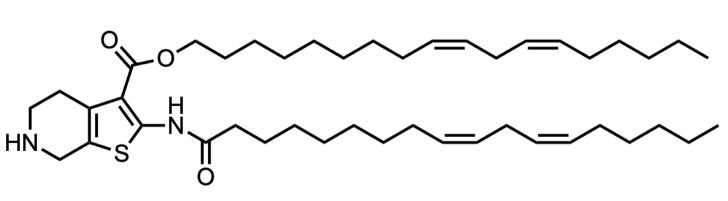
Ionizable lipid for LNP and nucleic-acid delivery research.
Lipid 20b is a thiophene-based ionizable lipid synthesized via the Gewald reaction. It features dual unsaturated linoleic tails (C18:2) attached to the same side of the thiophene core and a tertiary amine headgroup. Formulated into LNPs (~100 nm, PDI ~0.2) with DSPC/cholesterol/DMG-PEG, it exhibits high mRNA encapsulation (>90%). Unlike traditional lipids, 20b lacks a pH-dependent ionization profile, likely due to electron delocalization in the thiophene ring. Intravenously, 20b LNPs transfect the liver and spleen in mice. Notably, subretinal delivery in mice and non-human primates (NHPs) achieved robust mRNA expression in photoreceptors (35% rods, 45% cones at high dose) and retinal pigment epithelium (RPE) with minimal acute toxicity. Immunosuppression enhanced rod transfection efficiency. High-dose administration in NHPs caused subretinal debris, but low doses (2.5 µg mRNA) maintained retinal health. This lipid demonstrates potential for liver and retinal gene therapy.
| CAS No. | Not available |
| Chemical Name | Lipid 20b |
| Synonyms | Lipid-20b |
| SMILES | Not available |
| Formula | C44H72N2O3S |
| M.Wt | 709.12 |
| Purity | >98% |
| Storage | Pure form: −20 °C, 1 year; In solvent: −80 °C, 6 months; −20 °C, 1 month. Sealed and protected from light. |
| Shipping condition | Ships from Shanghai. Pure lipid is stable during ice-pack transport. |
| Publication | Thiophene-based lipids for mRNA delivery to pulmonary and retinal tissues-PNAS-March 4, 2024 121 (11) e2307813120 |
The product molecular weight is prefilled when available and remains editable. Confirm solvent compatibility and solubility before preparation.
Solvent volumes update from the molecular weight above.
| Mass | 1 mM | 5 mM | 10 mM |
|---|---|---|---|
| 10 mg | 14.1020 mL | 2.8204 mL | 1.4102 mL |
| 25 mg | 35.2550 mL | 7.0510 mL | 3.5255 mL |
| 50 mg | 70.5099 mL | 14.1020 mL | 7.0510 mL |
| 100 mg | 141.0199 mL | 28.2040 mL | 14.1020 mL |
| 250 mg | 352.5496 mL | 70.5099 mL | 35.2550 mL |
Contact our team with the catalog number and requested quantity.