Sail lipid 7669
DC68208
Recommended because it shares a closely related research category or delivery context. Formulation and performance are product- and study-specific.
View product →
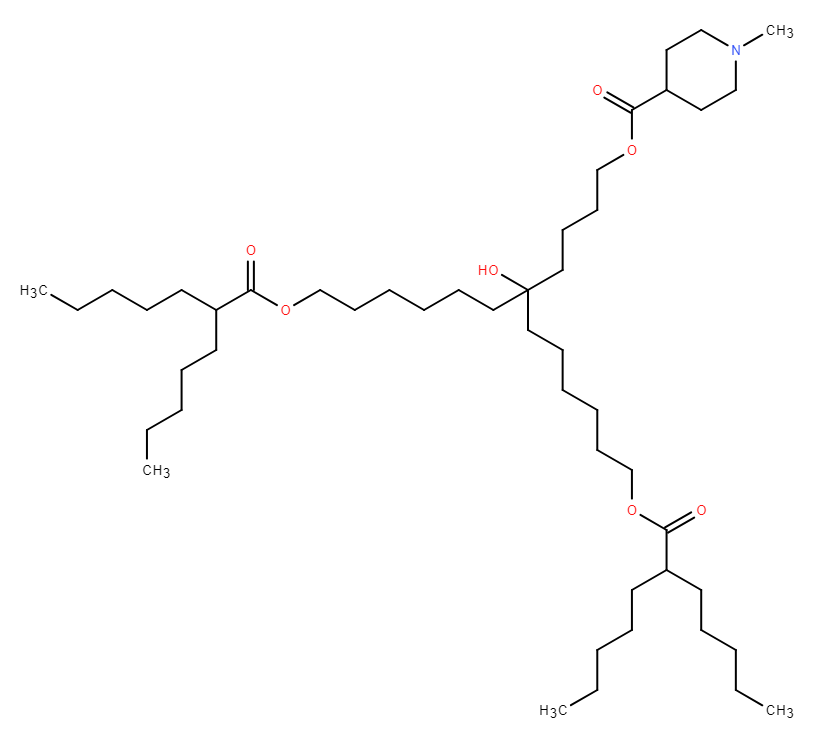
Ionizable lipid for LNP and nucleic-acid delivery research.
CL15F 7-5 is a piperidine-based ionizable lipid from the CL15F library, characterized by a symmetrically branched tail structure with a 7-carbon main chain and a 5-carbon side chain. This moderate tail length positions it between short-tail (e.g., CL15F 6-4) and long-tail (e.g., CL15F 14-12) variants, granting it a unique balance in mRNA delivery properties. Its LNPs exhibit optimized organ selectivity, enabling significant mRNA expression in both the spleen and muscle, as demonstrated by in vivo luciferase assays following intravenous and intramuscular administration. This lipid structure facilitates a favorable DSPC surface density on LNPs, which moderates interactions with serum proteins like ApoE, thereby reducing rapid hepatic clearance and promoting extrahepatic delivery. In vaccine applications, CL15F 7-5 LNPs encapsulating SARS-CoV-2 RBD mRNA elicited robust anti-RBD IgG titers and neutralizing antibodies in mice, outperforming the clinically benchmarked SM-102 lipid. The piperidine headgroup further contributes to storage stability by minimizing the generation of aldehyde impurities that can form mRNA-lipid adducts. Consequently, CL15F 7-5 represents a versatile lipid for developing stable, spleen-targeted mRNA vaccines and therapeutics, leveraging tail-length engineering for enhanced efficacy without complex formulation changes.
| CAS No. | Not available |
| Chemical Name | CL15F 7-5 |
| Synonyms | CL15F 7 5 |
| SMILES | CCCCCC(CCCCC)C(=O)OCCCCCCC(O)(CCCCCCOC(=O)C(CCCCC)CCCCC)CCCCOC(=O)C1CCN(C)CC1 |
| Formula | C48H91O7N |
| M.Wt | 794.26 |
| Purity | ELSD-HPLC>95% |
| Storage | Pure form: −20 °C, 1 year; In solvent: −80 °C, 6 months; −20 °C, 1 month. Sealed and protected from light. |
| Shipping condition | Ships from Shanghai. Pure lipid is stable during ice-pack transport. |
| Publication | Not available |
The product molecular weight is prefilled when available and remains editable. Confirm solvent compatibility and solubility before preparation.
Solvent volumes update from the molecular weight above.
| Mass | 1 mM | 5 mM | 10 mM |
|---|---|---|---|
| 10 mg | 12.5903 mL | 2.5181 mL | 1.2590 mL |
| 25 mg | 31.4758 mL | 6.2952 mL | 3.1476 mL |
| 50 mg | 62.9517 mL | 12.5903 mL | 6.2952 mL |
| 100 mg | 125.9034 mL | 25.1807 mL | 12.5903 mL |
| 250 mg | 314.7584 mL | 62.9517 mL | 31.4758 mL |
Contact our team with the catalog number and requested quantity.