C18 NC-TNP
DC60537
Recommended because it shares a closely related research category or delivery context. Formulation and performance are product- and study-specific.
View product →
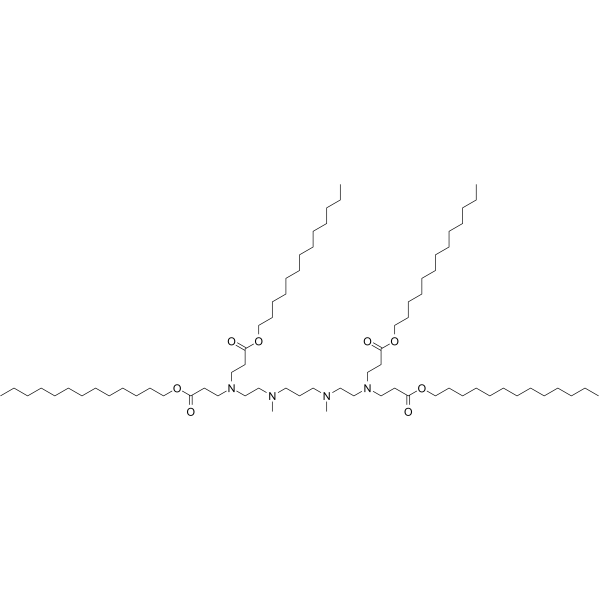
Components are supplied separately; this is not a premixed LNP. RNA/cargo, buffer and formulation service are not included.
| CAS No. | 1566560-20-0 |
| Chemical Name | 503O13 |
| Synonyms | 503-O13, 503O-13 |
| SMILES | O=C(CCN(CCN(CCCN(CCN(CCC(OCCCCCCCCCCCCC)=O)CCC(OCCCCCCCCCCCCC)=O)C)C)CCC(OCCCCCCCCCCCCC)=O)OCCCCCCCCCCCCC |
| Formula | C73H144N4O8 |
| M.Wt | 1205.975 |
| Purity | >95% by ELSD-HPLC |
| Storage | Pure form: −20 °C, 1 year; In solvent: −80 °C, 6 months; −20 °C, 1 month. Sealed and protected from light. |
| Shipping condition | Ships from Shanghai. Pure lipid is stable during ice-pack transport. |
| Publication | Whitehead KA, Dorkin JR, Vegas AJ, et al. Degradable lipid nanoparticles with predictable in vivo siRNA delivery activity. Nature Communications. 2014;5:4277. |
Study-specific compositions, preparation conditions and experimental outcomes for 503O13.
Complete 2014 article and 15-page supporting information rechecked, including visual review of the immune-cell and body-weight figures. Standard screening, optimized Factor VII dose response, and data from other lipidoids are separated.
Reported composition and calculated mass are separate. Molecular-weight inputs use catalog values or an explicitly identified reference average; DMG-PEG2000 is fixed initially at 2507. Edit inputs only when using a verified alternative material.
mol%Main article Results, p.4; Methods, p.8
| Component | Molecular weight | Molar parts | Normalized mol% | Amount (µmol) | Weight (mg) |
|---|---|---|---|---|---|
| 503O13 | 50.000 | 57.5727 | 69.4312 | ||
| Cholesterol | 38.500 | 44.3309 | 17.1406 | ||
| DSPC | 10.000 | 11.5145 | 9.0982 | ||
| DMG-PEG2000 | 1.500 | 1.7272 | 4.3300 |
Calculated total: 100.0000 mg lipid. RNA, solvent and process loss are excluded.
Optimized ratio not disclosedFig.6d and Results, pp.7–8; general formulation method does not identify the exact optimized 503O13 composition
| Component | Molecular weight | Reported molar entry | Calculated mass |
|---|---|---|---|
| 503O13 | 1205.975 | Not recovered | Not calculated |
| Cholesterol | 386.65 | Not recovered | Not calculated |
| DSPC | 790.15 | Not recovered | Not calculated |
| DMG-PEG2000 | 2507 | Not recovered | Not calculated |
No complete mass recipe is generated for this formulation while composition or identity-dependent inputs remain unresolved.
The paper specifies mPEG2000-DMG molecular weight 2660. The website component calculator uses the catalog convention DMG-PEG2000 = 2507; its calculated masses therefore represent the catalog component, not an exact recreation of that historical PEG grade.
For total lipid mass M (mg), molar parts rᵢ and molecular weight MWᵢ: component mass = M × rᵢ × MWᵢ / Σ(r × MW). Component amount (µmol) = component mass (mg) × 1000 / MWᵢ. Molar parts are normalized only for the displayed percentage. The calculation does not infer N/P or RNA dose.
| Parameter | Reported procedure / limitation | Source |
|---|---|---|
| Organic phase | Lipidoid, cholesterol, DSPC and mPEG2000-DMG were dissolved in 90% ethanol plus 10% 10 mM sodium citrate by volume. | Methods: Formulation of LNPs, p.8 |
| Aqueous phase and loading | siRNA was diluted in 10 mM sodium citrate. Lipidoid:siRNA was 5:1–10:1 by mass depending on the experiment. This is not a total-lipid:siRNA mass ratio; no N/P value is specified. | Methods: Formulation of LNPs, p.8 |
| Mixing | Equal volumes of lipid and siRNA solutions were rapidly mixed by microfluidic device or pipetting. The paper does not assign a specific mixing implementation to each 503O13 experiment. | Methods: Formulation of LNPs, p.8 |
| Buffer exchange | Dilution in PBS followed by dialysis against PBS for 90 min using a 3,500-MWCO cassette. | Methods: Formulation of LNPs, p.8 |
| Optimization boundary | The general series used 50:38.5:(11.5−X):X lipidoid/cholesterol/DSPC/PEG-lipid. The specific X for optimized 503O13 is not supplied. The separately optimized 304O13 PEG fraction cannot be transferred to 503O13. | Methods p.8; Results p.4 and Fig.6d |
| Unreported process details | Buffer pH, precise microfluidic flow settings, final concentration and an experiment-specific 503O13 loading ratio are not reported in the recovered method. A sterile-filtration step is not stated there. | Methods p.8 |
| Measurement / batch | Reported result | Evidence context |
|---|---|---|
| Particle diameter / PDI / encapsulation | No numerical 503O13-specific values recovered. Table 1 describes other individual lipidoids; library ranges are not product-specific specifications. | Main article Table 1 and Fig.6 |
| Apparent particle pKa | The 500-series text places 503O13 among candidates satisfying pKa ≥5.5; no exact 503O13 value is tabulated. | Results p.6 and Fig.6 |
| Tolerability endpoint | 503O13 appears in the 5 mg/kg siRNA body-weight panel; this is a limited body-weight endpoint, not a full toxicology assessment. | Supplementary Fig.9, PDF p.13 |
| Experiment and dose | Readout and comparator | Result and source |
|---|---|---|
| Initial hepatic Factor VII screen Female C57BL/6 mice ≥6 weeks; anti-FVII siRNA; intravenous tail vein; 5 mg/kg siRNA; injection volume 0.01 mL/g | Readout: 48 h Comparator: PBS / FVII baseline | 503O13 is among the 500-series formulations producing >95% FVII silencing. The exceptions identified by the authors were 509O13 and 510O13. n=3; mean±SD.Fig.6b; Results pp.6–8; In vivo gene silencing, p.9 |
| Unoptimized dose-response ranking 503O13 screening formulation; female C57BL/6 mice; intravenous anti-FVII siRNA | Readout: 48 h Comparator: Other second-generation lipidoids at the screening composition | Nonoptimized 503O13 EC50 is approximately 0.05 mg/kg by the plotted bar; this is an approximate graphical value. It is separate from the optimized 0.01 mg/kg result.Fig.6c, p.7 |
| Optimized Factor VII dose response Optimized 503O13 LNP; intravenous anti-FVII siRNA; doses plotted 5, 0.5, 0.1, 0.03, 0.01 and 0.003 mg/kg | Readout: 48 h Comparator: 503O13 with nontargeting siRNA | Reported EC50 0.01 mg/kg siRNA. The nontargeting control did not suppress FVII. n=3; mean±SD; one-way ANOVA F(6,14)=86.69, P<0.0001; Tukey comparison P<0.05 for each tested active-siRNA dose versus siControl.Fig.6d and caption, p.7; Results p.8 |
| Body-weight screen 500-series LNPs including 503O13; 5 mg/kg siRNA | Readout: Time point not specified in the figure caption Comparator: PBS | No statistically significant body-weight decrease versus PBS by Student’s t-test. The 503O13 group has three plotted animals; no 503O13-specific cytokine, clinical-chemistry or histology conclusion follows from this panel.Supplementary Fig.9, PDF p.13 |
503O13 is an ester-containing lipidoid selected within a structure–activity framework involving O13 tails, multiple substitution sites, a tertiary amine and sufficient apparent particle pKa. These are library-level predictive associations. Direct 503O13-specific trafficking and endosomal-escape measurements were not recovered.
Results apply to the stated LNP composition, cargo, process, dose, route and model. LNP experimental measurements are not batch-release specifications for the isolated lipid.
Whitehead KA, Dorkin JR, Vegas AJ, et al. Degradable lipid nanoparticles with predictable in vivo siRNA delivery activity. Nature Communications. 2014;5:4277.
Download experiment table (CSV) · Open printable Formulation & Performance guide
Revision FP-20261024-b2 · Source review: 24 October 2026 · DC Chemicals
The product molecular weight is prefilled when available and remains editable. Confirm solvent compatibility and solubility before preparation.
Solvent volumes update from the molecular weight above.
| Mass | 1 mM | 5 mM | 10 mM |
|---|---|---|---|
| 10 mg | 8.2920 mL | 1.6584 mL | 829.20 μL |
| 25 mg | 20.7301 mL | 4.1460 mL | 2.0730 mL |
| 50 mg | 41.4602 mL | 8.2920 mL | 4.1460 mL |
| 100 mg | 82.9205 mL | 16.5841 mL | 8.2920 mL |
| 250 mg | 207.3011 mL | 41.4602 mL | 20.7301 mL |
Contact our team with the catalog number and requested quantity.