Additional lipid-related research products retained from the source catalog when a more specific LNP category has not yet been assigned. Review each product page for its actual chemical identity and intended research use.
10 products currently listedResearch-use products only
Evidence noteCategory membership indicates research relevance. Organ targeting, cell specificity and performance must be verified from the formulation and study conditions cited for each product.
503O13 is a next-generation, biodegradable lipid nanoparticle (LNP) engineered for highly efficient and targeted siRNA delivery. Designed through rational structure-activity criteria—including optimal tail length (O13), tertiary amines, and a surface pKa ≥5.5—this single-component LNP achieves unparalleled gene silencing with an ultra-low EC50 of 0.01 mg/kg in preclinical models.503O13 outperforms non-degradable counterparts (e.g., C12-200) with improved toxicity profiles—no hepatic necrosis or pancreatic inflammation—while maintaining rapid blood clearance (t1/2: 6 min) and organ-specific accumulation (liver/spleen).
246C10 is a synthesized ionizable lipid. 246C10 can be formulated into lipid nanoparticles (LNPs) with dioleoylphosphatidylethanolamine (DOPE), cholesterol, and C16-PEG2000 ceramide (PEG-lipid) as well as mRNA. The lipid nanoparticle formulations can be used for mRNA delivery. To obtain iLNPs that could specifically target liver sinusoidal endothelial cells (LSECs), six different ionizable lipids (241C10 to 246C10) were synthesized by an epoxide ring-opening reaction with piperazine- or piperidine-containing amines. Biodistribution and gene regulation of various iLNPs were assessed in vivo, and the results showed that the 246C10 iLNPs (containing piperazine amine) had the highest luciferase expression in the liver. When further analyzing the 246C10 iLNPs transfection efficiency in different types of liver cells, it was found that tdTomato fluorescence was mainly concentrated in hepatocytes, not in LSECs. Figure 6f shows that 80% of hepatocytes are fluorescent, 40% of LSECs are fluorescent, and 20% of Kupffer cells are fluorescent. Due to the mannose receptor on LSECs, mannose-PEG lipid was introduced into 246C10 iLNPs to alter the distribution of iLNPs in different liver cells. As shown in Figure 6g, tdTomato fluorescence distribution was 15% of hepatocytes, 70% of LSECs, and 15% of Kupffer cells, significantly improved the ability of iLNPs to actively target LSECs. In contrast, this work indirectly shows that the iLNPs with piperazine head lipid are more able to deliver mRNA to the liver and translate the target protein than the iLNPs with piperidine head lipid. It is worth mentioning that the preparation buffer of 246C10 iLNPs could influence the encapsulation efficiency of mRNA. With the addition of sodium chloride in the citrate buffer, the encapsulation efficiency of CRISPR-Cas9 mRNA and sgRNA was increased. These iLNPs were able to treat hemophilia safely, without causing hepatotoxicity, the immune response induced by Cas9 and off-target editing.
98N12-5 is an ionizable cationic lipid. It has been used in combination with other lipids in the generation of lipid nanoparticles (LNPs). LNPs containing 98N12-5 and encapsulating proprotein convertase subtilisin kexin type 9 (PCSK9) siRNA selectively accumulate in the liver and reduce total serum cholesterol levels in mice and rats and serum LDL levels in cynomolgus monkeys.
YSK 05 is a pH-sensitive cationic lipid. YSK 05 improves the intracellular trafficking of non-viral vectors. YSK 05-MEND shows significantly good gene silencing activity and hemolytic activity. YSK 05 overcomes the suppression of endosomal escape by PEGylation. YSK 05 effectively enhances siRNA delivery both in vitro and in vivo.
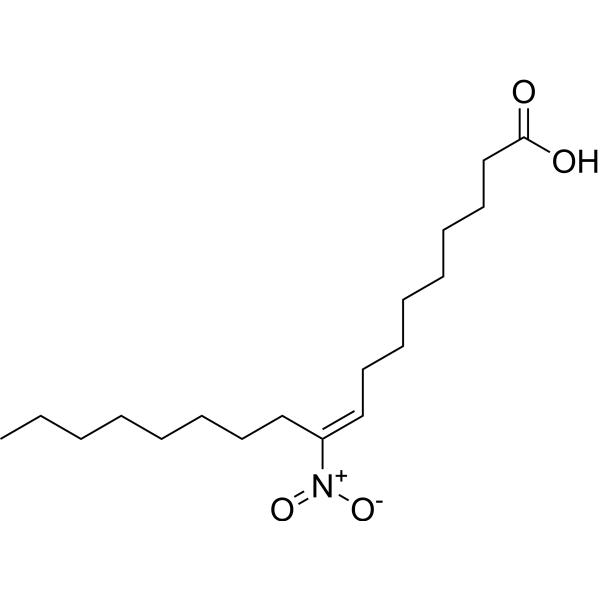
10-Nitrooleic acid (CXA-10), a nitro fatty acid, has potential effects in disease states in which oxidative stress, inflammation, fibrosis, and/or direct tissue toxicity play significant roles.
CLinDMA, a cationic lipid known to potentially trigger inflammatory responses, is utilized in the synthesis of LNP201. This liposome-based assembly is specifically designed for the systemic delivery of siRNA.
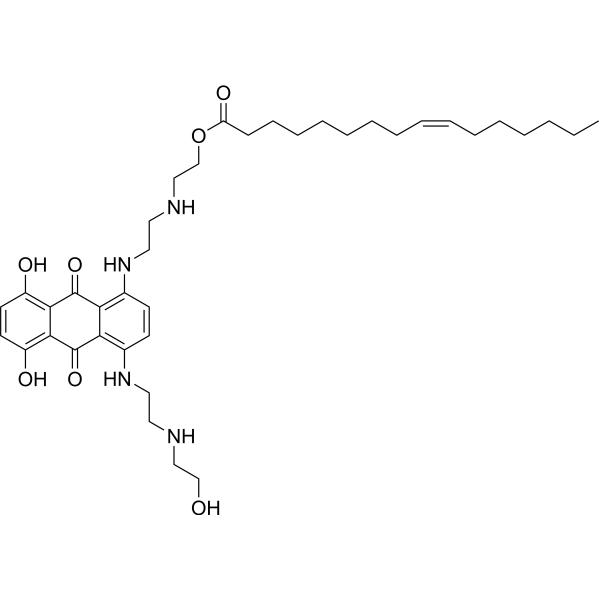
mono-Pal-MTO is a palm oil-based lipid produced by combining the anticancer drug mitoxantrone (MTO) with palmitoleic acid. When nanoparticles of mono-Pal-MTO and di-Pal-MTO are combined in a molar ratio of 1:1, they show effective siRNA cell delivery and enhance anticancer activity.
di-Pal-MTO is a palm oil-based lipid produced by combining the anticancer drug mitoxantrone (MTO) with palmitoleic acid. When nanoparticles of mono-Pal-MTO and di-Pal-MTO are combined in a molar ratio of 1:1, they show effective siRNA cell delivery and enhance anticancer activity.






.png)