DLin-MC3-DMA
DC10800
Recommended because it shares a closely related research category or delivery context. Formulation and performance are product- and study-specific.
View product →

Components are supplied separately; this is not a premixed LNP. RNA/cargo, buffer and formulation service are not included.
ssPalmO-Phe is a self-degradable ionizable lipid-like material studied for hepatic delivery of siRNA and antisense oligonucleotides. The reported siRNA and ASO formulations differ in composition and loading. Strong knockdown was accompanied by cargo-dependent liver toxicity in the ASO experiments.
Open full Formulation & Performance →
This review distinguishes siRNA potency, ASO potency, particle recovery and encapsulation, and the safety of loaded versus empty particles.
The results below describe the cited research formulations. Product specifications and commercial pack options are shown in the Specifications and ordering sections.
| Component | DC Chemicals product | Molecular weight | Molar ratio | Mass at 1 µmol total lipid (mg) |
|---|---|---|---|---|
| ssPalmO-Phe | DC59002 | 1173.777 | 70 | 0.809501 |
| Cholesterol | DCD-041 | 386.65 | 30 | 0.114281 |
| DMG-PEG2000 | DC40169 | 2507 | 1.5 | 0.037049 |
siRNA formulation: ssPalmO-Phe/cholesterol = 70:30 with an additional 1.5 parts DMG-PEG2000; lipid/siRNA = 400 nmol/µg. The displayed 70:30:1.5 parts are normalized only for mass calculations. The 400 nmol/µg value is neither a weight ratio nor N/P. ASO uses the separate four-component composition below.
Prefilled proportions follow the source specified above. Molecular weights and ratios are editable. Results are calculated, not measured study data. No N/P or RNA dose is inferred.
| Component | MW | Molar ratio | Mass (mg) | Mass % |
|---|---|---|---|---|
| ssPalmO-Phe | ||||
| Cholesterol | ||||
| DMG-PEG2000 |
| Component | DC Chemicals product | Molecular weight | Molar ratio | Mass at 1 µmol total lipid (mg) |
|---|---|---|---|---|
| ssPalmO-Phe | DC59002 | 1173.777 | 40 | 0.462572 |
| DOPC | DC33653 | 786.11 | 20 | 0.154899 |
| Cholesterol | DCD-041 | 386.65 | 40 | 0.152374 |
| DMG-PEG2000 | DC40169 | 2507 | 1.5 | 0.037049 |
ssPalmO-Phe/DOPC/cholesterol = 40:20:40 plus 1.5 parts DMG-PEG2000. Lipid/ASO = 25 nmol/µg. The sum of the displayed parts is 101.5; this is not the siRNA composition. Main text Section 3.5 and Table 3.
Prefilled proportions follow the source specified above. Molecular weights and ratios are editable. Results are calculated, not measured study data. No N/P or RNA dose is inferred.
| Component | MW | Molar ratio | Mass (mg) | Mass % |
|---|---|---|---|---|
| ssPalmO-Phe | ||||
| DOPC | ||||
| Cholesterol | ||||
| DMG-PEG2000 |
| Preparation | Measured properties | Source / distinction |
|---|---|---|
| 1.5% PEG addition, siRNA formulation | 112 nm; PDI 0.135; zeta potential −4.6 mV | Main Table 1. |
| Same preparation | 64% siRNA recovery; 100% encapsulation efficiency | Recovery is the fraction of input recovered; encapsulation is a different measurement. |
| 3% PEG head-group comparison | 96 nm; PDI 0.079; zeta potential −6 mV; 46% recovery; 100% encapsulation | Main Table 2; a distinct preparation, not the 1.5% PEG row. |
| Surface pKa | 5.97 ± 0.06 | Main Fig. 6b; head-group comparison context. |
| Model / endpoint | Dose / timing | Result |
|---|---|---|
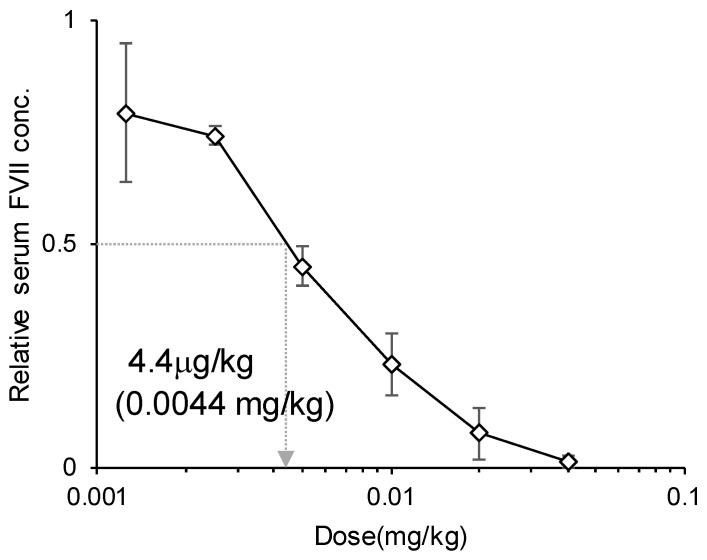
| Mouse plasma factor VII | IV siRNA; 24 h; n = 3 | ED50 = 4.4 µg/kg (Main Fig. 4). |
| Higher tested dose | 40 µg/kg siRNA; 24 h | 98.7 ± 1.3% factor VII knockdown (Main Fig. 4). |
These results belong to the optimized siRNA formulation, not the ASO formulation.
| Cargo | Diameter / PDI / zeta potential | Loading measurement |
|---|---|---|
| ApoB-targeting ASO (ASOap) | 45 nm / 0.156 / −2.6 mV | 24.1% recovery; Table 3. |
| Nr3c1-targeting ASO (ASOgr) | 53 nm / 0.185 / +12 mV | 71.4% recovery; Table 3. |
| ASO encapsulation efficiency | Not reliably quantified | The authors report that the OliGreen assay without surfactant did not yield reliable fluorescence; recovery is not substituted for encapsulation. |
| Cargo / target | LNP versus naked ASO | Study context |
|---|---|---|
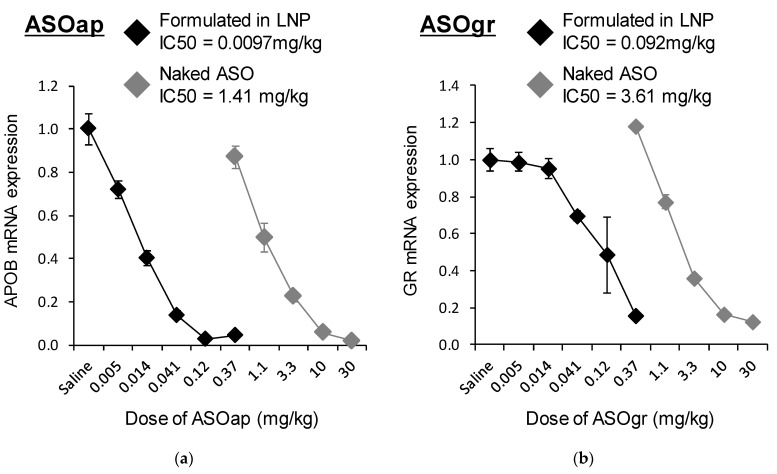
| ASOap / ApoB | IC50 0.0097 versus 1.41 mg/kg; 146-fold dose difference | IV; liver gene expression at 96 h; n = 4; Main Fig. 8a. |
| ASOgr / Nr3c1 | IC50 0.092 versus 3.61 mg/kg; 39.3-fold dose difference | IV; liver gene expression at 96 h; n = 4; Main Fig. 8b. |
| Experiment | Finding | Interpretation |
|---|---|---|
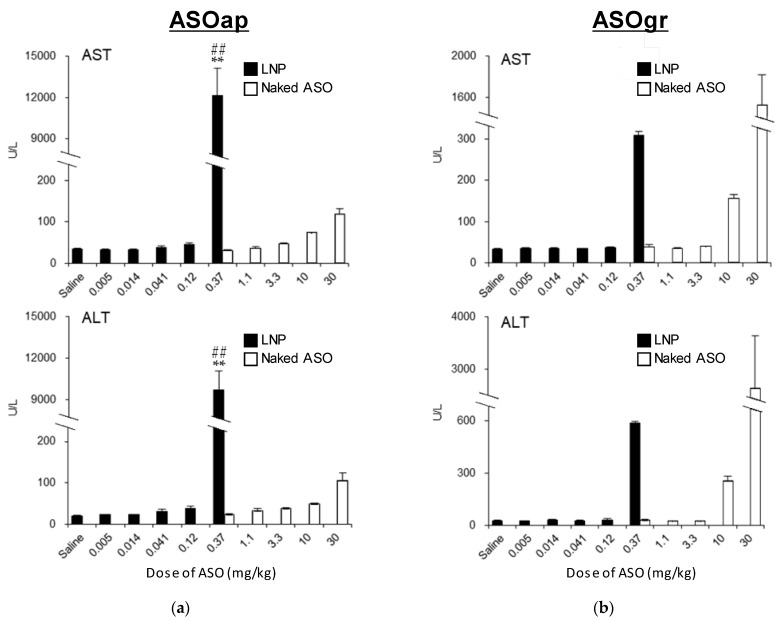
| ASOap-loaded LNP | Severe hepatotoxicity at the 0.37 mg/kg ASO dose | Main Fig. 9. Potency improvements did not eliminate ASO-associated liver injury. |
| ASOgr-loaded LNP | AST/ALT elevations were also observed at 0.37 mg/kg, with lower magnitude than ASOap | Main Fig. 9b; both ASO-loaded formulations reveal toxicity at lower doses than the naked-ASO comparators. |
| Empty ASO-composition LNP | No significant AST/ALT elevation reported over 49–782 mg/kg total lipid (29–470 mg/kg ssPalmO-Phe), at 96 h | Main Fig. 10. This is not evidence that loaded LNPs are safe over that range. |
| Other formulation context | The discussion cites liver-enzyme elevation at high doses for a different mRNA composition | Safety depends on composition, cargo, dose and observation window; empty-particle results cannot be generalized. |
| CAS No. | 2377474-67-2 |
| Chemical Name | ssPalmO-Phe |
| Synonyms | Benzeneacetic acid, 4-[[(9Z )-1-oxo-9-octadecen-1-yl]oxy]-, 1,1′-[dithiobis(2,1-ethanediyl-1,4-piperidinediyl-2,1-ethanediyl)] ester (ACI);ssPalmOPhe, ssPalmO Phe |
| SMILES | C(C(OCCC1CCN(CCSSCCN2CCC(CCOC(CC3=CC=C(OC(CCCCCCC/C=C\CCCCCCCC)=O)C=C3)=O)CC2)CC1)=O)C4=CC=C(OC(CCCCCCC/C= C\CCCCCCCC)=O)C=C4 |
| Formula | C70H112N2O8S2 |
| M.Wt | 1173.777 |
| Purity | >95% by ELSD-HPLC |
| Storage | Pure form: −20 °C, 1 year; In solvent: −80 °C, 6 months; −20 °C, 1 month. Sealed and protected from light. |
| Shipping condition | Ships from Shanghai. Pure lipid is stable during ice-pack transport. |
| Publication |
The product molecular weight is prefilled when available and remains editable. Confirm solvent compatibility and solubility before preparation.
The paper reports 70/30 plus an additional 1.5 mol% DMG-PEG2000 (sum 101.5). The calculator retains those raw ratios and normalizes them only for lipid-component weighing. RNA, buffer, solvent, process loss and the 400 nmol/microgram loading are not included.
Solvent volumes update from the molecular weight above.
| Mass | 1 mM | 5 mM | 10 mM |
|---|---|---|---|
| 10 mg | 8.5195 mL | 1.7039 mL | 851.95 μL |
| 25 mg | 21.2988 mL | 4.2598 mL | 2.1299 mL |
| 50 mg | 42.5975 mL | 8.5195 mL | 4.2598 mL |
| 100 mg | 85.1951 mL | 17.0390 mL | 8.5195 mL |
| 250 mg | 212.9876 mL | 42.5975 mL | 21.2988 mL |
Contact our team with the catalog number and requested quantity.