Lipid 119-23
DC60605
Recommended because it shares a closely related research category or delivery context. Formulation and performance are product- and study-specific.
View product →
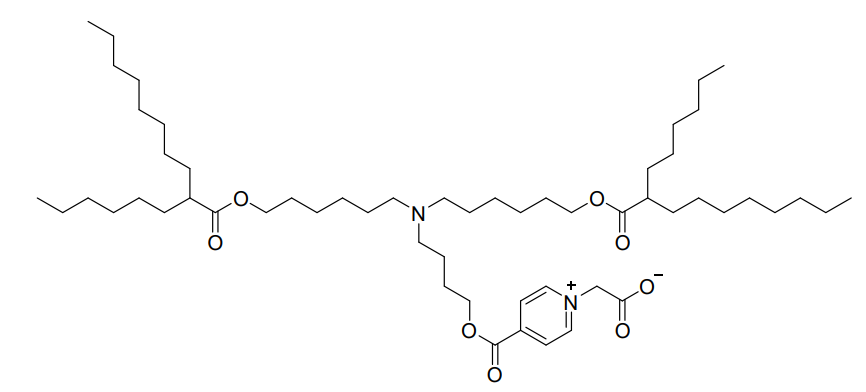
Ionizable lipid for LNP and nucleic-acid delivery research.
PyCB lipid (MeDZ) is a rationally designed zwitterionic ionizable lipid that serves as a core functional component in the novel three-component (ThrCo) lipid nanoparticle (LNP) platform. It is synthesized by covalently attaching a zwitterionic PyCB structure to the hydroxyl group of the clinically available ionizable lipid ALC-0315.Its key feature is its pH-responsive behavior. At physiological pH (~7.4), the PyCB headgroup exhibits zwitterionic properties, forming charge-assisted hydrogen bonds with water molecules (PyCB-H₂O complexes). This confers high hydrophilicity to the LNP surface, enhancing stability in aqueous environments and reducing nonspecific protein adsorption in the bloodstream. This zwitterionic surface effectively mimics and replaces PEGylated lipids, thereby avoiding PEG immunogenicity and the associated Accelerated Blood Clearance (ABC) effect upon repeated administrations.Crucially, in the acidic environment of endosomes (pH ~6.5), the PyCB group undergoes strong protonation, rapidly transforming into a cationic state (PyCB-H₃O⁺ complexes). This promotes efficient fusion with and disruption of the endosomal membrane, facilitating the escape and cytoplasmic release of encapsulated mRNA.By replacing both cholesterol and PEGylated lipids in traditional LNPs, PyCB lipid enables the redirection of LNP biodistribution from the liver to the spleen, achieving superior spleen-specific mRNA translation and enhancing antigen presentation for potent immune activation.
| CAS No. | Not available |
| Chemical Name | PyCB lipid |
| Synonyms | PyCBlipid, PyCB-lipid |
| SMILES | CCCCCCCCC(CCCCCC)C(=O)OCCCCCCN(CCCCCCOC(=O)C(CCCCCC)CCCCCCCC)CCCCOC(=O)C1=CC=[N+](CC(=O)[O-])C=C1 |
| Formula | C56H100N2O8 |
| M.Wt | 929.42 |
| Purity | ELSD-HPLC>95% |
| Storage | Pure form: −20 °C, 1 year; In solvent: −80 °C, 6 months; −20 °C, 1 month. Sealed and protected from light. |
| Shipping condition | Ships from Shanghai. Pure lipid is stable during ice-pack transport. |
| Publication | Not available |
The product molecular weight is prefilled when available and remains editable. Confirm solvent compatibility and solubility before preparation.
Solvent volumes update from the molecular weight above.
| Mass | 1 mM | 5 mM | 10 mM |
|---|---|---|---|
| 10 mg | 10.7594 mL | 2.1519 mL | 1.0759 mL |
| 25 mg | 26.8985 mL | 5.3797 mL | 2.6898 mL |
| 50 mg | 53.7970 mL | 10.7594 mL | 5.3797 mL |
| 100 mg | 107.5940 mL | 21.5188 mL | 10.7594 mL |
| 250 mg | 268.9850 mL | 53.7970 mL | 26.8985 mL |
Contact our team with the catalog number and requested quantity.