5A2-SC8
DC49907
Recommended because it shares a closely related research category or delivery context. Formulation and performance are product- and study-specific.
View product →
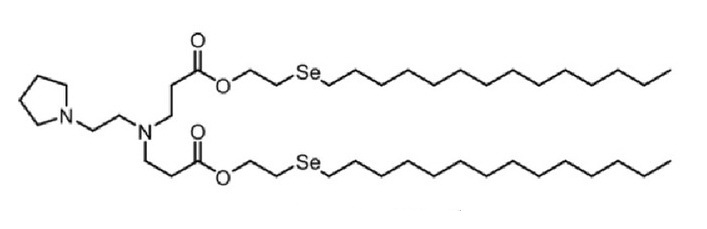
76-O17Se is a selenium-containing lipidoid investigated for intracellular delivery of mRNA and genome-editing proteins. In CAR-T cell engineering studies, 76-O17Se-based lipid nanoparticles delivered N1-methylpseudouridine-modified anti-CD19 CAR mRNA into CD8+ T lymphocytes. The resulting CAR-T cells demonstrated cytotoxic activity against B-cell lymphoma cells in vitro, supporting its application in nonviral mRNA delivery and transient immune-cell engineering research.
| CAS No. | Not available |
| Chemical Name | 76-O17Se |
| Synonyms | 76O17Se, 76 O17Se |
| SMILES | CCCCCCCCCCCCCC[Se]CCOC(=O)CCN(CCC(=O)OCC[Se]CCCCCCCCCCCCCC)CCN1CCCC1 |
| Formula | C44H86O4N2Se2 |
| M.Wt | 865.10 |
| Purity | >95% by ELSD-HPLC |
| Storage | Pure form: −20 °C, 1 year; In solvent: −80 °C, 6 months; −20 °C, 1 month. Sealed and protected from light. |
| Shipping condition | Ships from Shanghai. Pure lipid is stable during ice-pack transport. |
| Publication | Ye et al. ACS Biomater. Sci. Eng. 2022;8(2):722–733. |
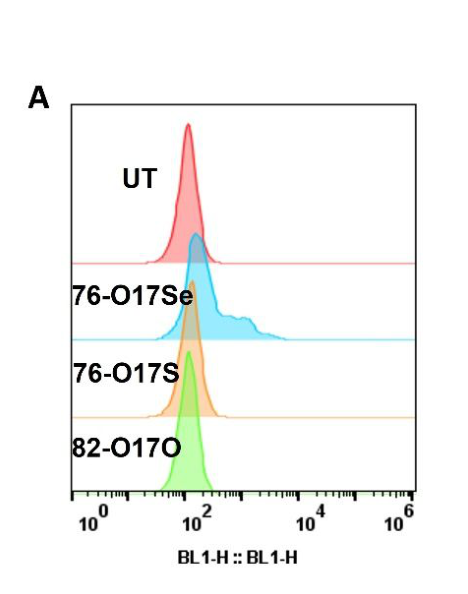
Anti-CD19 CAR-eGFP mRNA delivery was evaluated using 76-O17Se and related lipidoids. The observations below are tied to the explicitly labeled panels in the study's supporting information.
| Active lipidoid | 76-O17Se |
|---|---|
| System | Unformulated lipidoid nanoparticles. The article describes 76-O17Se without added helper lipids; a conventional four-component molar recipe is not assigned here. |
| Cargo | Anti-CD19 CAR-eGFP mRNA |
| Model / delivery | Human primary CD8+ T cells; in vitro cell transfection |
| Comparators | 76-O17S, 82-O17O and untreated cells (Figure S5A) |
| N/P / preparation | N/P ratio, full mixing procedure and buffer conditions are not established by the supplied supporting information. |
Sources: article formulation description; supporting information, Figure S5A, p. S6. The complete preparation method should be checked in the main article before reproducing the experiment.
Figure S5A shows the anti-CD19-eGFP fluorescence distribution in human primary CD8+ T cells after delivery using 76-O17Se, alongside related lipidoids and an untreated control.
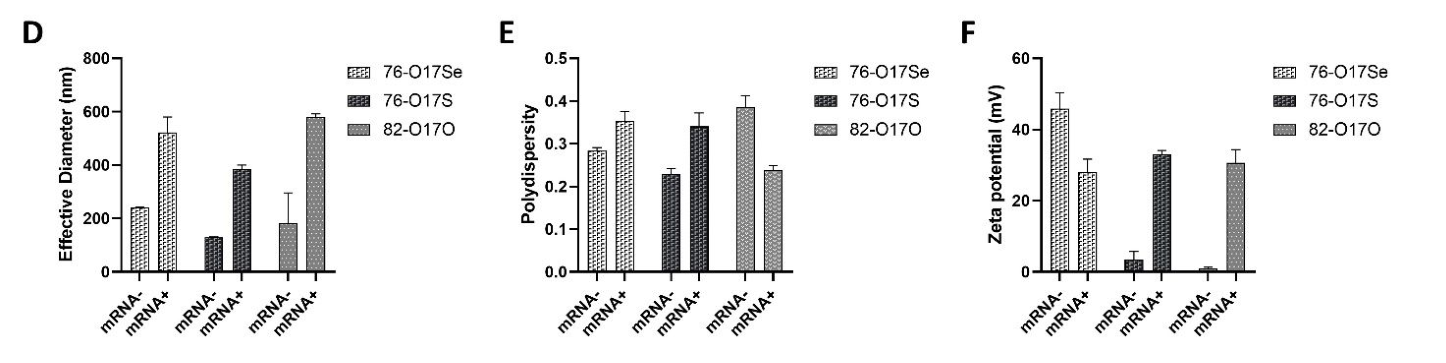
For the bars labeled 76-O17Se, mRNA loading is associated with a larger effective diameter, a modest increase in PDI and a lower positive zeta potential.
| Property | Before loading (mRNA−) | After loading (mRNA+) |
|---|---|---|
| Effective diameter | Approximately 240 nm | Approximately 520 nm |
| PDI | Approximately 0.29 | Approximately 0.35 |
| Zeta potential | Approximately +46 mV | Approximately +28 mV |
Figure-read estimates: rounded visual readings from Figure S2D–F, p. S4. The source provides bar plots, not a numerical data table; these are not exact reported means, batch specifications or acceptance criteria.
The supporting T-cell dose study also shows declining cell survival as dose increases (Figures S5B–C and S6). Reporter-positive percentages must be interpreted together with the live-cell gate, rather than treated as the percentage of all starting cells successfully engineered.
Figures S5B–C and S6 do not independently name the lipidoid in each dose panel. Their numerical dose–response values are therefore not assigned to 76-O17Se here. Figure S5C is headed “48 hr”, although its caption repeats “24 hr”.
The macrophage formulation data explicitly labeled 9322-O16B in Figures S2A–C and S3–S4 are separate from the 76-O17Se observations. They do not substantiate a claim that 76-O17Se outperforms Lipofectamine 2000 or MC3 in primary macrophages.
Ye Z, Chen J, Zhao X, Li Y, Harmon J, Huang C, Chen J, Xu Q. In Vitro Engineering Chimeric Antigen Receptor Macrophages and T Cells by Lipid Nanoparticle-Mediated mRNA Delivery. ACS Biomaterials Science & Engineering. 2022;8(2):722–733. DOI: 10.1021/acsbiomaterials.1c01532. View publication →
Supporting information: ab1c01532_si_001, 8 pages, supplied for this product update. Directly labeled evidence: S2D–F and S5A. Main-article bibliographic details were verified; the full main text was not accessible during this update. No numerical N/P, encapsulation efficiency, pKa or complete preparation protocol is inferred.
Values shown are literature-reported observations or explicitly labeled figure-read estimates for the cited study conditions. They do not guarantee performance of the supplied product in other formulations or experiments.
The product molecular weight is prefilled when available and remains editable. Confirm solvent compatibility and solubility before preparation.
Solvent volumes update from the molecular weight above.
| Mass | 1 mM | 5 mM | 10 mM |
|---|---|---|---|
| 10 mg | 11.5594 mL | 2.3119 mL | 1.1559 mL |
| 25 mg | 28.8984 mL | 5.7797 mL | 2.8898 mL |
| 50 mg | 57.7968 mL | 11.5594 mL | 5.7797 mL |
| 100 mg | 115.5936 mL | 23.1187 mL | 11.5594 mL |
| 250 mg | 288.9839 mL | 57.7968 mL | 28.8984 mL |
Contact our team with the catalog number and requested quantity.