5A2-SC8
DC49907
Recommended because it shares a closely related research category or delivery context. Formulation and performance are product- and study-specific.
View product →
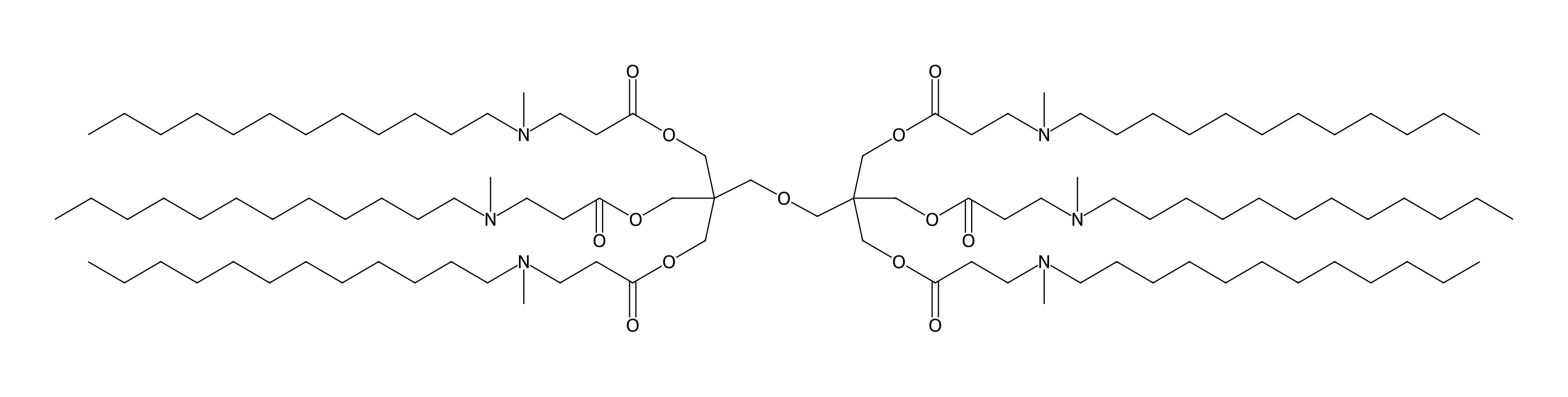
6Ac1-C12 is a biodegradable ionizable lipid studied in liver- and lung-directed mRNA-LNPs. Published work distinguishes conventional helper-lipid formulations from simplified lung-directed systems and measures organ accumulation, functional expression and cell-type delivery separately.
Open full Formulation & Performance →
Changing the helper components changes the biological outcome. The liver B-2 formulation and five lung-directed variants are listed separately, with molecular-weight conversions and source-specific measurements.
The current catalog identity is C106H208N6O13, molecular weight 1774.86. Quantitative summaries below were checked against the author Source Data workbook.
| Component | DC Chemicals product | Molecular weight | Molar ratio | Mass at 1 µmol total lipid (mg) |
|---|---|---|---|---|
| 6Ac1-C12 | DC60809 | 1774.86 | 15 | 0.429402 |
| DOPE | DC33634 | 744.03 | 20 | 0.240010 |
| Cholesterol | DCD-041 | 386.65 | 25 | 0.155907 |
| DMG-PEG2000 | DC40169 | 2507 | 2 | 0.080871 |
Relative molar parts, not percentages. 6Ac1-C12:mRNA mass ratio 10:1; this is not total lipid:mRNA or N/P. Main p.9; SI pp.2–4. DMG-PEG2000 uses 2507 for the catalog conversion.
Prefilled proportions follow the source specified above. Molecular weights and ratios are editable. Results are calculated, not measured study data. No N/P or RNA dose is inferred.
| Component | MW | Molar ratio | Mass (mg) | Mass % |
|---|---|---|---|---|
| 6Ac1-C12 | ||||
| DOPE | ||||
| Cholesterol | ||||
| DMG-PEG2000 |
| Component | DC Chemicals product | Molecular weight | Molar ratio | Mass at 1 µmol total lipid (mg) |
|---|---|---|---|---|
| 6Ac1-C12 | DC60809 | 1774.86 | 60 | 0.878644 |
| DOTAP (chloride) | DC33636 | 698.555 | 60 | 0.345819 |
| DMG-PEG2000 | DC40169 | 2507 | 1.2 | 0.024822 |
Relative molar parts, not percentages. 6Ac1-C12:mRNA mass ratio 20:1; this is not total lipid:mRNA or N/P. Main p.9; SI p.4. DMG-PEG2000 uses 2507 for the catalog conversion.
Prefilled proportions follow the source specified above. Molecular weights and ratios are editable. Results are calculated, not measured study data. No N/P or RNA dose is inferred.
| Component | MW | Molar ratio | Mass (mg) | Mass % |
|---|---|---|---|---|
| 6Ac1-C12 | ||||
| DOTAP (chloride) | ||||
| DMG-PEG2000 |
| Component | DC Chemicals product | Molecular weight | Molar ratio | Mass at 1 µmol total lipid (mg) |
|---|---|---|---|---|
| 6Ac1-C12 | DC60809 | 1774.86 | 60 | 0.660618 |
| DOTAP (chloride) | DC33636 | 698.555 | 60 | 0.260008 |
| Cholesterol | DCD-041 | 386.65 | 40 | 0.095943 |
| DMG-PEG2000 | DC40169 | 2507 | 1.2 | 0.018663 |
Relative molar parts, not percentages. A separate lipid:mRNA mass ratio is not assigned here. Main p.9; SI pp.4,21. DMG-PEG2000 uses 2507 for the catalog conversion.
Prefilled proportions follow the source specified above. Molecular weights and ratios are editable. Results are calculated, not measured study data. No N/P or RNA dose is inferred.
| Component | MW | Molar ratio | Mass (mg) | Mass % |
|---|---|---|---|---|
| 6Ac1-C12 | ||||
| DOTAP (chloride) | ||||
| Cholesterol | ||||
| DMG-PEG2000 |
| Component | DC Chemicals product | Molecular weight | Molar ratio | Mass at 1 µmol total lipid (mg) |
|---|---|---|---|---|
| 6Ac1-C12 | DC60809 | 1774.86 | 15 | 0.214701 |
| DOPE | DC33634 | 744.03 | 20 | 0.120005 |
| Cholesterol | DCD-041 | 386.65 | 25 | 0.077954 |
| DMG-PEG2000 | DC40169 | 2507 | 2 | 0.040435 |
| DOTAP (chloride) | DC33636 | 698.555 | 62 | 0.349277 |
Relative molar parts, not percentages. A separate lipid:mRNA mass ratio is not assigned here. Main pp.9–10; SI p.4. DMG-PEG2000 uses 2507 for the catalog conversion.
Prefilled proportions follow the source specified above. Molecular weights and ratios are editable. Results are calculated, not measured study data. No N/P or RNA dose is inferred.
| Component | MW | Molar ratio | Mass (mg) | Mass % |
|---|---|---|---|---|
| 6Ac1-C12 | ||||
| DOPE | ||||
| Cholesterol | ||||
| DMG-PEG2000 | ||||
| DOTAP (chloride) |
| Component | DC Chemicals product | Molecular weight | Molar ratio | Mass at 1 µmol total lipid (mg) |
|---|---|---|---|---|
| 6Ac1-C12 | DC60809 | 1774.86 | 50 | 0.983847 |
| DDAB (bromide) | DC60352 | 630.9525 | 40 | 0.279802 |
| DMG-PEG2000 | DC40169 | 2507 | 0.2 | 0.005559 |
Relative molar parts, not percentages. 6Ac1-C12:mRNA mass ratio 20:1; this is not total lipid:mRNA or N/P. Main p.9. DMG-PEG2000 uses 2507 for the catalog conversion.
Prefilled proportions follow the source specified above. Molecular weights and ratios are editable. Results are calculated, not measured study data. No N/P or RNA dose is inferred.
| Component | MW | Molar ratio | Mass (mg) | Mass % |
|---|---|---|---|---|
| 6Ac1-C12 | ||||
| DDAB (bromide) | ||||
| DMG-PEG2000 |
| Component | DC Chemicals product | Molecular weight | Molar ratio | Mass at 1 µmol total lipid (mg) |
|---|---|---|---|---|
| 6Ac1-C12 | DC60809 | 1774.86 | 50 | 0.632974 |
| DDAB (bromide) | DC60352 | 630.9525 | 40 | 0.180015 |
| Cholesterol | DCD-041 | 386.65 | 50 | 0.137892 |
| DMG-PEG2000 | DC40169 | 2507 | 0.2 | 0.003576 |
Relative molar parts, not percentages. A separate lipid:mRNA mass ratio is not assigned here. Main p.9; SI p.20. DMG-PEG2000 uses 2507 for the catalog conversion.
Prefilled proportions follow the source specified above. Molecular weights and ratios are editable. Results are calculated, not measured study data. No N/P or RNA dose is inferred.
| Component | MW | Molar ratio | Mass (mg) | Mass % |
|---|---|---|---|---|
| 6Ac1-C12 | ||||
| DDAB (bromide) | ||||
| Cholesterol | ||||
| DMG-PEG2000 |
| Formulation | Size (nm) | PDI | mRNA binding (%) |
|---|---|---|---|
| Liver B-2 | 66.70 ± 0.36 | 0.111 ± 0.017 | 85.67 ± 4.16 |
| 3-Comp Lung (DOTAP) | 116.83 ± 1.70 | 0.057 ± 0.021 | 95.10 ± 2.35 |
| 4-Comp Lung (DOTAP) | 110.47 ± 1.36 | 0.098 ± 0.031 | 96.79 ± 1.48 |
| 5-Comp Lung (DOTAP) | 87.48 ± 3.01 | 0.038 ± 0.020 | 90.71 ± 1.81 |
| 3-Comp Lung (DDAB) | 257.13 ± 2.21 | 0.134 ± 0.022 | 97.41 ± 2.55 |
Values are calculated mean ± sample SD, n = 3, from author Source Data: Figure 3 and Supplementary Figs. 9 and 17. The endpoint is mRNA binding efficacy; it has not been relabeled encapsulation efficiency. Different variants are not interchangeable.
| Study / condition | Result | Interpretation |
|---|---|---|
| IGROV1 ovarian-cancer cells; 25 ng luciferase mRNA/well | The B-2 ratio was selected through formulation screening | Screen context, not a clinical dose. |
| 6Ac1-C12 versus double-tail analogue | Higher membrane fusion in an endosomal-mimic FRET assay | A cell-free mechanism assay, not a measured in vivo escape percentage. |
| Confocal imaging with labeled mRNA | Uptake and subsequent intracellular redistribution were observed | Labeled-RNA location and translated protein are different endpoints. |
Main Figs. 2–3, Methods and Supplementary Fig. 7.
| Study / condition | Result | Interpretation |
|---|---|---|
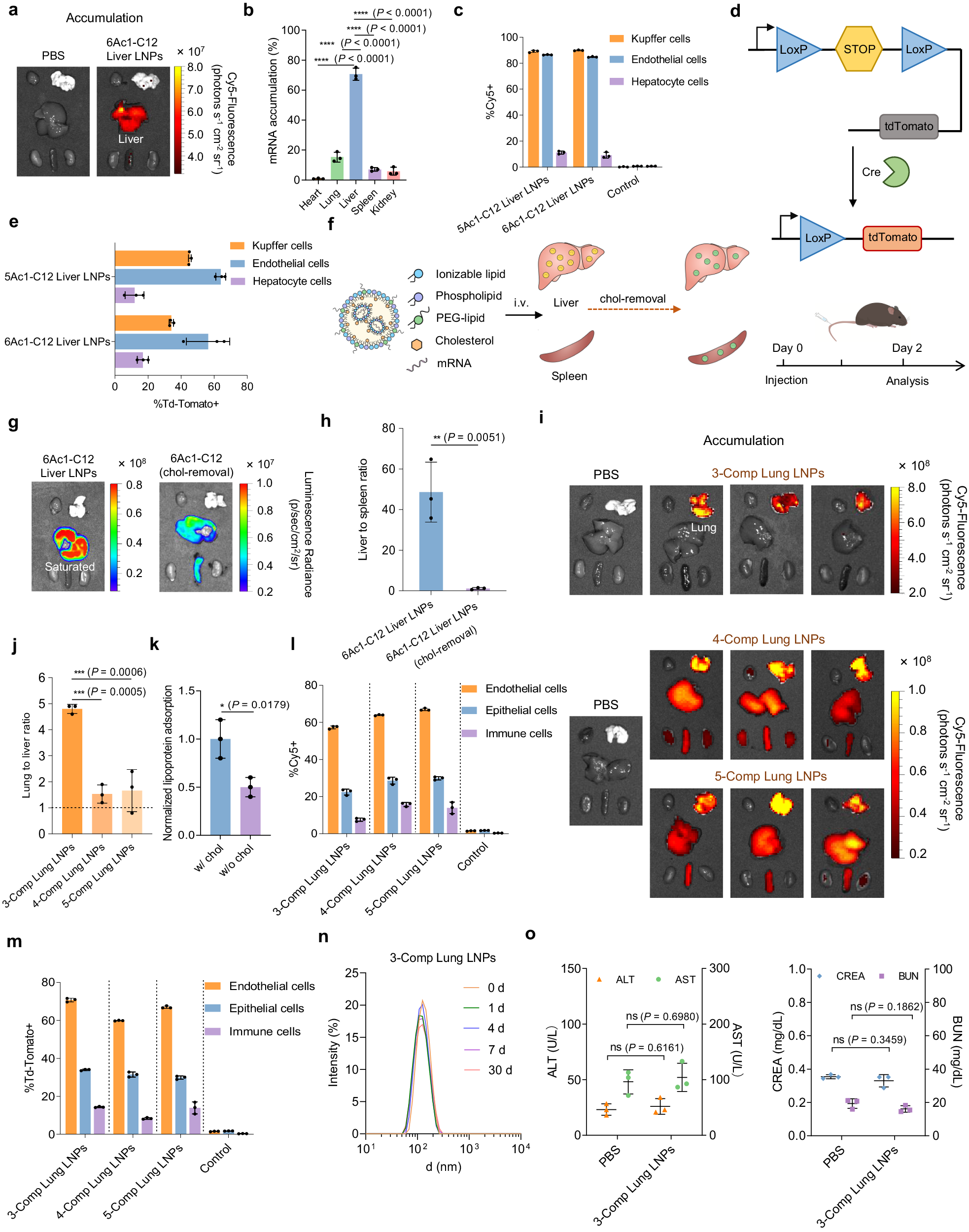
| B-2; intravenous reporter mRNA; 6 h | Approximately 98% of measured organ expression was in liver | Organ luminescence share, not 98% of injected RNA or hepatocytes. |
| Ai9 Cre reporter mice; 0.25 mg mRNA/kg IV; 48 h | Approximately 60% hepatic endothelial-cell transfection | Functional Cre reporter readout; not the percentage of all liver cells. |
| Cy5-mRNA distribution | Endothelial and Kupffer-cell uptake was observed | RNA accumulation does not by itself establish productive translation. |
Main Figs. 4–5 and Supplementary Figs. 23–24. Reporter and uptake experiments are kept separate.
| Study / condition | Result | Interpretation |
|---|---|---|
| Three-component DOTAP system; luciferase mRNA 0.25 mg/kg IV | Lung-selective expression and lung-enriched RNA accumulation | Cholesterol and phospholipid were absent from this formulation. |
| Three-, four- and five-component comparisons | Three-component DOTAP LNPs outperformed the tested corresponding four-/five-component systems in lung delivery | This comparison does not rank all possible formulations. |
| Ai9 Cre reporter; 0.25 mg/kg IV; 48 h | Approximately 71% pulmonary endothelial, 34% epithelial and 15% immune cells were reporter-positive | Percentages are within each cell population. |
| DDAB-containing variants | Also supported lung tropism | DDAB particle dimensions differ substantially from DOTAP variants; the results are not pooled. |
Main Figs. 4–5; Supplementary Figs. 17, 19–22 and 25–30.
| Study / condition | Result | Interpretation |
|---|---|---|
| Three-component DOTAP LNP storage | Particle size remained broadly unchanged over 30 days | Physical size stability does not establish retained RNA integrity or full biological potency. |
| C57BL/6 mice; 0.5 mg mRNA/kg IV; 24 h | ALT, AST, BUN, creatinine and organ histology were evaluated | Acute single-dose study; PBS and inflammatory positive controls were included. |
| Reported safety interpretation | The examined liver/lung formulations were well tolerated under these conditions | No chronic, repeat-dose or human safety claim is inferred. |
Main Fig. 5n–o and Supplementary Figs. 31–34.
| CAS No. | Not available |
| Chemical Name | 6Ac1-C12 |
| Synonyms | 6Ac1C12,, 6Ac1 C12 |
| SMILES | CCCCCCCCCCCCN(C)CCC(=O)OCC(COCC(COC(=O)CCN(C)CCCCCCCCCCCC)(COC(=O)CCN(C)CCCCCCCCCCCC)COC(=O)CCN(C)CCCCCCCCCCCC)(COC(=O)CCN(C)CCCCCCCCCCCC)COC(=O)CCN(C)CCCCCCCCCCCC |
| Formula | C106H208N6O13 |
| M.Wt | 1774.86 |
| Purity | >95% by ELSD-HPLC |
| Storage | Pure form: −20 °C, 1 year; In solvent: −80 °C, 6 months; −20 °C, 1 month. Sealed and protected from light. |
| Shipping condition | Ships from Shanghai. Pure lipid is stable during ice-pack transport. |
| Publication |
Molecular weight 1774.86 g/mol is based on the verified neutral 6Ac1-C12 structure. Calculate final solution volume, concentration or mass; verify complete dissolution.
Solvent volumes update from the molecular weight above.
| Mass | 1 mM | 5 mM | 10 mM |
|---|---|---|---|
| 10 mg | 5.6342 mL | 1.1268 mL | 0.5634 mL |
| 25 mg | 14.0856 mL | 2.8171 mL | 1.4086 mL |
| 50 mg | 28.1712 mL | 5.6342 mL | 2.8171 mL |
| 100 mg | 56.3425 mL | 11.2685 mL | 5.6342 mL |
| 250 mg | 140.8562 mL | 28.1712 mL | 14.0856 mL |
Contact our team with the catalog number and requested quantity.