5A2-SC8
DC49907
Recommended because it shares a closely related research category or delivery context. Formulation and performance are product- and study-specific.
View product →
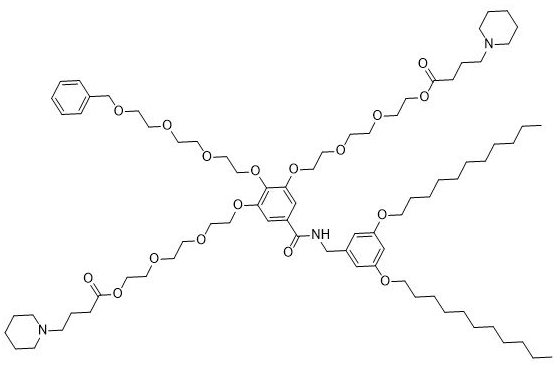
IAJD34 is a one-component ionizable amphiphilic Janus dendrimer studied for lung-directed mRNA delivery in mice. Published experiments include luciferase expression, transient TGF-β production, dose-dependent tolerability and an acute lung-injury model.
Open full Formulation & Performance →
The study uses IAJD34 as the sole amphiphilic carrier. Reporter expression, TGF-β pharmacology and lung-injury outcomes are separate experiments and are presented with their own doses and observation windows.
IAJD34 is not a conventional four-component lipid mixture. DSPC, cholesterol and PEG-lipid are not components of the cited one-component formulation.
| Component | DC Chemicals product | Molecular weight | Molar ratio | Mass at 1 µmol total lipid (mg) |
|---|---|---|---|---|
| IAJD34 | DC67292 | 1392.91 | 100 | 1.392910 |
IAJD34 is 100% of the carrier amphiphile; RNA is listed separately. The reported IAJD34:mRNA mass ratio is 40:1. Assembly used 10 mM acetate at pH 4.0. N/P was not established in this review and is not inferred from the mass ratio.
Prefilled proportions follow the source specified above. Molecular weights and ratios are editable. Results are calculated, not measured study data. No N/P or RNA dose is inferred.
| Component | MW | Molar ratio | Mass (mg) | Mass % |
|---|---|---|---|---|
| IAJD34 |
| Study / condition | Result | Interpretation |
|---|---|---|
| Ionization | Reported IAJD34 pKa 6.74 | Lung-targeted carrier selected for the study. |
| Luciferase formulation storage | Reporter potency retained after 5 days at 4°C | Biological potency assessment for that cargo and interval. |
| TGF-β formulation storage | Particle size and PDI followed over 5 weeks at 4°C | Physical stability does not establish 5-week biological potency. |
Main Fig. 1, Supplementary Fig. 2 and Methods. No batch particle-size specification is inferred.
| Study / condition | Result | Interpretation |
|---|---|---|
| BALB/c mice; 10 µg mRNA; intravenous | Predominantly pulmonary expression on organ imaging at 4 h | Whole-body and isolated-organ measurements are distinct. |
| Whole-body flux at 4 h | 3.12 × 10^7 ± 9.15 × 10^6 photons/s | This reported value is not lung-only flux. |
| Serial imaging | Expression declined at 24, 48 and 72 h | Transient expression; no permanent transfection claim. |
| Dose exploration | 10, 20 and 30 µg mRNA evaluated | Different time points and doses must not be compared as a single potency metric. |
Main Fig. 1 and Supplementary Tables 2–3.
| Study / condition | Result | Interpretation |
|---|---|---|
| 10, 20 or 30 µg TGF-β mRNA; intravenous; 24 h | Increased mature/cleaved TGF-β in bronchoalveolar lavage (BAL) | Cargo-specific protein production; not a universal carrier endpoint. |
| Total TGF-β | Increases were reported at 20 and 30 µg | Total and cleaved protein assays are distinct. |
| Spatial and time-course studies | Pulmonary immunostaining and 4–48 h protein/cellular analyses | Supports transient pulmonary pharmacology; see source plots for endpoint-specific groups. |
Main Figs. 3–7; assay-specific sample sizes and statistical tests are provided in the linked captions.
| Study / condition | Result | Interpretation |
|---|---|---|
| Highest TGF-β mRNA dose: 30 µg; 24 h | Increased BAL protein and neutrophils; increased serum ALT | Evidence of pulmonary barrier/inflammatory effects and a liver-enzyme signal. |
| Histological response | Dose-related fibrin and inflammatory-cell changes in lung | Activity of the TGF-β payload contributes to the observed response. |
| Other safety readouts | AST did not show the same increase; other examined organs lacked corresponding overt histological injury | These observations do not support a blanket claim of no toxicity. |
Main dose-response figures and supplementary safety analyses. Results apply to the tested formulation and payload.
| Study / condition | Result | Interpretation |
|---|---|---|
| BALB/c mice; 10 µg TGF-β mRNA delivered concurrently with injury induction | Assessed 3 days later against empty-carrier and PBS groups | An early intervention/co-administration model, not reversal of established fibrosis. |
| Lung response | Reduced selected inflammatory signals and recruited alveolar macrophage response; preservation of the large-aggregate surfactant pool | Readouts describe specific components of injury. |
| Endpoints without rescue | Treatment did not prevent injury-associated body-weight loss or resident alveolar macrophage depletion | Therapeutic effects were partial and endpoint-dependent. |
Main Figs. 8–10 and supplementary data; long-term fibrosis and clinical benefit were not established.
Lung delivery and expression — Figure 1 — Original source figures.
Lung-injury outcomes — Figures 8–10 — Original source figures.
| CAS No. | Not available |
| Chemical Name | IAJD34 |
| Synonyms | IAJD-34, IAJD 34 |
| SMILES | CCCCCCCCCCCOC1=CC(OCCCCCCCCCCC)=CC(CNC(=O)C2=CC(OCCOCCOCCOC(=O)CCCN3CCCCC3)=C(OCCOCCOCCOCC3=CC=CC=C3)C(OCCOCCOCCOC(=O)CCCN3CCCCC3)=C2)=C1 |
| Formula | C79H129N3O17 |
| M.Wt | 1392.91 |
| Purity | >95% by ELSD-HPLC |
| Storage | Pure form: −20 °C, 1 year; In solvent: −80 °C, 6 months; −20 °C, 1 month. Sealed and protected from light. |
| Shipping condition | Ships from Shanghai. Pure lipid is stable during ice-pack transport. |
| Publication |
The product molecular weight is prefilled when available and remains editable. Confirm solvent compatibility and solubility before preparation.
Solvent volumes update from the molecular weight above.
| Mass | 1 mM | 5 mM | 10 mM |
|---|---|---|---|
| 10 mg | 7.1792 mL | 1.4358 mL | 717.92 μL |
| 25 mg | 17.9480 mL | 3.5896 mL | 1.7948 mL |
| 50 mg | 35.8961 mL | 7.1792 mL | 3.5896 mL |
| 100 mg | 71.7921 mL | 14.3584 mL | 7.1792 mL |
| 250 mg | 179.4804 mL | 35.8961 mL | 17.9480 mL |
Contact our team with the catalog number and requested quantity.