For research use only. We do not sell to patients.
Ionizable lipids / LIPID 331
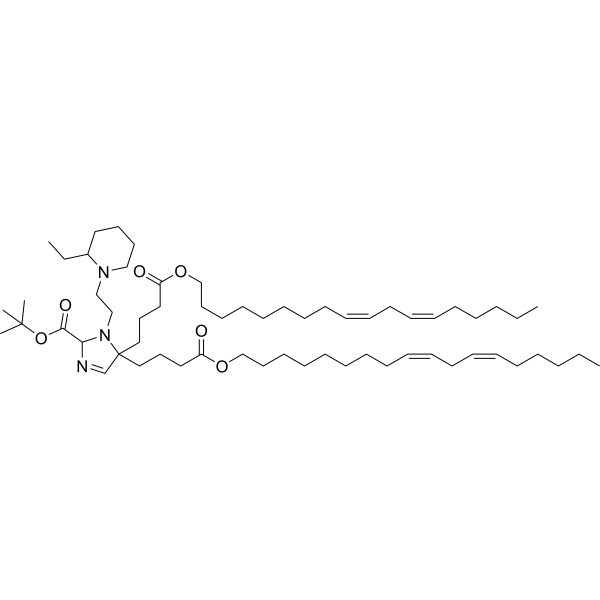
LIPID 331 chemical structure
Product imageResearch use only
CAT. NO. DC60489Featured

LIPID 331

Pack size & price

USD
TotalUS$850
We match the best price and quality on market.
Ships from ShanghaiIce-pack transportPure lipid recommended
Product overview

Description & Application

Lipid 331 is a biodegradable cyclic ionizable lipid. LNPs containing Lipid 331 result in robust transfection in the nasal and lung tissues of mice and efficient transfection of lung epithelial cells and lung-resident APCs. Lipid 331 is a promising candidate for mRNA vaccine delivery, offering the potential for further enhancing the potency of mRNA vaccines.

Literature evidence

Formulation & In Vivo Data

Reported intramuscular formulation

Componentmol%Role
Lipid 33135Ionizable lipid
DOPE16Helper phospholipid
Cholesterol46.5Sterol
C14-PEG20002.5PEG lipid

Process: aqueous mRNA and ethanol lipid phases mixed microfluidically at 3:1 aqueous:ethanol; final mRNA 0.1 mg/mL; dialysis against PBS overnight at 4 °C. Reported ionizable-lipid:mRNA mass ratio: 10:1.

Calculator disabled. N/P is not reported and C14-PEG2000 identity/MW is not sufficiently specified for component weighing. Do not convert the 10:1 mass ratio to N/P.

Reported intranasal formulation

Componentmol%Role
Lipid 33130Ionizable lipid
DOTAP39Cationic helper lipid
Cholesterol30Sterol
C14-PEG20001PEG lipid

Used for the reported nasal/lung transfection and intranasal vaccine studies. N/P and lipid:mRNA mass ratio were not separately reported for this formulation.

Literature-reported65.4 ± 0.8 nmSI p. 15, Supplementary Fig. 2a
Literature-reported0.2SI p. 15
Literature-reported−6.2 ± 1.7 mVSI p. 15
Literature-reported75.0 ± 8.9%SI p. 15
Literature-reported7.53 ± 0.17SI p. 15, TNS assay
Literature-reportedHigher antibody titres and T-cell activation than MC3/ALC-0315 in specified mouse studiesmOVA and SARS-CoV-2 antigen studies; cargo/route specific
Evidence scope. Values are taken from Li et al. and its author-supplied supporting information. C3d-fusion mRNA is a separate RNA-adjuvant strategy; it must not be treated as a property of Lipid 331 alone. DC Chemicals supplies the lipid compound and does not guarantee reproduction of study results.
Source

Li B, Jiang AY, Raji I, et al. Nat Biomed Eng. 2025;9:167–184. DOI 10.1038/s41551-023-01082-6.

Article · Supporting Information PDF

CAS No.Not available
Chemical NameLIPID 331
SynonymsLIPID-331,LIPID331
SMILESO=C(OCCCCCCCC/C=C\C/C=C\CCCCC)CCCC1(CCCC(OCCCCCCCC/C=C\C/C=C\CCCCC)=O)C=NC(C(OC(C)(C)C)=O)N1CCN2CCCCC2CC
FormulaC61H107N3O6
M.Wt978.52
Purity>95%
StoragePure form: −20 °C, 1 year; In solvent: −80 °C, 6 months; −20 °C, 1 month. Sealed and protected from light.
Shipping conditionShips from Shanghai. Pure lipid is stable during ice-pack transport.
PublicationEnhancing the immunogenicity of lipid-nanoparticle mRNA vaccines by adjuvanting the ionizable lipid and the mRNA--Nature Biomedical Engineering (2023)
Laboratory planning

Lipid 331 Solution Calculator

This calculator uses the verified Lipid 331 molecular weight (978.52 g/mol) to prepare a standalone stock solution. It does not calculate LNP component masses or infer N/P.

Mass = concentration × volume × molecular weight
Enter any three values to calculate the fourth.
C1 × V1 = C2 × V2
Enter any three positive values to calculate the fourth.
LNP component-mass calculator remains disabled. The paper does not report N/P, and C14-PEG2000 identity/MW is not sufficiently specified. Do not convert the reported 10:1 ionizable-lipid:mRNA mass ratio to N/P.
Preparing stock solutions

Quick preparation table

Solvent volumes update from the molecular weight above.

Mass1 mM5 mM10 mM
10 mg10.2195 mL2.0439 mL1.0220 mL
25 mg25.5488 mL5.1098 mL2.5549 mL
50 mg51.0976 mL10.2195 mL5.1098 mL
100 mg102.1952 mL20.4390 mL10.2195 mL
250 mg255.4879 mL51.0976 mL25.5488 mL

Need a different pack size or technical document?

Contact our team with the catalog number and requested quantity.

Contact us
Handling guidance

Shipping, storage and sampling

How is the lipid shipped, and how should I store it?
We generally ship the neat (undissolved) lipid compound rather than an ethanol solution. The neat lipid is stable during transport with ice packs, and shipments originate from Shanghai. Pure form: store at −20 °C for up to 1 year. In solvent: store at −80 °C for up to 6 months or at −20 °C for up to 1 month. Keep sealed and protected from light. Avoid repeated thaw cycles for best results.
Pure lipid or solution — which should I choose?
Pure lipid is generally more stable during shipping and storage, so we usually recommend the pure form. A solution in ethanol or chloroform can be supplied when required by your workflow. Tell us the intended application, solvent and target concentration so the most suitable format can be confirmed.
How should I measure a small amount of oily or viscous lipid?
Ionizable lipids are often oily liquids or viscous semisolids, so material can be lost during repeated weighing or transfer. For a small pack, dissolve the entire quantity and aliquot it volumetrically. For example, add 1 mL ethanol to 25 mg lipid to prepare a 25 mg/mL stock, then use a pipette to withdraw the required amount. For quantities above 100 mg, direct weighing with an analytical balance may be more practical. Always confirm solvent compatibility and solubility first.
Can you support formulation optimization and scale-up?
Yes. Share the RNA cargo, target tissue, administration route, formulation method and assay plan. Our team can discuss starting molar ratios, N/P ratio and scale-up requirements for research workflows.