5A2-SC8
DC49907
Recommended because it shares a closely related research category or delivery context. Formulation and performance are product- and study-specific.
View product →
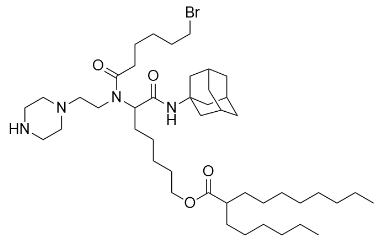
Ionizable lipid for LNP and nucleic-acid delivery research.
The LUMI-6 lipid, autonomously designed via the LUMI-lab platform, is a brominated ionizable lipid optimized for mRNA delivery. Formulated at a molar ratio of 35:28:34.5:2 (LUMI-6:DOTAP:cholesterol:C14-PEG2000), LNPs exhibit uniform physicochemical properties, including a hydrodynamic diameter of ~80 nm, polydispersity index (PDI) <0.2, and robust mRNA encapsulation efficiency. In vitro, LUMI-6 LNPs demonstrated 1.8-fold higher transfection potency in human bronchial epithelial cells compared to its debrominated counterpart (LUMI-6D), with minimal cytotoxicity confirmed by CCK-8 assays. In vivo, pulmonary delivery of CRISPR-Cas9 mRNA via LUMI-6 LNPs achieved 20.3% gene editing efficiency in murine lung epithelial cells, surpassing SM-102 (Moderna’s clinical benchmark) and demonstrating preferential tropism for lung epithelium over endothelial cells—critical for inhaled therapies targeting cystic fibrosis and surfactant disorders. The brominated tail enhances endosomal escape through optimized protonation dynamics, though explicit pKa values remain unmeasured. Synthesized via high-throughput combinatorial chemistry and refined through AI-driven active learning, LUMI-6 combines scalable production with organ-selective delivery, positioning it as a transformative platform for pulmonary nucleic acid therapeutics.
| CAS No. | Not available |
| Chemical Name | LUMI6 |
| Synonyms | LUMI-6, LUMI 6 |
| SMILES | CCCCCCCCC(CCCCCC)C(=O)OCCCCCC(C(=O)NC12CC3CC(CC(C3)C1)C2)N(CCN1CCNCC1)C(=O)CCCCCBr |
| Formula | C45H81O4BrN4 |
| M.Wt | 822.07 |
| Purity | ELSD-HPLC>95% |
| Storage | Pure form: −20 °C, 1 year; In solvent: −80 °C, 6 months; −20 °C, 1 month. Sealed and protected from light. |
| Shipping condition | Ships from Shanghai. Pure lipid is stable during ice-pack transport. |
| Publication | https://www.biorxiv.org/content/10.1101/2025.02.14.638383v1.full.pdf |
The product molecular weight is prefilled when available and remains editable. Confirm solvent compatibility and solubility before preparation.
Solvent volumes update from the molecular weight above.
| Mass | 1 mM | 5 mM | 10 mM |
|---|---|---|---|
| 10 mg | 12.1644 mL | 2.4329 mL | 1.2164 mL |
| 25 mg | 30.4110 mL | 6.0822 mL | 3.0411 mL |
| 50 mg | 60.8221 mL | 12.1644 mL | 6.0822 mL |
| 100 mg | 121.6441 mL | 24.3288 mL | 12.1644 mL |
| 250 mg | 304.1104 mL | 60.8221 mL | 30.4110 mL |
Contact our team with the catalog number and requested quantity.