AA76-lipid
DC60924
Recommended because it shares a closely related research category or delivery context. Formulation and performance are product- and study-specific.
View product →
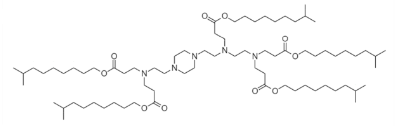
Ionizable lipid for LNP and nucleic-acid delivery research.
200Oi10 is a highly potent, biodegradable ionizable lipidoid optimized for targeted mRNA delivery, with its organ tropism dynamic to the route of administration. Under intravenous injection, it demonstrates an extraordinary 97.7% liver specificity mediated by endogenous ApoE binding. Strikingly, shifting to intraperitoneal injection redirects its tropism, yielding up to 46.4% pancreatic targeting, which can be further boosted when co-formulated with DOTAP. Featuring ester-conjugated cleavable tails, 200Oi10 guarantees rapid metabolic clearance and negligible tissue accumulation toxicity, making it an exceptional candidate for localized pancreatic therapy and efficient hepatic gene delivery.
| CAS No. | Not available |
| Chemical Name | 200Oi10 |
| Synonyms | 200,Oi,10, 200Oi,10 |
| SMILES | CC(C)CCCCCCCOC(=O)CCN(CCC(=O)OCCCCCCCC(C)C)CCN(CCC(=O)OCCCCCCCC(C)C)CCN1CCN(CCN(CCC(=O)OCCCCCCCC(C)C)CCC(=O)OCCCCCCCC(C)C)CC1 |
| Formula | C75H145O10N5 |
| M.Wt | 1,277.01 |
| Purity | ELSD-HPLC>95% |
| Storage | Pure form: −20 °C, 1 year; In solvent: −80 °C, 6 months; −20 °C, 1 month. Sealed and protected from light. |
| Shipping condition | Ships from Shanghai. Pure lipid is stable during ice-pack transport. |
| Publication | Enhancing RNA-lipid nanoparticle delivery: Organ- and cell-specificity and barcoding strategies-J Control Release. 2024 Sep 18;375:366388. |
The product molecular weight is prefilled when available and remains editable. Confirm solvent compatibility and solubility before preparation.
Solvent volumes update from the molecular weight above.
| Mass | 1 mM | 5 mM | 10 mM |
|---|---|---|---|
| 10 mg | 7.8308 mL | 1.5662 mL | 783.08 μL |
| 25 mg | 19.5770 mL | 3.9154 mL | 1.9577 mL |
| 50 mg | 39.1540 mL | 7.8308 mL | 3.9154 mL |
| 100 mg | 78.3079 mL | 15.6616 mL | 7.8308 mL |
| 250 mg | 195.7698 mL | 39.1540 mL | 19.5770 mL |
Contact our team with the catalog number and requested quantity.