200Oi10
DC60545
Recommended because it shares a closely related research category or delivery context. Formulation and performance are product- and study-specific.
View product →
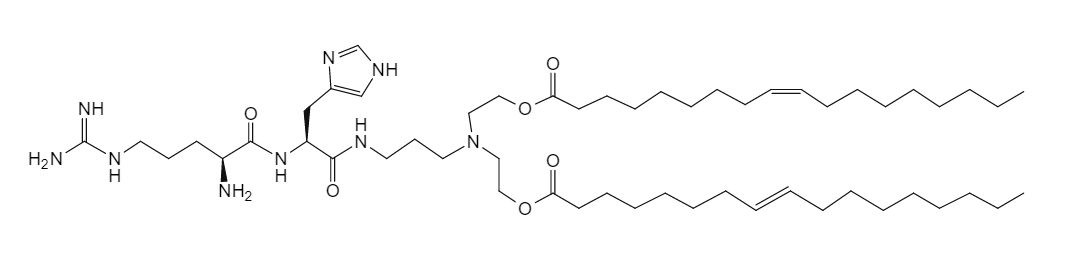
Ionizable lipid for LNP and nucleic-acid delivery research.
AA76-lipid is a dipeptide-modified ionizable lipid, engineered with an arginine-histidine motif, that constitutes the core of the pancreatic-targeted AH-LNP delivery platform. Its chemical architecture, characterized by an externally positioned and C-terminally modified arginine residue, was identified through systematic screening as the optimal structure for function. Upon intraperitoneal administration, AH-LNPs formulated with this lipid interact with proteins in the peritoneal fluid, undergoing dynamic assembly into significantly larger complexes. This substantial increase in size (from ~100 nm to over 360 nm) exploits a physical targeting principle termed the Capsule-filter-mediated pancreatic targeting (CAMP) mechanism. Large particles are selectively filtered out by the dense capsules of other abdominal organs, leading to preferential enrichment in the capsule-deficient pancreas. Concurrently, the arginine-histidine motif directs the formation of a distinct protein corona enriched with apolipoproteins (e.g., APOE, APOB-100), which mimics very-low-density lipoprotein (VLDL). This corona enables efficient cellular internalization primarily into pancreatic stromal cells via VLDL receptor (VLDLR)-mediated endocytosis, known as the VMP pathway. The synergistic integration of the physical CAMP targeting and the biological VMP uptake mechanisms empowers AA76-lipid-based AH-LNPs to achieve highly specific, potent, and sustained mRNA delivery and gene editing within the pancreas across multiple species, demonstrating exceptional therapeutic efficacy in models of both autoimmune pancreatitis and pancreatic cancer.
| CAS No. | Not available |
| Chemical Name | AA76-lipid |
| Synonyms | AA76 lipid;AA 76 lipid |
| SMILES | O=C(CCCCCCC/C=C\CCCCCCCC)OCCN(CCOC(CCCCCCC/C=C\CCCCCCCC)=O)CCCNC([C@H](CC1=CNC=N1)NC([C@@H](N)CCCNC(N)=N)=O)=O |
| Formula | C55H101N9O6 |
| M.Wt | 984.45 |
| Purity | ELSD-HPLC>95% |
| Storage | Pure form: −20 °C, 1 year; In solvent: −80 °C, 6 months; −20 °C, 1 month. Sealed and protected from light. |
| Shipping condition | Ships from Shanghai. Pure lipid is stable during ice-pack transport. |
| Publication | [1]. Lei J, et al. Pancreatic-targeted lipid nanoparticles based on organ capsule filtration. Nature. Published online February 25, 2026. |
The product molecular weight is prefilled when available and remains editable. Confirm solvent compatibility and solubility before preparation.
Solvent volumes update from the molecular weight above.
| Mass | 1 mM | 5 mM | 10 mM |
|---|---|---|---|
| 10 mg | 10.1580 mL | 2.0316 mL | 1.0158 mL |
| 25 mg | 25.3949 mL | 5.0790 mL | 2.5395 mL |
| 50 mg | 50.7898 mL | 10.1580 mL | 5.0790 mL |
| 100 mg | 101.5796 mL | 20.3159 mL | 10.1580 mL |
| 250 mg | 253.9489 mL | 50.7898 mL | 25.3949 mL |
Contact our team with the catalog number and requested quantity.