
Research lipid catalog
Ionizable Lipid Products
Explore 848 lipid and RNA delivery products. Search the full catalog or browse by research category.
Search covers product name, catalog number, synonyms, available CAS numbers and categories. Spaces, hyphens and common punctuation are ignored. Duplicate legacy records are consolidated under one canonical product result.
3666 products · Showing 3421–3440 · 20 per page
DC Chemicals lipid expertise
Built for ionizable-lipid discovery and RNA delivery research
DC Chemicals supports formulation and delivery research with a broad, searchable portfolio of cationic and ionizable lipids. The current directory brings together 848 unique research-use products, with product specifications, pricing, chemical structures and literature-linked formulation data added as each record is verified.
Our experience spans complex lipid synthesis, purification, analytical release and process development. For custom molecules or larger-scale requirements, our team can discuss route development, technical specifications and scale-up options for the intended research workflow.
Learn about cationic and ionizable lipids →Proprietary innovation · Co-development · GMP
From proprietary lipid design to GMP-grade custom synthesis
DC Chemicals has independently developed ionizable-lipid structures supported by company-owned intellectual property, and selected proprietary lipid programs have advanced to GMP-stage development.
We welcome joint development with customers—from molecular design and lipid synthesis through route and process development. We can also support custom synthesis of GMP-grade ionizable lipids to agreed technical specifications and quality requirements.
Discuss a co-development project →Proprietary ionizable-lipid structuresCollaborative molecular designCustom lipid synthesisProcess development and scale-upGMP-grade project support
Product quick links
Explore ionizable lipids
Browse specifications, pricing and literature-linked product information.
Cat. No.Product NameField of ApplicationChemical Structure
DSPE-CY5.5FeaturedFeatured
Phospholipids DSPE belong to the lipid family of biopolymers. Phospholipids consist of two fatty acids, a glycerol unit, a phosphate group, and a polar molecule. The phosphate groups and polar head regions of the molecule are hydrophilic (attracted to water), while the fatty acid tail is hydrophobic (repelled by water). When placed in water, the phospholipids Orient themselves into a double layer, where the non-polar tail region faces the inner region of the double layer. The polar head region faces outward and interacts with the water. Applications in drug release, nanotechnology and new materials research, cell culture. As well as ligand research, peptide synthesis support, grafted polymer compounds, new materials and pegylated modified functional coatings and other active compounds.

DSPE-CY3FeaturedFeatured
Phospholipids DSPE belong to the lipid family of biopolymers. Phospholipids consist of two fatty acids, a glycerol unit, a phosphate group, and a polar molecule. The phosphate groups and polar head regions of the molecule are hydrophilic (attracted to water), while the fatty acid tail is hydrophobic (repelled by water). When placed in water, the phospholipids Orient themselves into a double layer, where the non-polar tail region faces the inner region of the double layer. The polar head region faces outward and interacts with the water. Applications in drug release, nanotechnology and new materials research, cell culture. As well as ligand research, peptide synthesis support, grafted polymer compounds, new materials and pegylated modified functional coatings and other active compounds.

DSPE-ICGFeaturedFeatured
ICG indocyanine green is a three carbon cyanine dye with good water solubility and a molecular weight of 775. Indocyanine green can almost completely bind to plasma proteins in plasma and whole blood, ensuring that it remains almost completely in Xueguan and is not easily diffused outward. Indocyanine green (ICG) is a near-infrared imaging reagent currently approved by the US Food and Drug Administration (FDA) for clinical use. ICG is a three carbon cyanine dye with near-infrared characteristic absorption peaks, emission wavelengths between 795 and 845nm, and has amphiphilic structures that are both hydrophilic and lipophilic. Near infrared light has a greater penetration depth in tissues and is less affected by biological tissue background, Due to its near-infrared absorption and emission fluorescence characteristics, ICG can be used as an excellent tissue penetrating agent in vivo.

DSPE-FAFeaturedFeatured

KRN-7000(S34)FeaturedFeatured
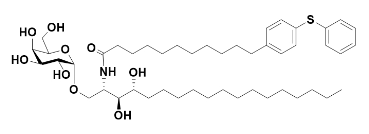
KRN-7000(C34)FeaturedFeatured
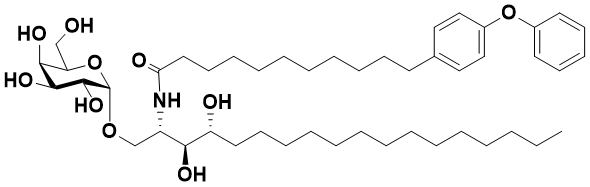
KRN-7000(7DW8-5)FeaturedFeatured
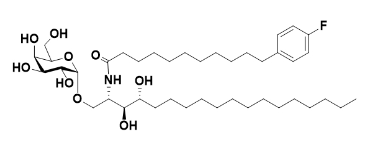
TLR7/8 agonist 4 hydroxy-PEG10-acid hydrochlorideFeaturedFeatured
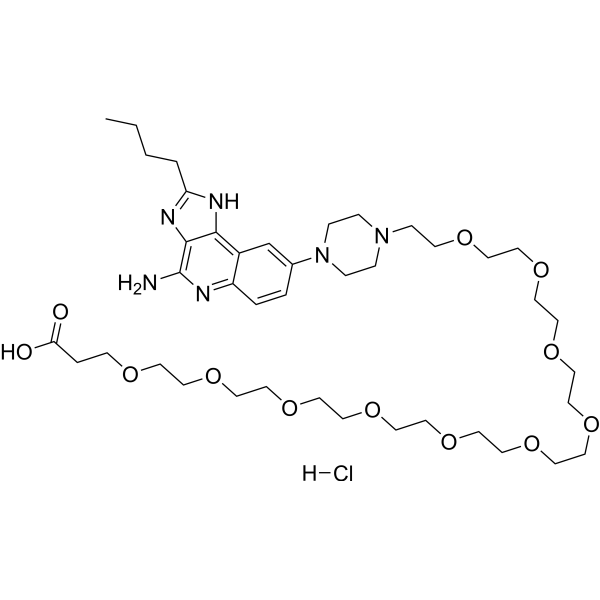
TLR7/8 agonist 4 hydroxy-PEG10-acid hydrochloride (compound 9) is a drug-linker conjugate for ADC with potent antitumor activity by using TLR7/8 agonist 4, linked via the cleavable ADC linker hydroxy-PEG10-acid.
TLR4-IN-C34-C2-COOHFeaturedFeatured
TLR4-IN-C34-C2-COO is a linker that incorporates TLR4 inhibitor TLR4-IN-C34. TLR4-IN-C34 inhibits TLR4 in enterocytes and macrophages, and reduces systemic inflammation in mouse models of endotoxemia and necrotizing enterocolitis.
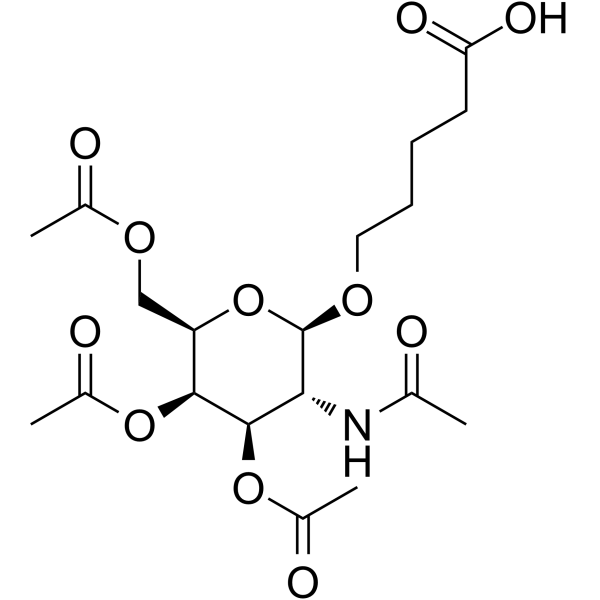
SMU127FeaturedFeatured
SMU127 (SMU-127, ZINC666243) is a specific TLR1-TLR2 small molecule agonist with EC50 of 0.55 uM; stimulates NF-κB activation and promotes TNFα secretion in human macrophages and mononuclear cells, inhibits the growth of breast cancer tumors in BABL/c mice.
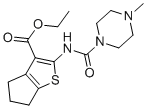
3M-003FeaturedFeatured
A potent TLR7/8 agonist that induces robust production of the Th1-polarizing cytokines TNF-alpha and IL-12 from neonatal antigen-presenting cells (APCs)..

3M-002FeaturedFeatured
A selective TLR8 agonist that induces activation of NF-κB at 0.4 uM; induces similar cytokine profiles from human PBMC compared with TLR8 agonist ssRNA; effectively stimulates IL-12 production from mDC, but not pDC; induces TNF-α and IL-12 at 0.1 uM from monocytes and monocyte-derived DC (Mo-DC).

ANA975FeaturedFeatured
ANA975 is an oral prodrug of the TLR-7 agonist Isatoribine (ANA245;7-Thia-8-oxoguanosine) against hepatitis C virus (HCV) infection.HCV InfectionPhase 1 Discontinued

Szu101FeaturedFeatured
Novel TLR7 agonist via immune response induction and tumor microenvironment modulation

Malp-2FeaturedFeatured
Toll-like receptor 2/6 (TLR-2/6) agonist, regulating Lcn2 gene, promoting collateral growth

Vb-201FeaturedFeatured
Novel anticryptosporidial agent, acting as a toll-like receptor-2 (TLR2) antagonist

E6742FeaturedFeatured
E6742 (E6742) is a potent, selective, dual TLR7/8 inhibitor with binding Kd of 1.7 uM/37 nM in ITC assays, respectively, inhibits TLR7/8 agonist CL097 induced reporter activation with IC50 values of 22, 68, and 3.0 nM for hTLR7, mTLR7, and hTLR8, respecti

Smu-z1FeaturedFeatured
Novel potent TLR1/2 Specific Agonist, Suppressing Leukemia Cancer Cell Growth by Stimulating Cytotoxic T Lymphocytes

CL097FeaturedFeatured
CL097, a potent TLR7/8 agonist, induces pro-inflammatory cytokines in macrophages. CL097 induces NADPH oxidase priming, resulting in an increase of the fMLF-stimulated ROS production.

RS 09FeaturedFeatured
RS 09 is a TLR4 agonist. RS 09 promotes NF-κB nuclear translocation and induces inflammatory cytokine secretion in RAW264.7 macrophages in vitro. RS 09 acts as an adjuvant in vivo; RS 09 enhances X-15 specific antibody serum concentrations, when administered with X-15-KLH in mice.

No products match this search.
Page 172 of 184 · Browse all 3666 products