For research use only. We do not sell to patients.
Ionizable lipids / E20
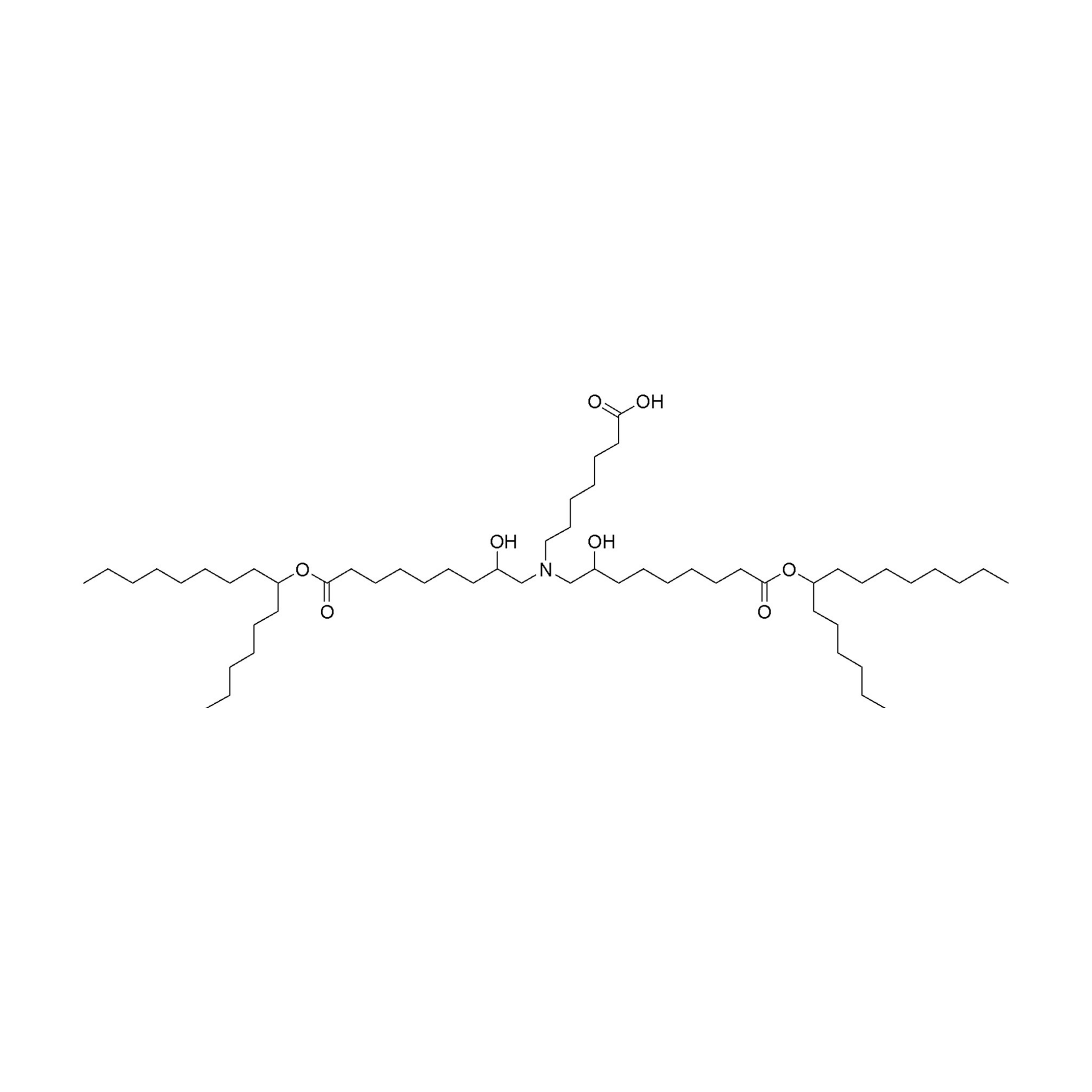
E20 chemical structure
Product imageResearch use only
CAT. NO. DC68227Featured

E20

Ionizable lipid for LNP and nucleic-acid delivery research.

Research highlights
Charge-switching ionizable lipidmRNA and plasmid-DNA deliveryLiterature-reported low immunostimulatory activityAcute lung injury research
Derived from the cited study; not a product specification or performance guarantee.

Pack size & price

USD
Supporting components
DOPE DC33634 · 100 mg+Cholesterol DCD-041 · 100 mg+DMG-PEG2000 DC40169 · 100 mg

Components are supplied separately; this is not a premixed LNP. RNA/cargo, buffer and formulation service are not included.

TotalPrice on request
We match the best price and quality on market.
Ships from ShanghaiIce-pack transportPure lipid recommended
Product overview

Description & Application

E20 is a charge-switching ionizable S-lipid containing a tertiary amine, a carboxylic acid, two secondary alcohols and two branched ester-linked hydrophobic domains. The cited study formulated E20 into switchable nanoparticles (SNPs) for mRNA and plasmid-DNA delivery. Literature-reported E20 SNP data include an apparent pKa of 4.99 for becoming neutral, an N/P ratio of 4.1 in the reported four-component formulation, efficient hEPO mRNA expression after intravenous administration, low immunostimulatory activity in the reported models and activity in an intratracheal IL-22 mRNA acute-lung-injury study. All formulation and performance information shown below is literature-derived study evidence, not a product specification or a guarantee of reproducible LNP performance.

CAS No.Not available
Chemical NameE20
SynonymsS-lipid E20, Lipid E20, E20 S-lipid
SMILESCCCCCCCCC(CCCCCC)OC(=O)CCCCCCC(O)CN(CCCCCCC(=O)O)CC(O)CCCCCCC(=O)OC(CCCCCC)CCCCCCCC
FormulaC55H107NO8
M.Wt910.46
PurityNot available
StoragePure form: −20 °C, 1 year; In solvent: −80 °C, 6 months; −20 °C, 1 month. Sealed and protected from light.
Shipping conditionShips from Shanghai. Pure lipid is stable during ice-pack transport.
PublicationLiang D, Qi Y, Han H, et al. Charge-switching ionizable lipids lower the toxicity of lipid nanoparticles. Nature Nanotechnology. Published online September 8, 2026.

Literature-reported formulation composition

Componentmol%Role
E2035.9Ionizable lipid
DOPE24.2Helper phospholipid
Cholesterol38.7Sterol
DMG-PEG20001.2PEG lipid
Reported total100Source values retained

Formulation weight calculator

The cited formulation and available component molecular weights are pre-filled. Enter the exact molecular weight for any substituted material before calculating.

The 4 reported lipid components total 100 mol%.
ComponentMolecular weight (g/mol)Literature molar ratio
E20
DOPE
Cholesterol
DMG-PEG2000
Calculated component requirements
ComponentNormalized mol%Amount (µmol)Required weight (mg)
Total100.000%

Research planning aid only. Results cover lipid component weights and do not include RNA, buffer, solvent, process loss or an N/P ratio.

4.1
21:1 to 24:1 total lipids:mRNA
mRNA in 10 mM citrate buffer, pH 4.0; dialysed against PBS, pH 7.4
hEPO mRNA
Intravenous injection (retro-orbital IV)
0.1 mg mRNA/kg, single dose
Wild-type BALB/c mice, 10-16 weeks old, 18-20 g
Microfluidic mixing with aqueous phase at 3 mL/min and ethanolic lipid phase at 1 mL/min, followed by dialysis against 1,000-fold excess PBS at 4 °C for 2-4 h

Literature-reported performance for the cited formulation

Literature-reported4.99R18 fluorescence assay · pKa for becoming neutralMain article Figure 2b; SI Section 5.4
Literature-reported90-100 nmPost-formulation DLS characterization · Range reported for the five top SNPs E3, E7, E12, E15 and E20; not an E20-only exact valueSI Figure S76 and text, p. 135
Literature-reported<0.2Post-formulation DLS characterization · Reported for the SNP formulation panel; not an E20-only exact valueSI Figure S77 and text, p. 135
Literature-reported600 mU/mL24 h after 0.1 mg/kg IV hEPO mRNA · Reported as equivalent to MC3-DLin LNPs and 100-fold above the cited therapeutic thresholdMain article Figure 3b and text
Literature-reportedNo increase in IL-6, IL-1β or MIP-24 h after 1 mg/kg IV luciferase mRNA in LPS-pretreated mice · Traditional LNP comparators increased the measured cytokines in the LPS-pretreated modelMain article Figure 3c-f; SI Figures S95-S97
Literature-reportedAll E20-SNP-treated mice survived the 7-day observation periodAfter 1 mg/kg IV luciferase nanoplasmid DNA · All MC3-DLin LNP-pDNA-treated mice died within 24 hMain article Figure 3g-i and text; SI Section 6.2

Additional reported findings

Human PBMC study

E20-SNPs efficiently delivered luciferase mRNA to human PBMCs and did not induce any of the 14 cytokines evaluated in the reported experiment.

Human PBMCs from four donors; 2,000 ng/mL mRNA; 24 h · Main article Figure 4; SI Figures S90-S93
Acute lung injury study

E20-SNPs carrying IL-22 mRNA were reported to be more effective than the traditional LNP comparators in the LPS-induced acute-lung-injury model without exacerbating pre-existing inflammation.

BALB/c mice; 3 mg/kg intratracheal LPS followed 3 h later by 2.5 mg/kg intratracheal LNP/IL-22 mRNA · Main article acute-lung-injury section; SI Section 6.4
Charge-switching behavior

The study reports that E20 SNPs are neutral or negatively charged at physiological pH and become positively charged under acidic formulation/endosomal conditions.

R18 apparent-pKa and pH-dependent zeta-potential experiments · Main article Figure 2b; SI Figures S78-S80
Literature Data DisclaimerAll formulation parameters and performance values shown in this section are derived from the cited publication and are provided for reference only. These results were obtained using the specific materials, formulation process, cargo, dose, analytical method, model and administration route described in that study. Unless otherwise stated, the data were not generated or independently verified by DC Chemicals. DC Chemicals supplies the lipid compound only and does not guarantee that customers will reproduce the reported LNP properties or biological performance.

The administration route shown above was used in the cited study and is not a clinical-use instruction or recommendation by DC Chemicals.
Cited literature for this formulation and performance datasetLiang D, Qi Y, Han H, et al. Charge-switching ionizable lipids lower the toxicity of lipid nanoparticles. Nature Nanotechnology. Published online September 8, 2026. DOI: 10.1038/s41565-026-02262-6
Structure: main Figure 2a and SI Figures S6, S14 and S51; formulation and N/P ratio: SI Section 4.1 and Table S1; performance: main Figures 2-5 and the cited SI figures.
Laboratory planning

Solution Calculators

The product molecular weight is prefilled when available and remains editable. Confirm solvent compatibility and solubility before preparation.

Mass = concentration × volume × molecular weight
Enter any three values to calculate the fourth.
C₁V₁ = C₂V₂
Enter any three values to calculate the fourth.
Preparing stock solutions

Quick preparation table

Solvent volumes update from the molecular weight above.

Mass1 mM5 mM10 mM
10 mg10.9835 mL2.1967 mL1.0983 mL
25 mg27.4586 mL5.4917 mL2.7459 mL
50 mg54.9173 mL10.9835 mL5.4917 mL
100 mg109.8346 mL21.9669 mL10.9835 mL
250 mg274.5865 mL54.9173 mL27.4586 mL

Need a different pack size or technical document?

Contact our team with the catalog number and requested quantity.

Contact us
Handling guidance

Shipping, storage and sampling

How is the lipid shipped, and how should I store it?
We generally ship the neat (undissolved) lipid compound rather than an ethanol solution. The neat lipid is stable during transport with ice packs, and shipments originate from Shanghai. Pure form: store at −20 °C for up to 1 year. In solvent: store at −80 °C for up to 6 months or at −20 °C for up to 1 month. Keep sealed and protected from light. Avoid repeated thaw cycles for best results.
Pure lipid or solution — which should I choose?
Pure lipid is generally more stable during shipping and storage, so we usually recommend the pure form. A solution in ethanol or chloroform can be supplied when required by your workflow. Tell us the intended application, solvent and target concentration so the most suitable format can be confirmed.
How should I measure a small amount of oily or viscous lipid?
Ionizable lipids are often oily liquids or viscous semisolids, so material can be lost during repeated weighing or transfer. For a small pack, dissolve the entire quantity and aliquot it volumetrically. For example, add 1 mL ethanol to 25 mg lipid to prepare a 25 mg/mL stock, then use a pipette to withdraw the required amount. For quantities above 100 mg, direct weighing with an analytical balance may be more practical. Always confirm solvent compatibility and solubility first.
Can you support formulation optimization and scale-up?
Yes. Share the RNA cargo, target tissue, administration route, formulation method and assay plan. Our team can discuss starting molar ratios, N/P ratio and scale-up requirements for research workflows.