LP-01
DC31000
Recommended because it shares a closely related research category or delivery context. Formulation and performance are product- and study-specific.
View product →
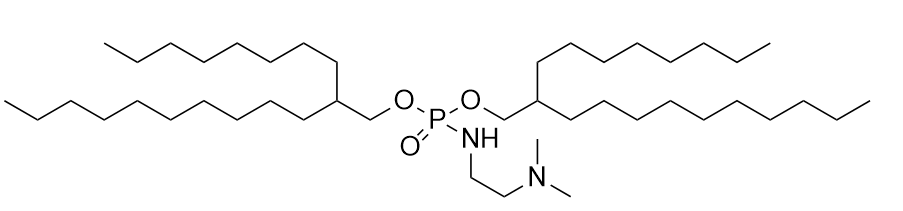
Ionizable lipid for LNP and nucleic-acid delivery research.
BiP-20 is a branched ionizable phospholipid identified as a lead compound for efficient hepatic mRNA delivery.BiP-20 is a novel, efficient, and safe liver-targeted LNP delivery vehicle. With an ideal pKa of 6.56, it achieves highly efficient liver targeting and endosomal escape primarily through the ApoE/LDL-R pathway. It demonstrates exceptional performance in gene editing at very low doses: for CRISPR-Cas9-mediated editing of TTR, a 10 μg dose achieved ~64% efficiency, which is 8-fold higher than the clinical benchmark lipid LP-01. In Prime Editing targeting the PCSK9 gene, its efficiency (4.30%) also significantly surpassed that of MC3, SM102, and LPO1. Furthermore, it mediates a 5.9-fold increase in hepatic protein expression compared to MC3. Safety assessments indicate it does not induce liver function abnormalities, showing strong therapeutic potential.
| CAS No. | Not available |
| Chemical Name | BIP-20 |
| Synonyms | BIP20;BIP 20 |
| SMILES | CCCCCCCCCCC(CCCCCCCC)COP(NCCN(C)C)(OCC(CCCCCCCC)CCCCCCCCCC)=O |
| Formula | C44H93N2O3P |
| M.Wt | 729.2128 |
| Purity | ELSD-HPLC>95% |
| Storage | Pure form: −20 °C, 1 year; In solvent: −80 °C, 6 months; −20 °C, 1 month. Sealed and protected from light. |
| Shipping condition | Ships from Shanghai. Pure lipid is stable during ice-pack transport. |
| Publication | Jozić A, Le Roux C, Kim J, et al. In vivo endosomal escape assay identifies mechanisms for efficient hepatic LNP delivery. Nat Biotechnol. Published online March 11, 2026. doi:10.1038/s41587-026-03022-6 |
The product molecular weight is prefilled when available and remains editable. Confirm solvent compatibility and solubility before preparation.
Solvent volumes update from the molecular weight above.
| Mass | 1 mM | 5 mM | 10 mM |
|---|---|---|---|
| 10 mg | 13.7134 mL | 2.7427 mL | 1.3713 mL |
| 25 mg | 34.2835 mL | 6.8567 mL | 3.4284 mL |
| 50 mg | 68.5671 mL | 13.7134 mL | 6.8567 mL |
| 100 mg | 137.1342 mL | 27.4268 mL | 13.7134 mL |
| 250 mg | 342.8355 mL | 68.5671 mL | 34.2835 mL |
Contact our team with the catalog number and requested quantity.