DLin-MC3-DMA
DC10800
Recommended because it shares a closely related research category or delivery context. Formulation and performance are product- and study-specific.
View product →
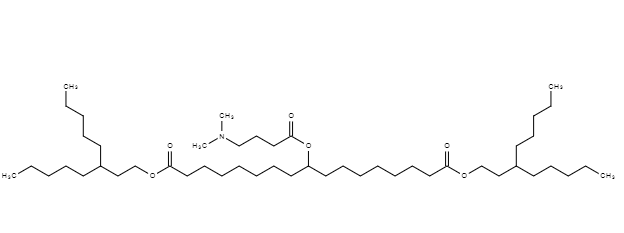
L-369 is a biodegradable ionizable lipid corresponding to Compound 17 in WO2013086354A1. The patent reports its evaluation in a Factor VII siRNA-LNP mouse screen and formulation particle-size measurements. Compound-specific clinical performance and a nonhuman-primate safety margin are not established by this source.
Open full Formulation & Performance →
The primary patent supports a bounded hepatic siRNA-delivery record. Compound 17 is assigned to an ED50 interval rather than an exact potency value; particle and silencing results apply to the complete LNP.
The catalog connectivity was matched to Compound 17 in WO2013086354A1, rather than the same-formula isomer Compound 22. The neutral formula is C49H95NO6.
| Component | DC Chemicals product | Molecular weight | Molar ratio | Mass at 1 µmol total lipid (mg) |
|---|---|---|---|---|
| L-369 / Compound 17 | DC65701 | 794.28 | 50 | 0.397140 |
| DSPC | DC57005 | 790.15 | 10 | 0.079015 |
| Cholesterol | DCD-041 | 386.65 | 38.5 | 0.148860 |
| PEG-DMG | DC40169 | 2507 | 1.5 | 0.037605 |
Example 35 reports ionizable lipid:DSPC:cholesterol:PEG-DMG = 50:10:38.5:1.5 mol%. No unique Compound 17 N/P or lipid:siRNA mass ratio was identified. PEG-DMG mass conversion uses the catalog convention 2507.
Prefilled proportions follow the source specified above. Molecular weights and ratios are editable. Results are calculated, not measured study data. No N/P or RNA dose is inferred.
| Component | MW | Molar ratio | Mass (mg) | Mass % |
|---|---|---|---|---|
| L-369 / Compound 17 | ||||
| DSPC | ||||
| Cholesterol | ||||
| PEG-DMG |
| Record | Reported result | Interpretation |
|---|---|---|
| Payload | AD-1661 siRNA targeting Factor VII | Hepatic gene-silencing model |
| Lipid composition | Compound 17:DSPC:cholesterol:PEG-DMG = 50:10:38.5:1.5 mol% | Example 35 |
| Preparation approach | In-line mixing followed by buffer exchange | Reported experimental approach, not validated manufacturing instructions |
| N/P and lipid:siRNA mass ratio | Not established for the specific Compound 17 record | Do not infer from general LNP conventions |
WO2013086354A1, Example 35; printed p202 onward.
| Record | Reported result | Interpretation |
|---|---|---|
| Model | Female C57BL/6 mice, 7–9 weeks; n=3 per group | Example 36 |
| Administration / timing | Intravenous; Factor VII readout at 24 h | Complete siRNA-LNP formulation |
| Initial screen | 0.1, 0.3, 1.0 and 5.0 mg/kg siRNA; active formulations retested at lower ranges | Screen design, not a dosing recommendation |
| Compound 17 potency | ED50 bin 0.001–0.10 mg/kg, designated ** | An interval, not a precise ED50 |
| Endpoint | 50% reduction in circulating Factor VII relative to control | Gene silencing, not disease-model efficacy |
| Controls | PBS and benchmark formulations | No exact superiority claim inferred |
WO2013086354A1, Example 36. Compound 17 row: printed p207 / PDF p208 in the archived visual review.
| Record | Reported result | Interpretation |
|---|---|---|
| Diameter | 56 nm before and 56 nm after overnight dialysis | Example 37 exact structure row; no uncertainty supplied |
| Stability | No reported diameter change during dialysis | Not long-term shelf life, serum or freeze–thaw stability |
| Other parameters | Compound-specific PDI, encapsulation, zeta potential and apparent pKa not established | Leave unavailable values blank |
| Tolerability and NHP | No Compound 17-specific NHP or wide-safety-margin dataset identified | Broad patent embodiments are not verified Compound 17 findings |
| Evidence type | Public primary patent | Not clinical validation |
WO2013086354A1, Example 37, printed p209 / PDF p210. Synthesis and chemical analytical measurements are omitted from this public summary.
| CAS No. | 1443522-24-4 |
| Chemical Name | L-369 |
| Synonyms | L369, L 369,Lipid 369, Lipid369 |
| SMILES | C(OCCC(CCCCC)CCCCC)(=O)CCCCCCCC(OC(=O)CCCN(C)C)CCCCCCCC(OCCC(CCCCC)CCCCC)=O |
| Formula | C49H95NO6 |
| M.Wt | 794.28 |
| Purity | >95% by ELSD-HPLC |
| Storage | Pure form: −20 °C, 1 year; In solvent: −80 °C, 6 months; −20 °C, 1 month. Sealed and protected from light. |
| Shipping condition | Ships from Shanghai. Pure lipid is stable during ice-pack transport. |
| Publication |
The product molecular weight is prefilled when available and remains editable. Confirm solvent compatibility and solubility before preparation.
Solvent volumes update from the molecular weight above.
| Mass | 1 mM | 5 mM | 10 mM |
|---|---|---|---|
| 10 mg | 12.5900 mL | 2.5180 mL | 1.2590 mL |
| 25 mg | 31.4750 mL | 6.2950 mL | 3.1475 mL |
| 50 mg | 62.9501 mL | 12.5900 mL | 6.2950 mL |
| 100 mg | 125.9002 mL | 25.1800 mL | 12.5900 mL |
| 250 mg | 314.7505 mL | 62.9501 mL | 31.4750 mL |
Contact our team with the catalog number and requested quantity.