DLin-MC3-DMA
DC10800
Recommended because it shares a closely related research category or delivery context. Formulation and performance are product- and study-specific.
View product →
Ionizable lipid for LNP and nucleic-acid delivery research.
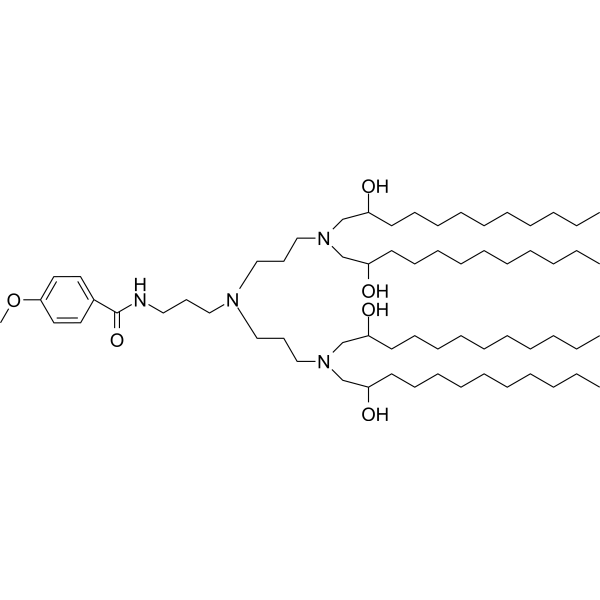
AA-T3A-C12 is a leading anisamide-tethered lipidoid (AA-lipidoid) identified through a combinatorial library screening for targeted RNA delivery to activated fibroblasts, offering a promising approach to treat liver fibrosis.AA-T3A-C12 is a leading anisamide-tethered lipidoid (AA-lipidoid) identified through a combinatorial library screening for targeted RNA delivery to activated fibroblasts, offering a promising approach to treat liver fibrosis. It is synthesized via a one-pot, two-step modular method that combines anisamide—a ligand for sigma receptors overexpressed on activated hepatic stellate cells (HSCs)—with a T3A polyamine core and C12 epoxide tails, enabling efficient siRNA encapsulation in lipid nanoparticles (LNPs). In vitro, AA-T3A-C12 LNPs exhibit enhanced cellular uptake and gene silencing in activated fibroblasts, dependent on sigma receptor binding, as confirmed by haloperidol blockade studies, and outperform non-targeted analogs and the FDA-approved MC3 LNPs in fibroblast selectivity.In a mouse model of CCl4-induced liver fibrosis, AA-T3A-C12/siHSP47 LNP achieves approximately 65% knockdown of heat shock protein 47 (HSP47), a key fibrotic target, leading to significant reduction in collagen deposition and fibrosis alleviation, with a good safety profile and no exacerbation of liver injury.
| CAS No. | Not available |
| Chemical Name | AA-T3A-C12 |
| Synonyms | AAT3AC12, AA T3A C12 |
| SMILES | OC(CCCCCCCCCC)CN(CC(O)CCCCCCCCCC)CCCN(CCCNC(C1=CC=C(OC)C=C1)=O)CCCN(CC(O)CCCCCCCCCC)CC(O)CCCCCCCCCC |
| Formula | C65H126N4O6 |
| M.Wt | 1,059.72 |
| Purity | ELSD-HPLC>95% |
| Storage | Pure form: −20 °C, 1 year; In solvent: −80 °C, 6 months; −20 °C, 1 month. Sealed and protected from light. |
| Shipping condition | Ships from Shanghai. Pure lipid is stable during ice-pack transport. |
| Publication | Ligand-tethered lipid nanoparticles for targeted RNA delivery to treat liver fibrosis-Nature Communications volume 14, Article number: 75 (2023) |
The product molecular weight is prefilled when available and remains editable. Confirm solvent compatibility and solubility before preparation.
Solvent volumes update from the molecular weight above.
| Mass | 1 mM | 5 mM | 10 mM |
|---|---|---|---|
| 10 mg | 9.4365 mL | 1.8873 mL | 943.65 μL |
| 25 mg | 23.5911 mL | 4.7182 mL | 2.3591 mL |
| 50 mg | 47.1823 mL | 9.4365 mL | 4.7182 mL |
| 100 mg | 94.3645 mL | 18.8729 mL | 9.4365 mL |
| 250 mg | 235.9114 mL | 47.1823 mL | 23.5911 mL |
Contact our team with the catalog number and requested quantity.