
| Parameter | Specification |
|---|---|
| CAS No. | Not available |
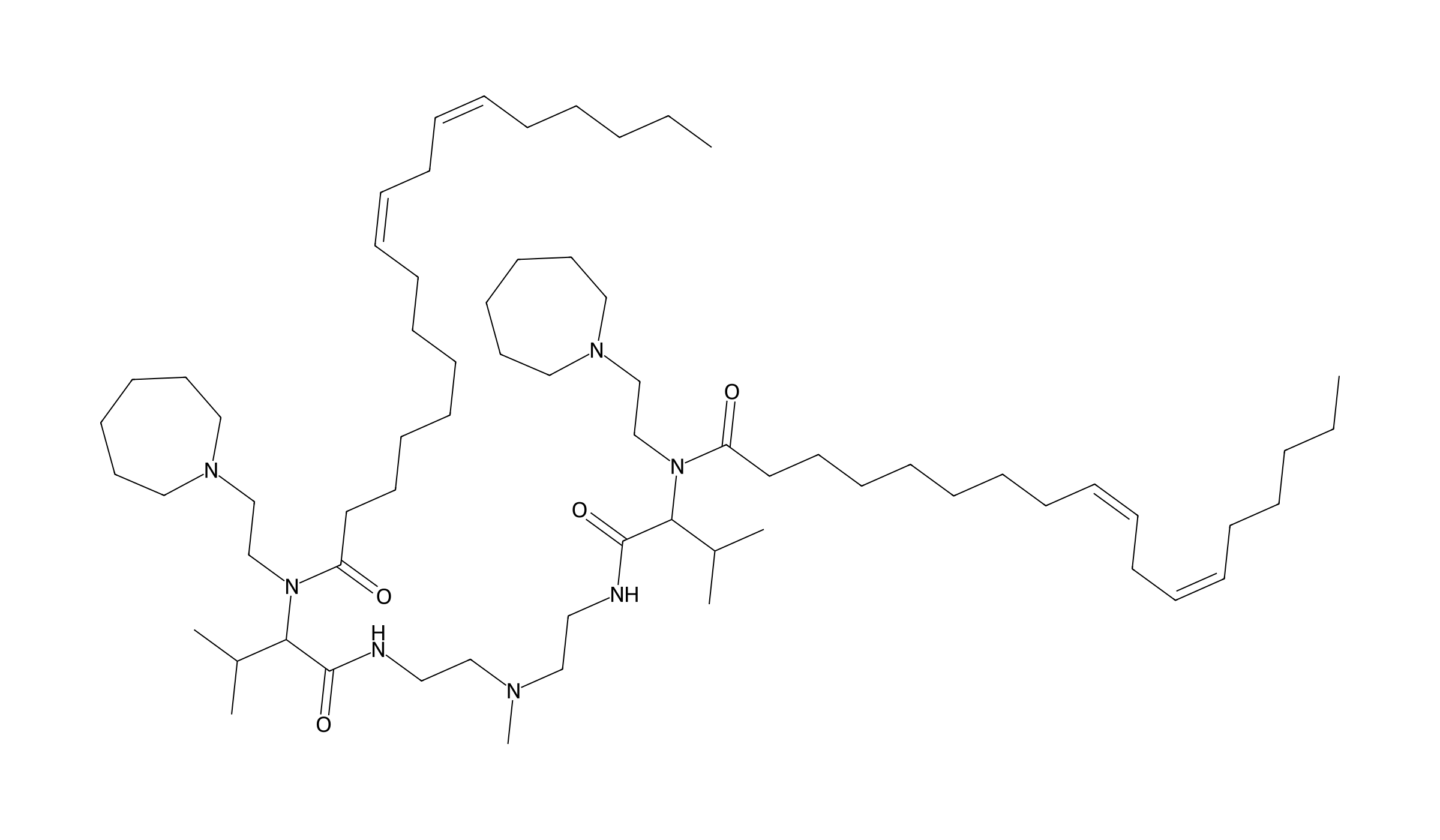
| Chemical Name | A1I4R13C18-2 |
| Synonyms | A1I4R13C18 2; A1I4R13C182 |
| SMILES | CCCCC/C=C\C/C=C\CCCCCCCC(=O)N(CCN1CCCCCC1)C(C(=O)NCCN(C)CCNC(=O)C(C(C)C)N(CCN1CCCCCC1)C(=O)CCCCCCC/C=C\C/C=C\CCCCC)C(C)C |
| Formula | C67H123N7O4 |
| M.Wt | 1090.77 |
| Purity | >95% by ELSD-HPLC |
| Storage | Refer to the supplied batch label and documentation. |
| Shipping condition | Contact us for current shipping conditions. |
| Publication | WO2023142167A1 (2023) |
Open full Formulation & Performance page →
A1I4R13C18-2 · DCL0024 · Patent evidence
Formulation & Performance
Four-component formulation
| Component | DC Chemicals product | Molecular weight | Molar proportion | Mass contribution per 1 µmol total lipid |
|---|---|---|---|---|
| A1I4R13C18-2 | DCL0024 | 1090.77 | 50% | 0.545385 mg |
| DSPC | DC57005 | 790.15 | 10% | 0.079015 mg |
| Cholesterol | DCD-041 | 386.65 | 38.5% | 0.148860 mg |
| DMG-PEG | Not uniquely mapped | Not specified in the patent | 1.5% | Requires the PEG-lipid molecular weight |
Reported: test lipid:cholesterol:DSPC:DMG-PEG = 50:38.5:10:1.5 mol%. The table above reorders DSPC and cholesterol while retaining their original assignments. The molar proportions total 100%. Molecular weights for the test lipid are calculated from the verified neutral structure; mass contributions are calculations, not measured values.
The source names DMG-PEG without a PEG chain length or molecular weight. It cannot be uniquely assigned to DMG-PEG2000. Complete mass percentages require a defined PEG-lipid molecular weight.
Component mass calculator
Defaults follow Example 6. Enter the molecular weight of your selected PEG-lipid before calculating the complete formulation. DMG-PEG2000 (DC40169) may be selected as a separate commercial research option using MW 2507; this choice is not identified in the patent.
| Component | MW | Molar ratio | Mass (mg) | Mass % |
|---|---|---|---|---|
| A1I4R13C18-2 | ||||
| DSPC | ||||
| Cholesterol | ||||
| DMG-PEG |
Enter the PEG-lipid molecular weight to calculate mass fractions.
Study conditions and formulation parameters
| Parameter | Reported information | Source |
|---|---|---|
| Cargo | Luciferase mRNA | Example 10 |
| Model | C57BL/6 mice, 6–8 weeks old | Example 10 |
| Route | Intravenous, tail vein | Example 10 |
| mRNA dose | 5 µg per mouse | Example 10 |
| Endpoint | 6 hours after formulation administration; bioluminescence imaging | Example 10 |
| Test lipid : nucleic acid mass ratio | 11:1 (w/w); this is not an N/P ratio | Example 6 |
| N/P ratio | Not reported | Example 6 |
| Preparation context | Ethanolic lipid phase and citrate-buffered aqueous RNA phase; aqueous:organic volume ratio 3:1; buffer exchange into PBS | Example 6 |
| Buffer | 25 mM citrate, pH 3.0, during mixing | Example 6 |
| Particle size / PDI / zeta potential / encapsulation | No compound-specific measurements reported for these two lipids in Table 1 | Example 6, Table 1 |
| pKa | Not reported for this compound | Supplied patent |
Intravenous mRNA expression in mice
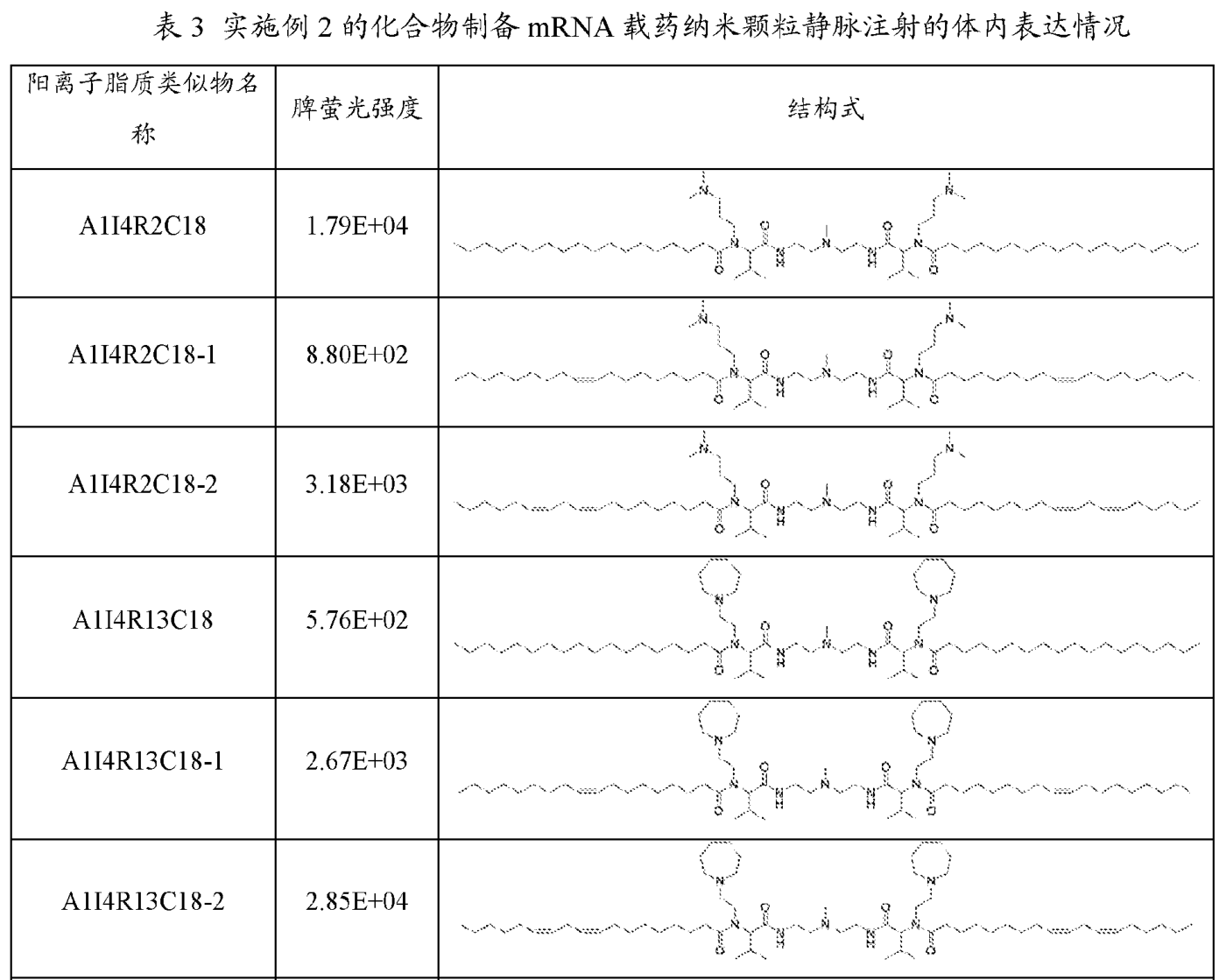
| Lipid | Splenic luminescence intensity | Study context |
|---|---|---|
| A1I4R13C18-2 | 2.85 × 10⁴ | IV luciferase mRNA, 5 µg per mouse, 6-hour endpoint |
| A1I4R2C18-2 | 3.18 × 10³ | Same reported screen and formulation framework |
Reported values transcribed from Table 3, printed page 27 (PDF page 29). The table labels the endpoint as splenic luminescence intensity but does not specify its numerical unit, replicate count, error bars or statistical significance for these rows.
A1I4R13C18-2 has an approximately 8.96-fold higher tabulated reading than A1I4R2C18-2 (28,500 ÷ 3,180; calculated). This arithmetic comparison does not establish statistical significance or a general advantage across routes, doses or cargos.
What these data establish
The patent provides compound-specific reporter-expression results after intravenous administration. It does not establish selective spleen targeting, a therapeutic outcome, or efficacy in humans for either product.
Cell data and tolerability
No compound-specific cytotoxicity, serum chemistry, organ histology, repeated-dose safety or therapeutic-index results were identified for A1I4R13C18-2 in the supplied patent. No low-toxicity claim is assigned. The intramuscular, immunization and other data for similarly named compounds are not attributed to this product.
Original patent table
References
- Liu Z, Chen Y, He Z, Yue Z. Cationic lipid analog, and composition and use thereof. WO2023142167A1. Applicant: Guangzhou Lide Biomedicine Technology Co Ltd. Published 3 August 2023. Read the original patent. Compound identities: Example 2 and Table 3; formulation: Example 6 (printed page 19); intravenous mouse study: Example 10 (printed page 20), Table 3 (printed page 27). Printed page numbers refer to the supplied publication; PDF pages are two pages higher.