Sail lipid 7669
DC68208
Recommended because it shares a closely related research category or delivery context. Formulation and performance are product- and study-specific.
View product →
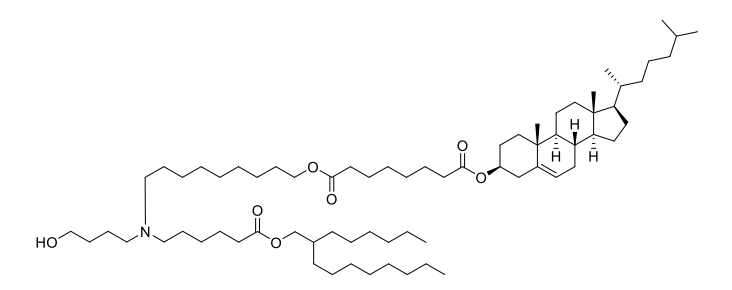
Ionizable lipid for LNP and nucleic-acid delivery research.
iChol15-C4A2 is a groundbreaking ionizable cholesteryl lipid, expertly designed to overcome the primary challenge of liver-centric accumulation in mRNA therapeutics. Its innovative "two-in-one" structure seamlessly integrates cholesterol with an ionizable headgroup, enabling the formation of stable, three-component Lipid Nanoparticles (Tc-LNPs).The key advantage of Tc-LNPs formulated with iChol15-CA2 is their significantly reduced adsorption of Apolipoprotein E (ApoE).This unique property directly attenuates ApoE/LDLR-mediated uptake by liver cells, dramatically shifting biodistribution toward extrahepatic tissues. Peer-validated research demonstrates a remarkable 20-50 fold increase in the spleen-to-liver mRNA expression ratio compared to standard LNPs like ALC-0315, unlocking unparalleled potential for targeting the immune system. Beyond its superior targeting capability, iChol15-C4A2 ensures high mRNA encapsulation efficiency, excellent colloidal stability, and proven biocompatibility. It offers a powerful, off-the-shelf solution to advance next-generation mRNA applications, from innovative vaccines and cancer immunotherapies to treatments for splenic disorders. Discover how iChol15-C4A2 can transform your delivery platform.
| CAS No. | Not available |
| Chemical Name | iChol15-C4A2 |
| Synonyms | iChol15C4A2, iChol15 C4A2 |
| SMILES | CCCCCCCCC(CCCCCC)COC(=O)CCCCCN(CCCCO)CCCCCCCCCOC(=O)CCCCCCC(=O)O[C@H]1CC[C@@]2(C)C(=CC[C@@H]3[C@@H]2CC[C@@]2(C)[C@H]3CC[C@@H]2C(C)CCCC(C)C)C1 |
| Formula | C70H127O7N |
| M.Wt | 1,094.79 |
| Purity | >98% |
| Storage | Pure form: −20 °C, 1 year; In solvent: −80 °C, 6 months; −20 °C, 1 month. Sealed and protected from light. |
| Shipping condition | Ships from Shanghai. Pure lipid is stable during ice-pack transport. |
| Publication | Teng, Yilong, et al. "Computationally Aided Design of Ionizable Cholesteryl Lipids for Lipid Nanoparticles to Modulate Hepatic mRNA Accumulation." Journal of the American Chemical Society, 2025, doi:10.1021/jacs.5c14870. |
The product molecular weight is prefilled when available and remains editable. Confirm solvent compatibility and solubility before preparation.
Solvent volumes update from the molecular weight above.
| Mass | 1 mM | 5 mM | 10 mM |
|---|---|---|---|
| 10 mg | 9.1342 mL | 1.8268 mL | 913.42 μL |
| 25 mg | 22.8354 mL | 4.5671 mL | 2.2835 mL |
| 50 mg | 45.6709 mL | 9.1342 mL | 4.5671 mL |
| 100 mg | 91.3417 mL | 18.2683 mL | 9.1342 mL |
| 250 mg | 228.3543 mL | 45.6709 mL | 22.8354 mL |
Contact our team with the catalog number and requested quantity.