5A2-SC8
DC49907
Recommended because it shares a closely related research category or delivery context. Formulation and performance are product- and study-specific.
View product →
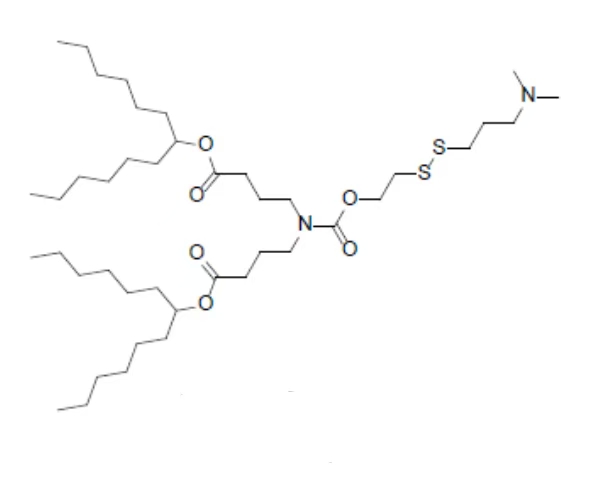
Ionizable lipid for LNP and nucleic-acid delivery research.
L2 is a redox-responsive lipid engineered for ultra-potent siRNA delivery. With shorter hexyl (C6) tails and a carbamate linker, it demonstrates the fastest biodegradation (liver half-life: 2.6 days) among tested lipids. L2 achieves >80% FVII gene knockdown at just 0.01 mg/kg—surpassing both L1 and MC3 in siRNA potency. Its higher apparent pKa (6.90) enhances endosomal disruption, correlating with strong in vitro hEPO expression. While slightly less effective for mRNA than L1, L2’s unmatched siRNA silencing efficiency, rapid cytosolic self-immolation, and low cytotoxicity position it as a leading candidate for RNAi therapeutics targeting hepatic diseases.
| CAS No. | Not available |
| Chemical Name | ATX L2 |
| Synonyms | ATX-L2, ATXL2 |
| SMILES | CCCCCCC(CCCCCC)OC(=O)CCCN(CCCC(=O)OC(CCCCCC)CCCCCC)C(=O)OCCSSCCCN(C)C |
| Formula | C42H82O6N2S2 |
| M.Wt | 775.25 |
| Purity | >98% |
| Storage | Pure form: −20 °C, 1 year; In solvent: −80 °C, 6 months; −20 °C, 1 month. Sealed and protected from light. |
| Shipping condition | Ships from Shanghai. Pure lipid is stable during ice-pack transport. |
| Publication | Design and Evaluation of Biodegradable Self-Immolative Lipids for RNA Delivery-R Mukthavaram, A Sagi, H Hong, R Recatto… - Advanced healthcare materials |
The product molecular weight is prefilled when available and remains editable. Confirm solvent compatibility and solubility before preparation.
Solvent volumes update from the molecular weight above.
| Mass | 1 mM | 5 mM | 10 mM |
|---|---|---|---|
| 10 mg | 12.8991 mL | 2.5798 mL | 1.2899 mL |
| 25 mg | 32.2477 mL | 6.4495 mL | 3.2248 mL |
| 50 mg | 64.4953 mL | 12.8991 mL | 6.4495 mL |
| 100 mg | 128.9906 mL | 25.7981 mL | 12.8991 mL |
| 250 mg | 322.4766 mL | 64.4953 mL | 32.2477 mL |
Contact our team with the catalog number and requested quantity.