5A2-SC8
DC49907
Recommended because it shares a closely related research category or delivery context. Formulation and performance are product- and study-specific.
View product →
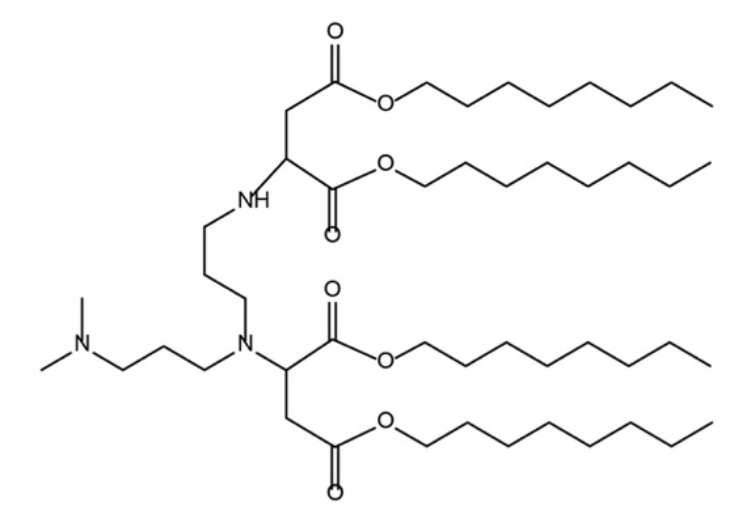
Ionizable lipid for LNP and nucleic-acid delivery research.
Lipid 5D8 is a novel biodegradable ionizable lipid (IL) developed through a combinatorial chemistry strategy to overcome the limitations of conventional lipid nanoparticles (LNPs) in mRNA delivery. Synthesized via a one-step, solvent-free Michael addition reaction between amine and thiol monomers, 5D8 features asymmetric lipid tails and a biodegradable ester backbone, ensuring both structural versatility and reduced toxicity. In preclinical studies, 5D8-based LNPs demonstrated exceptional liver-targeting efficiency and mRNA delivery performance. A single intravenous dose (1 mg/kg) achieved 61% CRISPR-Cas9-mediated editing of the TTR gene in mice, reducing serum TTR protein by 90%, outperforming benchmark lipids like C12-200 (51% editing). Moreover, 5D8 enabled efficient delivery of base editors (ABE8.8 and CBE4max), achieving 42% PCSK9 editing (74% serum protein reduction) and correcting hereditary tyrosinemia in mice, significantly extending survival. Beyond gene editing, 5D8 LNPs effectively delivered siRNA (complete serum TTR clearance at 0.05 mg/kg) and enhanced hepatocyte targeting by enriching apolipoprotein E on particle surfaces. Crucially, 5D8 exhibited superior biocompatibility with no hepatotoxicity (normal ALT/AST levels), contrasting traditional LNPs. Its rapid biodegradability and "plug-and-play" design make 5D8 a versatile platform for mRNA therapeutics, holding broad potential for treating genetic disorders, cardiovascular diseases, and beyond. This innovation represents a critical advancement toward safer, high-efficiency clinical translation of gene-editing therapies.L
| CAS No. | Not available |
| Chemical Name | Lipid 5D8 |
| Synonyms | Lipid-5D8 |
| SMILES | CCCCCCCCOC(=O)CC(NCCCN(CCCN(C)C)C(CC(=O)OCCCCCCCC)C(=O)OCCCCCCCC)C(=O)OCCCCCCCC |
| Formula | C48H93O8N3 |
| M.Wt | 840.28 |
| Purity | >98% |
| Storage | Pure form: −20 °C, 1 year; In solvent: −80 °C, 6 months; −20 °C, 1 month. Sealed and protected from light. |
| Shipping condition | Ships from Shanghai. Pure lipid is stable during ice-pack transport. |
| Publication | https://www.biorxiv.org/content/10.1101/2025.02.25.640222v1 |
The product molecular weight is prefilled when available and remains editable. Confirm solvent compatibility and solubility before preparation.
Solvent volumes update from the molecular weight above.
| Mass | 1 mM | 5 mM | 10 mM |
|---|---|---|---|
| 10 mg | 11.9008 mL | 2.3802 mL | 1.1901 mL |
| 25 mg | 29.7520 mL | 5.9504 mL | 2.9752 mL |
| 50 mg | 59.5040 mL | 11.9008 mL | 5.9504 mL |
| 100 mg | 119.0079 mL | 23.8016 mL | 11.9008 mL |
| 250 mg | 297.5199 mL | 59.5040 mL | 29.7520 mL |
Contact our team with the catalog number and requested quantity.