C12-200
DC58046
Recommended because it shares a closely related research category or delivery context. Formulation and performance are product- and study-specific.
View product →
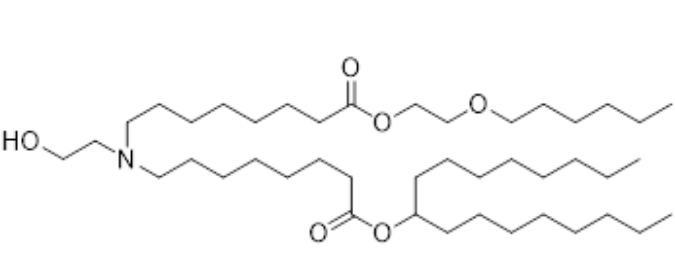
Ionizable lipid for LNP and nucleic-acid delivery research.
ND-O1 (SM-86 Analog-2) is a novel ionizable lipid designed to improve the delivery of siRNA via lipid nanoparticles (LNPs) for treating liver fibrosis. It is derived from SM-86 (structurally similar to SM-102, used in COVID-19 mRNA vaccines) but incorporates an ether bond within its hydrophobic tail, a first-of-its-kind modification aimed at enhancing delivery efficiency. In Vitro Efficiency: ND-O1 LNPs (LNP-O1) showed significantly higher siRNA transfection efficiency in activated fibroblasts compared to Lipid 5 LNPs (LNP-M). In Vivo Efficacy: In a CCl4-induced liver fibrosis mouse model, LNP-O1/siHSP47 (loaded with HSP47-targeting siRNA) reduced HSP47 expression by ~84%, threefold more effective than LNP-M. This led to a dramatic reduction in collagen deposition and marked improvement in liver fibrosis. Safety: The ether bond modification did not introduce additional toxicity, maintaining biocompatibility. ND-O1 represents a breakthrough in ionizable lipid design, demonstrating that strategic placement of ether bonds in hydrophobic tails can enhance LNP performance without compromising safety. Its success highlights its potential for clinical translation in RNA-based therapies for liver fibrosis and other hepatic diseases.
| CAS No. | Not available |
| Chemical Name | ND-O1 (SM-86 Analog-2) |
| Synonyms | NDO1, ND O1 |
| SMILES | CCCCCCCCC(CCCCCCCC)OC(=O)CCCCCCCN(CCO)CCCCCCCC(=O)OCCOCCCCCC |
| Formula | C43H85NO6 |
| M.Wt | 712.15 |
| Purity | ELSD-HPLC>95% |
| Storage | Pure form: −20 °C, 1 year; In solvent: −80 °C, 6 months; −20 °C, 1 month. Sealed and protected from light. |
| Shipping condition | Ships from Shanghai. Pure lipid is stable during ice-pack transport. |
| Publication | Ether bond-modified lipid nanoparticles for enhancing the treatment effect of hepatic fibrosis-International Journal of Pharmaceutics-Runxuan Chu a, Jianglong Kong b, Qiang Gao a, Yani Yang a, Ting Pan a c, Xiaohong Lu a, Zhefeng Wang a , Yi Wang b, Jun He Volume 671, 25 February 2025, 125192 |
The product molecular weight is prefilled when available and remains editable. Confirm solvent compatibility and solubility before preparation.
Solvent volumes update from the molecular weight above.
| Mass | 1 mM | 5 mM | 10 mM |
|---|---|---|---|
| 10 mg | 14.0420 mL | 2.8084 mL | 1.4042 mL |
| 25 mg | 35.1050 mL | 7.0210 mL | 3.5105 mL |
| 50 mg | 70.2099 mL | 14.0420 mL | 7.0210 mL |
| 100 mg | 140.4199 mL | 28.0840 mL | 14.0420 mL |
| 250 mg | 351.0496 mL | 70.2099 mL | 35.1050 mL |
Contact our team with the catalog number and requested quantity.